Mule deer
A western deer named for its big mule-like ears, common along canyon rims and desert washes in Grand Canyon, Zion, Yosemite, and Saguaro.
We saw it Our family spotted this one at Yellowstone National Park in August 2026.
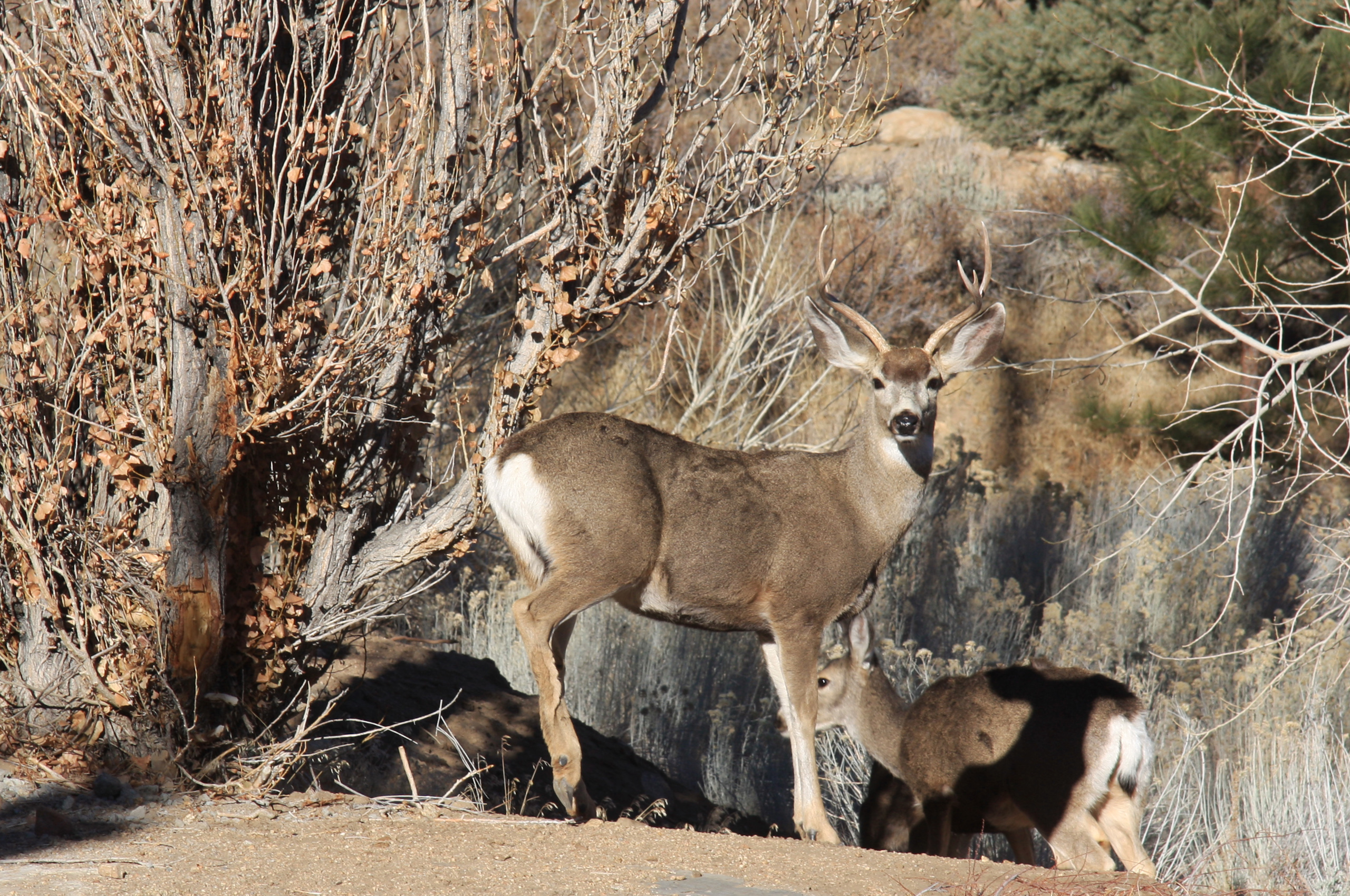

Mule deer at a glance
Odocoileus hemionus Mule deer; Odocoileus hemionus is oh-doh-KOY-lee-us hem-ee-OH-nus
- Type
- Mammal · deer
- Diet
- Herbivore
- Size
- About as tall at the shoulder as a kitchen counter (31 to 42 inches). A big buck weighs up to about 200 pounds, roughly as much as a grown man, and does are smaller. That is much smaller than an elk.
- Lifespan
- Around 9 to 11 years in the wild.
- Conservation
- Least concern
Eats grasses, leaves, twigs, flowers, nuts, berries
Mule deer are plant-eaters that nibble grasses, shrubs, twigs, nuts, and berries. They feed mostly in the cool morning and evening and rest in the shade when the desert heats up.
Should you worry?
Mule deer look calm and tame, but they are wild animals with sharp hooves, and bucks have antlers in fall. A mother deer will defend her fawn. Give them space, at least 25 yards, and never try to pet or feed one. Deer that are fed by people can get pushy and dangerous.
The ears give it the name. A mule deer’s ears are big and pointed, about three-quarters the length of its whole head, and they do two jobs at once: they swivel to catch a sound from far off, and they shed heat, which is how a deer keeps cool standing in a Saguaro wash in the middle of the day. When it is hot, the deer feeds at dawn and dusk and rests in the shade between.
Watch a startled mule deer run and you’ll see the other trick. Instead of galloping it stots. It bounces, all four hooves leaving and hitting the ground together, like a deer on a pogo stick. It looks almost funny until you notice how fast it clears the rocks and brush a predator has to scramble through.
Bucks build a fresh set of antlers every single year. They push up in spring under a fuzzy skin, harden in time for the fall contests between males, and drop off in winter, and then the whole thing starts over. Give the deer room to do all of this: twenty-five yards, no hands, no snacks. A deer that learns to beg is a deer that has stopped being wild.
Did you know?
- Mule deer are named for their ears, which are about three-quarters as long as their whole head. Those big ears catch faraway sounds and also let heat escape to keep the deer cool in the desert.
- When a mule deer is scared it can stot, bouncing away with all four hooves hitting the ground at the same time, like a pogo stick. It helps them bound over rocks and brush.
- A buck grows a whole new set of antlers every year. They start growing in spring, get used for fall contests between males, and drop off in winter.
Common questions
Why is it called a mule deer?
Because of its ears. They are large and pointed like a mule's ears, and they are the easiest way to tell this deer from other kinds.
Are mule deer dangerous to kids?
Not usually, but they are wild. They can kick with sharp hooves, and mothers protect their fawns. Stay back at least 25 yards and never feed them.
What do mule deer eat?
Plants of all kinds: grasses, leaves, twigs, flowers, nuts, and berries. They eat most in the cool parts of the day.
Why do they bounce when they run?
That bouncing is called stotting. Landing on all four feet at once helps them spring over rocks and bushes and get away from a predator fast.
What eats a mule deer?
Mountain lions, coyotes, bobcats, black bears, golden eagles, and feral dogs. A mule deer escapes by bounding uphill or making sudden turns, though that works less well against hunters in packs.
Where it lives
- Badlands National Park
- Black Canyon of the Gunnison National Park
- Crater Lake National Park
- Craters of the Moon National Monument and Preserve
- Fossil Butte National Monument
- Glacier National Park
- Grand Canyon National Park
- Grand Teton National Park
- Great Basin National Park
- Guadalupe Mountains National Park
- Lassen Volcanic National Park
- Lava Beds National Monument
- Mesa Verde National Park
- North Cascades National Park
- Rocky Mountain National Park
- Saguaro National Park
- Sequoia National Park
- Theodore Roosevelt National Park
- Wind Cave National Park
- Yellowstone National Park
- Yosemite National Park
- Zion National Park