We came in under the Roosevelt Arch on a Thursday morning, camped at Mammoth, moved to Canyon, and drove out six days later through West Yellowstone . Cy had been reading Aubrey Haines ’s The Yellowstone Story since spring; Big had been pulling up wolf videos from the Lamar Valley packs since November. Here is the one thing we would tell anyone: be in Lamar or Hayden before nine in the morning, or between four and six in the afternoon. We drove it early, parked, and waited, and on the second morning a man with a spotting scope let us take turns at his eyepiece and there were four wolves on the far slope. Outside the Roosevelt cabins a hawk took a pika while we sat waiting for dinner, and that whole day went into the journal.
What we knew going in held up. Bison gore more visitors each year than bears do. The park sits on the Yellowstone Caldera , an active supervolcano the USGS keeps on Normal alert. The 1872 act that created it set the template every other national park inherited. still shape the lodgepole stands we walked through, young trees all one height and packed too close to step between. F.V. Hayden ’s 1871 survey is what Congress saw before they voted, and the 1995 wolf reintroduction is the part Big had come for.
I
Basic info
- Established
- 1872
- Area
- 2,219,791 acres
- Visitors (2024)
- 4,744,353
- Elevation
- 5,282–11,358 ft
- Designation
- UNESCO Biosphere Reserve (1976)
- Designation
- UNESCO World Heritage Site (1978)
II
Logistics
Before you go
- Getting there
- Yellowstone has five entrances across Wyoming, Montana, and Idaho, and several close to regular vehicles in winter. Commercial airlines serve Cody and Jackson, Wyoming, Bozeman and Billings, Montana, and Idaho Falls, Idaho, all year. NPS
- How many days
- The park has five entrance stations, and driving between them takes several hours. Through late October 2026, a bridge project near Mammoth Hot Springs holds traffic to one lane, with delays of up to 15 minutes. NPS offers no day-by-day plan. NPS Build a day-by-day plan
- Entrance fee
- Entry costs $35 per private vehicle for 7 consecutive days (2026). An America the Beautiful pass covers entry, and you need no vehicle reservation. NPS
- Pets
- Pets may stay only within 100 feet of roads, parking areas, and campgrounds, on a leash 6 feet or shorter (2026). Boardwalks, trails, thermal areas, and the backcountry are closed to pets, even carried ones. NPS
Seasons
Spring
- Roads reopen on a staggered schedule from mid-April through Memorial Day.
- Snow lingers above 7,000 ft; lower elevations green up first.
- Bears emerge from hibernation, bison calves ("red dogs") drop, and the northern range is the wildlife window.
Summer
- All roads, lodges, and campgrounds open; this is peak season.
- Warm days at lower elevations, afternoon thunderstorms most days, cold nights above 8,000 ft.
- Every geyser basin, every entrance, and the worst crowding — half the year's visits land in June–August.
Fall
- Roads stay open through mid- or late-October; most close to wheeled traffic by early November.
- Cold nights, narrowing daylight, first snows above 8,000 ft.
- Bull elk bugle at Mammoth (peak third week of September); fewer crowds; the bison rut ended in August.
Winter
- Interior roads close to vehicles November through mid-April; access by snowcoach or snowmobile only.
- Deep cold, deep snow, short days.
- The North Entrance (Gardiner) to Northeast Entrance (Cooke City) road stays open year-round; wolf-watching in Lamar peaks February and March.
Yellowstone National Park with kids
Yellowstone is unusually kid-friendly for a wilderness park because the geyser basins, boardwalks, and roadside wildlife pull-outs are stroller-and-toddler accessible. Distances are the hard part. The Grand Loop is 142 miles of slow road, so plan camp moves carefully. For wildlife, the clock mattered more to us than the mileage: be in Lamar or Hayden before 9 a.m., or between 4 and 6 p.m. We drove in early, parked at a pullout, and waited. That is when we saw wolves in Lamar and a bison herd cross the road in front of us. Midday in both valleys we mostly watched heat shimmer and other cars.
- Junior Ranger booklet ($3) is excellent — every visitor center has them; badges sworn in by a ranger at any station.
- Bison and elk wander into developed areas. The 25-yard rule is real; explain it before the trip, not when you see one.
- Boardwalks are not optional. Falling into a hot spring is the most common serious injury; the rules exist for a reason.
- Wolf-watching in Lamar means a pre-dawn alarm and a hot thermos in the car; Hayden pays off again at a pullout before dinner. Worth it for a kid who can share a spotting scope.
Accessibility
Most of the park's headline sights have paved or boardwalk access for wheelchairs and strollers. Old Faithful, Grand Prismatic Spring (boardwalk loop), Mammoth Hot Springs lower terraces, the Norris museum, and Artist Point are all step-free.
- Old Faithful Visitor Education Center is fully accessible; eruption-time announcements posted at the desk.
- Grand Prismatic boardwalk loop is firm and flat; the Fairy Falls Overlook (the famous aerial view) is a 1.6 mi gravel grade — wheelchair-rated "with assistance."
- Most lodging has a limited number of ADA rooms. Book through Xanterra in person — the online system does not always show availability.
- Service animals welcome; pets are restricted to roads, parking lots, and within 100 ft of campsites.
Things you can't miss
Natural places
Grand Prismatic Spring↗
The third-largest hot spring on Earth — roughly 370 ft across, 121 ft deep — with rings of orange, ochre, and green that are heat-tolerant bacteria sorted by temperature. The boardwalk loop runs at ground level; the full ring of color only resolves from the 1.2-mile Fairy Falls overlook spur, mid-morning before the steam thickens.
Mammoth Hot Springs Terraces↗
Carbonate-rich water rises through Mississippian limestone and lays down travertine the moment it meets the air, roughly two tons a day across the active terraces. The Lower and Upper boardwalks each take about forty-five minutes; the channels shift season to season, so the white-and-orange pattern is never the one in the postcard.
Lamar Valley↗
Crow, Eastern Shoshone, Bannock, and Tukudika ground long before it was the place to find wolves; the northeast valley runs along the year-round Gardiner-to-Cooke-City road. Come early or come late. See With kids for the hours we kept. The scopes belong to the wolf-watchers, and they'll share a look at the Junction Butte pack if you ask.
Norris Geyser Basin↗
459°F measured down a research drill hole; the most acidic chemistry in the park; home to Steamboat, which has gone 300-plus feet on its major eruptions and is the world's tallest active geyser. Two loops, Porcelain (0.75 mi) and Back Basin (1.5 mi); features come and go between visits.
Old Faithful↗
Intervals run 60–110 minutes — short eruptions feed shorter waits, long ones (over 2.5 minutes) push it to the 90-minute pattern that has held since the 1998 earthquake. Heights range 106–184 ft; eruptions last 1.5–5 minutes. The next prediction is on the whiteboard at the Old Faithful Visitor Education Center and in the NPS app; the bench around the cone is paved.
Grand Canyon of the Yellowstone↗
Twenty miles long, 800–1,200 ft deep, walls of rhyolite altered by hydrothermal activity — puffs of steam still rise off the canyon faces. The Lower Falls drops 308 ft; Artist Point, Inspiration Point, and Lookout Point are short walks from the rim-drive parking. Most rim trails are stepped or stair-graded; the Brink of the Lower Falls parking sidewalk and the South Rim sidewalk are wheelchair-accessible.
Mud Volcano and Dragon's Mouth Spring↗
The NPS Historic Tribes page records the Kiowa tradition that places Dragon's Mouth as the hot spring where their creator gave them the Yellowstone area for their home; the Crow read the steam as the snorts of an angry bull bison. Mud Volcano itself is a 30 by 30 ft mud cone Nathaniel Langford described in 1870 as a seething, bubbling mass of mud. The hillsides smell of sulfur, the work of hydrogen sulfide bacteria breaking the rock down to clay; the spring's surge has been quieter since 1994.
Morning Glory Pool↗
Average temperature 159.3°F, pH 7.6, named in the 1880s for the flower it resembled. The center used to run uniform blue; the orange-and-yellow rings around it record decades of coins, rocks, and logs thrown into the vent — the debris cut circulation, dropped the temperature, and let cooler-water thermophiles in. The colors here are the bacteria, not the minerals. Rangers ask visitors to report vandalism.
West Thumb Geyser Basin↗
Hot springs that open directly onto the shoreline of Yellowstone Lake — Abyss Pool, named in 1935 by Chief Park Naturalist C.M. Bauer for its depth, sits at the water's edge. Fishing Cone, the spring that erupted to 40 ft in 1919, is where Superintendent P.W. Norris (1877–1882) first showed off the cook-your-catch-on-the-hook trick that visitors kept repeating for decades; the practice is now prohibited. The NPS removed the campground, cabins, cafeteria, and gas station that used to crowd the basin in the 1980s.
Yellowstone Lake↗
A 132-square-mile lake at 7,733 ft, the largest lake above 7,000 ft in North America, freezes over every winter in late December or early January and thaws in late May or early June. Average water temperature 41°F; immersion survival per NPS is 20–30 minutes, so swimming is not recommended. It holds the largest wild cutthroat trout population in North America, threatened now by illegally introduced lake trout, and a 390 ft canyon on the floor east of Stevenson Island is the deepest known point.
Nearby attractions
Roosevelt Arch↗
The stone arch at the only year-round entrance, cornerstone laid by Theodore Roosevelt on April 24, 1903. The inscription — For the Benefit and Enjoyment of the People — is lifted from the 1872 Yellowstone Act; the same act dispossessed the Crow, Eastern Shoshone, and Bannock who had used the upper Yellowstone for ten thousand years before the line was carved.
Buffalo Bill Center of the West↗
Five museums under one roof in Cody — Plains Indian, Whitney Western Art, Cody Firearms, Draper Natural History, and the namesake Buffalo Bill. The Plains Indian galleries draw from Arapaho, Lakota, Crow, Cheyenne, Blackfeet, and Pawnee collections; the wall text quotes living tribal historians beside the cradleboards, and Big read every label.
Grizzly & Wolf Discovery Center↗
An AZA-accredited sanctuary opened in 1993 for grizzlies and wolves that couldn't be released back to the wild — naturalists narrate the enclosure from a few feet away. The Keeper Kids program lets kids hide food for the bears before the gates open and then watch the search through the habitat.
Places to stay
Old Faithful Inn↗
Robert Reamer's 1903–04 log lodge — National Historic Landmark, the largest log structure in the world — with a seven-story lobby trussed in hand-hewn lodgepole pine. Walk in once and most kids will tell you it's the trip; the upper-floor balconies look down on the geyser through the front windows.
Lake Yellowstone Hotel & Cabins↗
The oldest operating hotel in any U.S. national park, opened 1891, yellow Colonial Revival above the lake. A string quartet plays the lobby in the afternoons; the sun porch faces the water; the loudest sound after ten p.m. is a screen door on the cabin row.
Mammoth Hot Springs Hotel & Cabins↗
The only in-park hotel you can drive to in winter, on the site of the 1883 National Hotel and rebuilt in 1936. Bull elk graze the parade-ground lawn during the September rut — close enough from a second-floor window to hear the bugle work the cold morning air.
Viewpoints and camping
Artist Point↗
A paved overlook on the South Rim of the Grand Canyon of the Yellowstone with the canonical angle on the 308-ft Lower Falls — the view Thomas Moran painted in 1872 and most people have been chasing since. About 250 yards from the car; that's part of why it works.
Grand Prismatic Overlook↗
The NPS-built platform on the Fairy Falls Trail spur is the only place to see the full color ring from above. A flat 1.2-mile out-and-back south of Midway Geyser Basin; the difference between boardwalk-level and the overlook is the difference between I saw it and I saw it.
Hayden Valley↗
Crow and Eastern Shoshone summer range along the Yellowstone River between Canyon and Fishing Bridge. Year-round range now for the central bison herd, a grizzly corridor in spring and fall. Drive it slowly with the window cracked; on a cold morning a bison's breath carries fifty yards. Come early or come late. See With kids for the hours.
Pebble Creek Campground↗
Twenty-seven sites along Soda Butte Creek in the northeast corner, vault toilets, no hookups, dense lodgepole shade. This is the campground the wolf-watchers stay at. You'll hear the pre-dawn Subarus heading out for Lamar before the coffee water boils.
Trails worth the time
Mount Washburn↗
Six miles round-trip from Dunraven Pass up to the 10,219-ft fire-lookout summit, with a glassed-in interpretive shelter and panoramas twenty to fifty miles into the interior. Bighorn sheep on the upper slopes; afternoon lightning above treeline in summer, so start early.
Upper Geyser Basin loop↗
Five miles of mostly paved boardwalk past Old Faithful, Castle, Grand, Riverside, Daisy, and Beehive. Stop at the Old Faithful Visitor Education Center first; rangers post the next predicted eruption windows and you can plan the loop around two or three of them.
Trout Lake↗
A 1.2-mile lollipop through Douglas fir up to a small lake in the northeast corner near Pebble Creek. River otters work the inlet in June when the cutthroat spawn; grizzlies frequent the meadow, so bear spray on the hip is not optional.
Yellowstone Lake Overlook↗
A 1.7-mile loop out of the West Thumb Geyser Basin parking lot — climbs through thermal features into a sage meadow with the Absaroka range stacked above the lake. Most people are down at the boardwalk and never look up.
Brink of the Lower Falls↗
A short, very steep 0.7-mile out-and-back — about 600 ft of drop on switchbacks — that puts you on the lip of the 308-ft Lower Falls. The water leaves the world right under the railing; the climb back is what gets people who skipped breakfast.
Food and drink
Old Faithful Inn Dining Room↗
Dinner under the seven-story log truss, in the same room since 1903, with a kitchen that buys Alaskan halibut and Idaho trout through the parks' Sustainable Seafood program. Reserve the same call you book the lodge; walk-ins get the lounge menu if anything.
Lake Yellowstone Hotel Dining Room↗
The dining room of the 1891 hotel, windows turned toward Yellowstone Lake. Service is slower than at the Inn. The courses arrive at the pace of the light on the water, which in July holds long enough to walk back to the cabin without a flashlight.
Mammoth Hotel Dining Room↗
The year-round room in the hotel built in 1936 — open the months when most of the loop road is snowmobile-only. Bull elk on the lawn through September; the menu leans Montana beef, bison, and trout, and the bar pours Bozeman and Big Sky breweries by the pint.
Things to do nearby
Yellowstone Wolf Tracker↗
A six-to-eight-hour guided day in Lamar with high-power spotting scopes set up at the pullouts before most cars are out of Gardiner. No age minimum and no cap on questions; tours depart Gardiner or Cooke City.
Bridge Bay boat tour, Yellowstone Lake↗
A one-hour cruise on the Lake Queen II out of Bridge Bay Marina, across the largest high-elevation lake in North America (above 7,000 ft, cold enough that survival time in the water is measured in minutes). Small-boat rentals at the same dock.
Chico Hot Springs↗
Open since 1900 in Paradise Valley, thirty miles north of Gardiner on US 89 — geothermal pool, lodge, dining room, day-use access. After the Boiling River swim site closed indefinitely in the 2022 flood recovery, this is the closest soak to the North Entrance.
Common questions
- When is the best month to visit with kids?
- Mid-June through mid-September is the only window when every road and lodge is open; September splits the difference between crowds and weather. Avoid the first two weeks of August if you can — that is peak crowding.
- When is the best time of day to see wildlife in Lamar and Hayden valleys?
- Before 9 a.m., or between 4 and 6 p.m. Those are the hours we kept for six days in August 2026, and they are when both valleys gave us anything: wolves in Lamar, and a bison herd through a parking lot twice on consecutive days. Between about 10 and 3 the valley floor goes hot and still, the animals move into shade or timber, and the pullouts fill with people who have just arrived. This is our experience of the place, not a park rule.
- How often does Old Faithful erupt?
- On average every 92 minutes, with a range of 35–120 minutes. Rangers post the next predicted eruption window at the Old Faithful Visitor Education Center.
- Are entry reservations required?
- No. Yellowstone does not use a timed-entry reservation system. Backcountry camping permits and most in-park lodging do require advance reservations.
- What do we do about bears?
- Carry bear spray, keep it accessible, and know how to use it — ranger demos are free at most visitor centers. Stay 100 yards from bears and wolves and 25 yards from bison and elk.
- What is the entrance fee?
- $35 per private vehicle for a 7-day pass. An America the Beautiful Annual Pass is $80 and pays for itself by the third national-park unit in a year.
- How long should we plan to stay?
- A minimum of three full days for a single loop; five days lets you see both loops and the Lamar Valley without rushing. The Grand Loop alone is 142 miles of slow speed limits and bison jams.
- Why is it called Yellowstone National Park?
- The park is named for the Yellowstone River. French-Canadian trappers said the Minnetaree called the river Mi tse a-da-zi, Rock Yellow River. The trappers turned that into Roche Jaune, and English speakers turned it into Yellow Stone.
Wild things at Yellowstone National Park
See all 77 →-
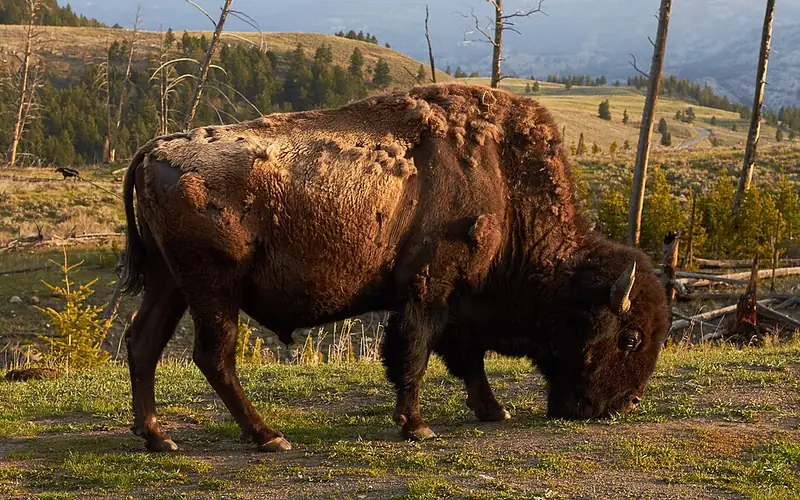 Mammal We saw it
 American bison
Bison bison
The biggest land animal in North America, a shaggy grazer of the plains you can watch cross the road in Yellowstone.
-
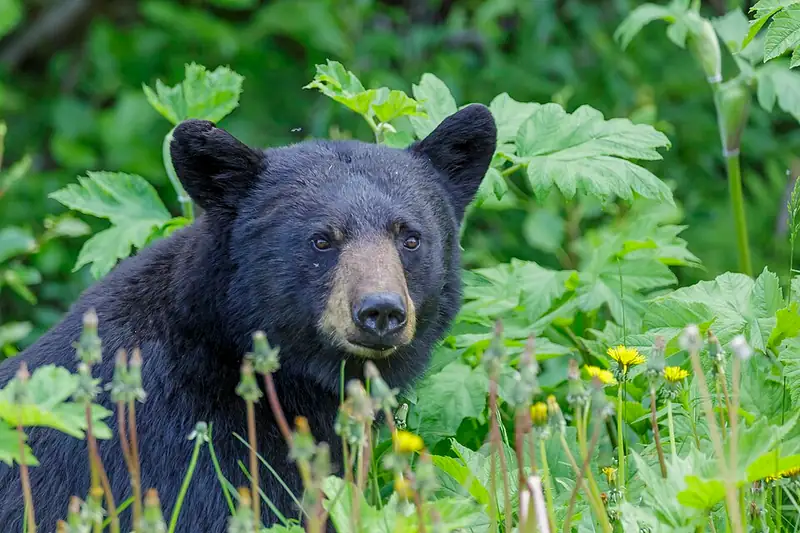 Mammal We saw it
 American black bear
Ursus americanus
The bear you're most likely to meet east of the Rockies, a strong tree-climber that eats mostly plants and comes in black, brown, or cinnamon.
-
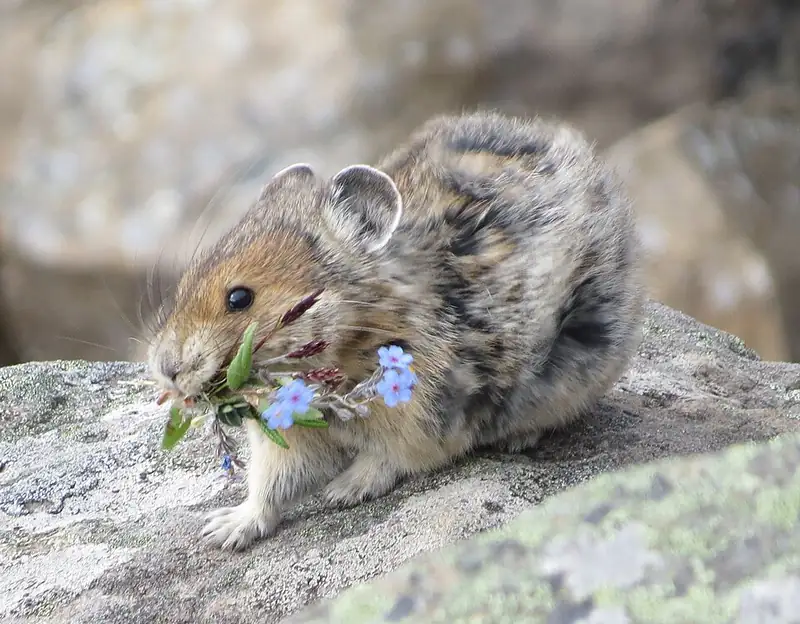 Mammal We saw it
 American pika
Ochotona princeps
A small round cousin of the rabbit that lives in mountain rock piles at Rocky Mountain, Mount Rainier, and North Cascades, and never sleeps through winter.
-
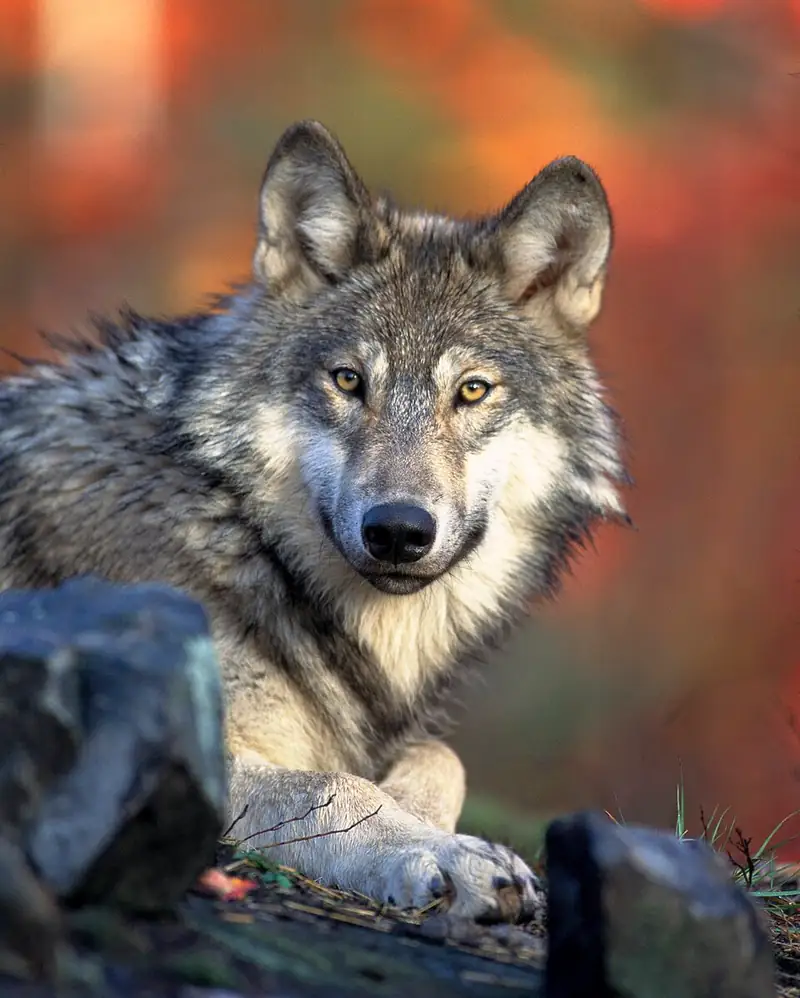 Mammal We saw it
 Gray wolf
Canis lupus
The biggest wild dog in North America, a pack hunter you might hear howling at dawn in Yellowstone, Denali, or Isle Royale.
-
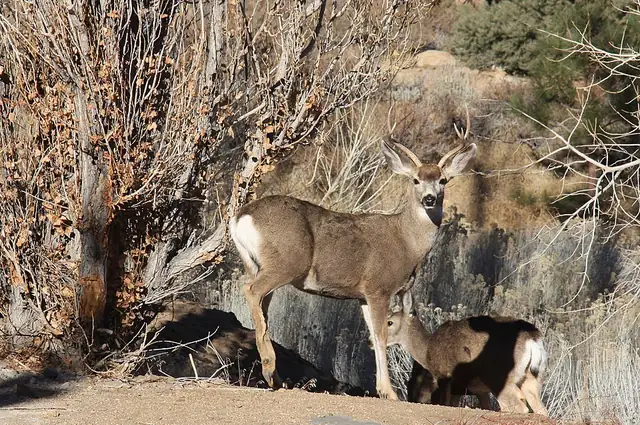 Mammal We saw it
 Mule deer
Odocoileus hemionus
A western deer named for its big mule-like ears, common along canyon rims and desert washes in Grand Canyon, Zion, Yosemite, and Saguaro.
-
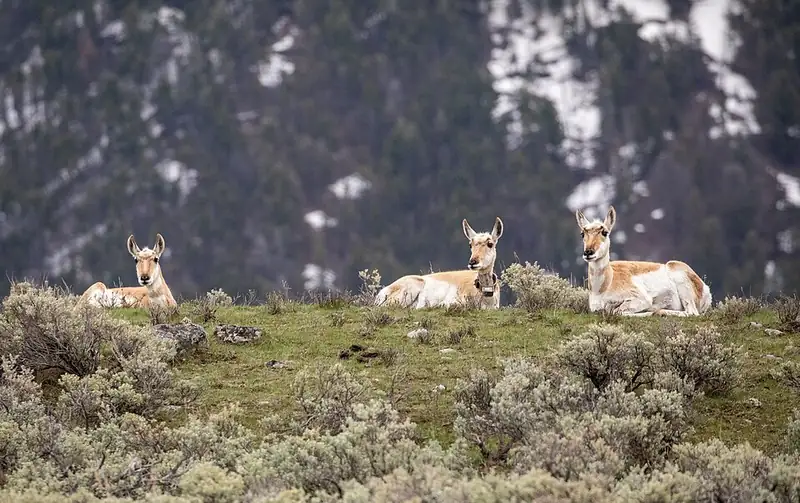 Mammal We saw it
 Pronghorn
Antilocapra americana
North America's fastest land mammal, seen in Yellowstone's northern range and at Lava Beds, built to outrun a predator that went extinct 12,000 years ago.
III
History
Who shaped this place
Indigenous nations
- Bannock (Shoshone-Bannock Tribes) — By 1900 the Tukudika, the Mountain Shoshone band that lived for thousands of years in what became Yellowstone, had been folded into the Eastern Shoshone of the Wind River Reservation and into the Mountain and Lemhi Shoshone and Bannock of the Fort Hall Reservation. NPS says some descendants prefer the name Mountain People to Tukudika or Sheep Eater.
- Northern Cheyenne Tribe — Roughly 444,000 acres of southeastern Montana make up the Northern Cheyenne Reservation, 99 percent of it held in tribal ownership.
Advocates
- Ferdinand V. Hayden↗ — USGS geologist
Led the federally-funded 1871 Hayden Geological Survey and lobbied Congress with photographs, paintings, and a hand-painted map.
- Nathaniel P. Langford — First park superintendent (1872, unpaid)
Member of the 1870 Washburn-Langford-Doane Expedition who spent the winter of 1870–71 lecturing in Washington and New York for park status.
- Thomas Moran — Painter, Hayden Survey
His monumental canvas The Grand Cañon of the Yellowstone was bought by Congress and hung in the Capitol while the bill was in committee.
Detractors
- Cost-conscious congressmen — U.S. Congress, 1872–1886
The 1872 act passed only because it required no appropriation; Yellowstone had effectively no funding, staff, or enforcement for fourteen years until the Army was sent in 1886.
- Settlers, miners, and poachers —
Routinely violated park boundaries through the late 19th century — felling timber, killing bison and elk for hides, and staking mineral claims.
- Superintendent Philetus W. Norris↗ — Park superintendent, 1877–1882
Actively pushed Indigenous removal after the 1877 Nez Perce flight through the park and the 1878 Bannock War, using the "uninhabited wilderness" framing to erase the Tukudika Shoshone.
Timeline
Yellowstone National Park Protection Act
President Grant signs the Act of March 1, 1872 (17 Stat. 32) — the first national park in the world.
U.S. Army takes over administration
After 14 years without funding, the Army moves into Camp Sheridan (later Fort Yellowstone) to police poaching and vandalism.
Roosevelt Arch and Old Faithful Inn
North-entrance arch dedicated by Theodore Roosevelt; Robert Reamer breaks ground on the Old Faithful Inn the same season.
NPS Organic Act
Congress creates the National Park Service to manage Yellowstone and its peers.
Army hands off to civilian Park Service
Military administration ends; Park Service rangers take over Yellowstone.
UNESCO Biosphere Reserve
Yellowstone is named one of the first U.S. biosphere reserves under UNESCO Man and the Biosphere.
UNESCO World Heritage Site
Inscribed for its geothermal features and wild ecosystems.
Yellowstone Fires
793,000 acres — about 36% of the park — burned in the largest fire season in park history, reshaping fire policy across the agency.
Gray wolves reintroduced
14 wolves from Jasper, Alberta released in Lamar Valley after a 70-year absence; 17 more followed in 1996.
NPS centennial
Park Service marks 100 years; Yellowstone records 4,257,177 visits, the pre-pandemic high to that point.
Record 4,860,242 visitors
Post-pandemic surge produces the busiest year in park history.
Historic flood closes the park
June rain-on-snow event destroys the Gardiner–Mammoth road; all five entrances close for the first time in 34 years.
4,744,353 visitors
Second-busiest year on record, up 5.4% from 2023.