Elk
A large deer of mountain meadows whose bulls grow branching antlers and, each fall, bugle a high whistling call across the valley.

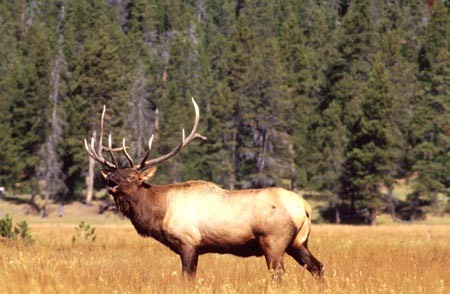
Elk at a glance
Cervus canadensis ELK; Cervus canadensis is SUR-vuss kan-uh-DEN-siss
- Type
- Mammal · deer
- Diet
- Herbivore
- Size
- A bull stands about 5 feet at the shoulder, tall enough to look a grown-up in the eye, and a big one can weigh as much as a horse (up to about 1,100 pounds / 500 kg, and up to 1,200 pounds in the largest Roosevelt elk). Cows are roughly half that.
- Lifespan
- Around 10 to 13 years in the wild.
- Conservation
- Least concern
Eats grasses, forbs, shrubs, tree bark in winter
Elk are grazers that eat mostly grasses and leafy plants, and they browse shrubs and even bark when snow covers the ground. A single elk eats about 20 pounds of plants a day, feeding in meadows at dawn and dusk.
Should you worry?
Elk look calm but they are large and wild. Bulls can be pushy in fall during the rut, and cows guard their calves closely in spring. Stay at least 25 yards away (about two school buses), watch from the road, and never walk into a meadow to get close to one.
In fall you often hear an elk before you see it. A bull tips his head back and bugles, a call that starts low, climbs to a high whistling squeal, and trails off in grunts. It carries across a whole valley at dawn and dusk, one bull answering another, each telling the other whose meadow this is.
The antlers doing the arguing are new every year. Only bulls grow them, and they grow fast, as much as an inch a day through the summer, then drop off in winter so the bull starts over from bare skin in spring. The rest of the day is quieter work: an elk eats about twenty pounds of grass and leafy plants, grazing the meadows in the cool hours.
The biggest elk of all live where you might not expect them, down at the coast. Roosevelt elk in Redwood are the largest kind in North America, and instead of a mountain meadow you may find a herd out on the prairie or standing on the gravel of a beach, antlers against the gray Pacific.
Did you know?
- Only the bulls grow antlers, and they grow fast, up to an inch a day, then drop off each winter and start over in spring.
- In fall, bull elk bugle — a call that climbs from a deep note to a high squeal and ends in grunts — to challenge other bulls and gather a group of cows.
- The Roosevelt elk of Redwood are the largest kind of elk in North America, with bulls up to 1,200 pounds; you can spot herds grazing in the prairies and even on the beach.
Common questions
Are elk dangerous to kids?
They can be if you get too close. Bulls get pushy in fall and cows protect their calves in spring. Keep at least 25 yards away, stay near the car or a building, and give them room.
What sound does an elk make?
In fall the bulls bugle — a call that starts low, rises to a high squeal, and finishes with grunts. You can hear it across a whole valley at dawn and dusk.
What is the difference between elk antlers and horns?
Antlers are bone that grows fresh every year and drops off in winter, and only males have them. Horns, like a bighorn sheep's, stay on for the animal's whole life.
Where can I see elk?
In mountain meadows at Rocky Mountain, Yellowstone, and Grand Teton, and in the coastal prairies of Redwood. Early morning and evening are the best times.
What eats elk?
Mountain lions, gray wolves, and grizzly and black bears. Coyotes and bobcats take calves. Healthy adults are rarely caught.
Where it lives
- Black Canyon of the Gunnison National Park
- Craters of the Moon National Monument and Preserve
- Glacier National Park
- Grand Teton National Park
- Great Basin National Park
- Guadalupe Mountains National Park
- Mesa Verde National Park
- North Cascades National Park
- Olympic National Park
- Redwood National and State Parks
- Rocky Mountain National Park
- Theodore Roosevelt National Park
- Wind Cave National Park
- Yellowstone National Park
- Zion National Park