American pika
A small round cousin of the rabbit that lives in mountain rock piles at Rocky Mountain, Mount Rainier, and North Cascades, and never sleeps through winter.
We saw it Our family spotted this one at Yellowstone National Park in August 2026.
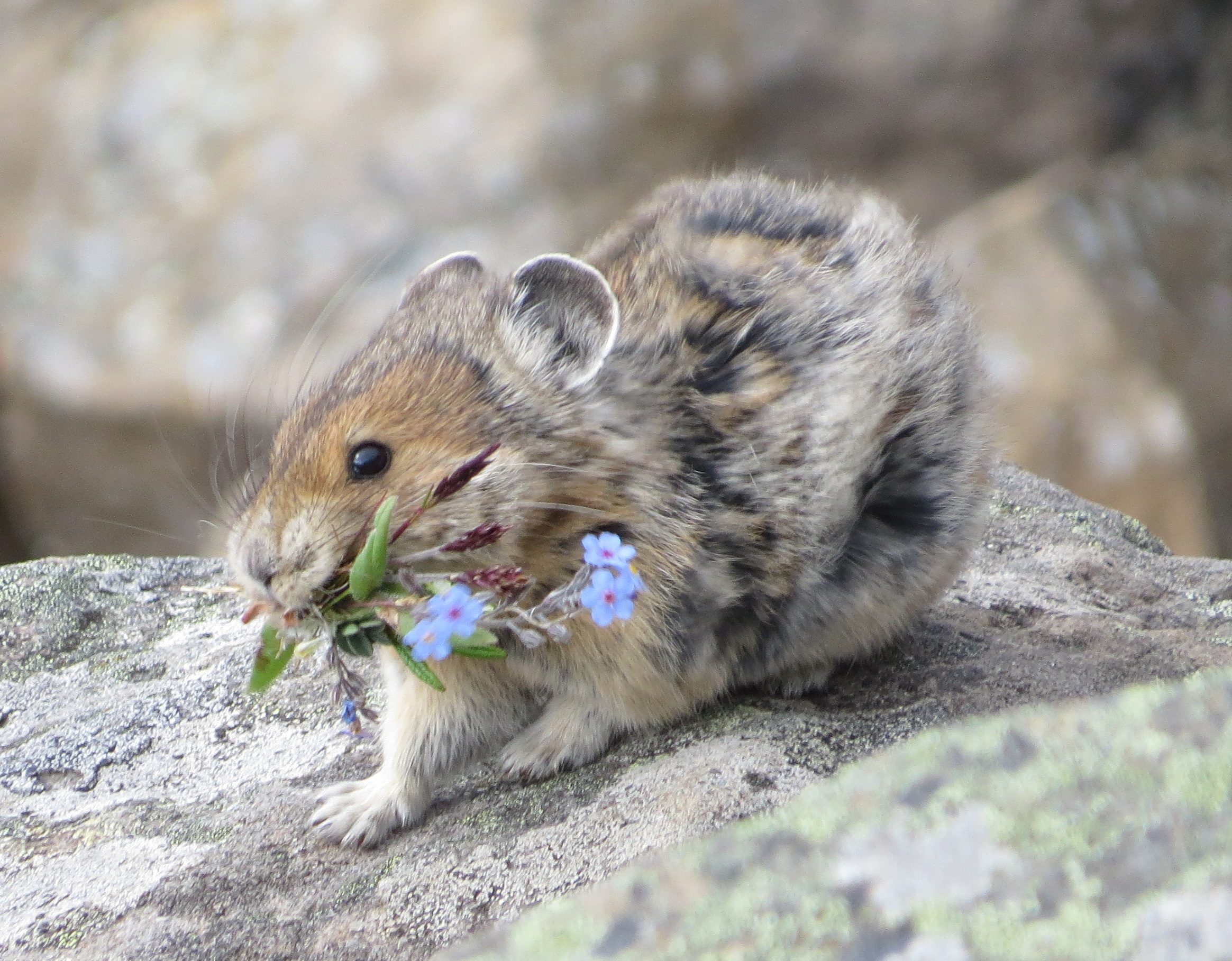

American pika at a glance
Ochotona princeps PY-kuh; Ochotona princeps is oh-koh-TOH-nuh PRIN-seps
- Type
- Mammal · lagomorph
- Diet
- Herbivore
- Size
- About the size of a potato, small enough to hold in two cupped hands (roughly 7 to 8 inches long). It has round ears, no visible tail, and thick fur.
- Lifespan
- Around 3 to 6 years in the wild.
- Conservation
- Least concern
Eats grasses, wildflowers, leaves, mountain plants
Pikas eat grasses, leaves, and mountain wildflowers all summer. Because they do not hibernate, they also cut extra plants and dry them in the sun to store for winter food.
Should you worry?
Pikas are harmless. They will not hurt you at all. They are fast and shy, so the trick is to sit still and quiet on the rocks and watch for one to pop up with a mouthful of flowers. Never chase or feed them, and don't move the rocks where they live.
Sit still on a mountain rock pile and wait, and eventually a small round face pops up between the boulders: round ears, no tail to speak of, a body about the size of a potato you could cup in two hands. That is a pika. It looks like a bunny that forgot to grow long ears, and though it lives among rocks like a mouse, it is no rodent at all: it belongs to the rabbits and hares.
Most small mountain animals sleep the winter away. The pika refuses. All summer it races back and forth clipping grass and wildflowers, then stacks them under the rocks to dry into little haypiles, its own hay barn, and when the snow buries the slope, it stays awake down in the rocks and eats from the pile. If you see one dash past with a mouthful of flowers sticking out both sides, that is the winter groceries.
The pika’s trouble is heat. It carries such thick fur that just two hours in air above about 82 degrees can kill it, so it needs the cool air deep in the talus, high on the mountain. As summers warm, the pika has to climb higher to find that cool, and near the top of a peak there is only so much higher left to go. That is why the scientists keep counting them.
Did you know?
- A pika does not hibernate. Instead it spends all summer clipping plants and piling them under rocks to dry into haypiles, then eats from those piles all winter under the snow.
- Pikas are not rodents. They belong to the same animal family as rabbits and hares, the lagomorphs. Their round ears and no-tail shape make them look like a tiny bunny that forgot its ears were supposed to be long.
- Pikas get too hot very easily. Just two hours in air warmer than about 82°F (28°C) can kill one, which is why they live up high in cool rock piles and why warming summers worry the scientists who watch them.
Common questions
Is a pika a rodent?
No. A pika is a lagomorph, the same family as rabbits and hares. It just looks like a tiny round mouse or bunny.
Do pikas hibernate?
No. They stay awake all winter and live off the haypiles of dried plants they collected during the summer.
Where do pikas live?
In cool piles of broken rock, called talus, high up in the mountains. The rocks stay cold enough for them even in summer.
Why are pikas in trouble from warm weather?
Pikas overheat easily. When the air gets too hot they have to climb higher up the mountain, and near the top there is less and less room to go.
What eats an American pika?
Weasels and ermines are small enough to chase pikas into the rock piles. Coyotes and martens catch young pikas that are too slow, and golden eagles take a few.
Where it lives
- Crater Lake National Park
- Craters of the Moon National Monument and Preserve
- Glacier National Park
- Grand Teton National Park
- Lassen Volcanic National Park
- Lava Beds National Monument
- Mount Rainier National Park
- North Cascades National Park
- Rocky Mountain National Park
- Sequoia National Park
- Yellowstone National Park
- Yosemite National Park