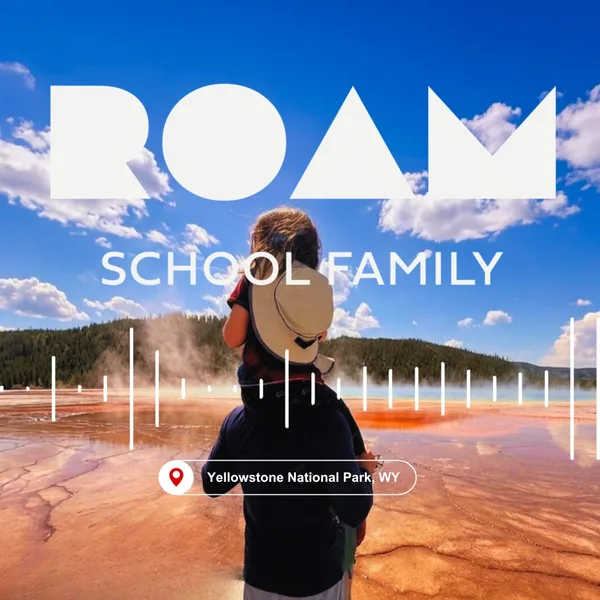
Yellowstone National Park | Is the supervolcano going to blow?
Listen now on: Apple Podcasts
Summary
A short written summary of the episode — not the full transcript. Press play above for the whole thing.
Earlier this fall, two professors in Great Britain published a story about Yellowstone. The headline asked whether it was the end of humanity. Then it went minute by minute: swarms of small earthquakes, the ground rising, two hundred thousand people told to leave, a column of ash thirty miles high that you could see from Denver.
We read it in the van, then parked in the middle of the thing it described.
So we called a volcanologist. Dr. Kayla Iacovino works at the SETI Institute, the place that looks for life on other planets, and she makes magma in her lab with a machine she describes as a car jack on steroids. Her first answer was the one nobody in the back seat had to wait for: no, Yellowstone is not going to erupt. The paper was a thought experiment, closer to a movie about what if than to a forecast.
What is actually under the park is not a pocket of gooey lava. It is a white-hot blob with the consistency of overcooked oatmeal, so stiff a spoon would stand up in it. That stiffness is why it cannot go anywhere. It just breathes. You need magma to be runny for it to blow.
Kayla told us she skipped earth science in school because she thought she was too smart for it. Then she found rocks. Her title is experimental petrologist, which means she studies the origins of rocks, and she now spends her days melting them to understand volcanoes on this planet and others. Big had one question left at the end of the interview: where is the volcano? The answer is that we were standing on it.
Then we drove the loop with new eyes. Mammoth Hot Springs is a white staircase where hot water dissolves rock like sugar in hot tea and then stacks it back up into a wedding cake. In Lamar Valley we cut the engine and let a herd of bison lean on the hood for the warmth. Old Faithful is a kettle with the lid stuck on, a thousand people on benches waiting for the sign to be right. Grand Prismatic is a rainbow made by living things, a mood ring built by some of the oldest life on Earth. At Biscuit Basin in 2024 the ground popped beside the boardwalk; the boardwalk was damaged and nobody was hurt.
The part that stayed with us was the monitoring. USGS scientists and university teams measure the chemistry of the gases, the temperature and pH of the lakes, the tiny earthquakes, and the ground itself to the millimeter. If Yellowstone were getting ready, the ground would tell us. It is not getting ready, because the oatmeal is too stiff.
Which brings us back to the arch at the entrance. For the benefit and enjoyment of the people. Those words are not decoration. The ranger who turned her laser thermometer around so a kid could read 160 degrees works for you. The rangers who keep bears out of campgrounds work for you. The scientists checking a millimeter a day work for you. Yellowstone is an active volcano you can stand inside for days and feel nothing but excited, and the people who keep it that way are paid by the public who owns it.
Little wanted to know what future archaeologists would make of a thousand people clapping for water. The ranger did not have to turn the thermometer around. She did it because the place belongs to the kid holding it.
The place
Yellowstone National Park — The first national park in the world: 2.2M acres of geyser basin, caldera, and the Lamar wolves we got up before dawn to find.
Who helped
- Dr. Kayla IacovinoExperimental petrologist and principal investigator, SETI Institute Carl Sagan Center for Research — interviewed for this episodeKayla Iacovino studies volcanoes on Earth and other planets, and runs lab experiments that melt rock to recreate magma chambers. She holds a PhD in volcanology from the University of Cambridge and works at the SETI Institute's Carl Sagan Center for Research.