Black-tailed prairie dog
A burrowing ground squirrel, not a dog. Its towns along Theodore Roosevelt's scenic loop mow the grass short and pull bison and pronghorn in to graze.
We saw it Our family spotted this one at Theodore Roosevelt National Park in September 2026 and at Wind Cave National Park in September 2026 and at Badlands National Park in September 2026.


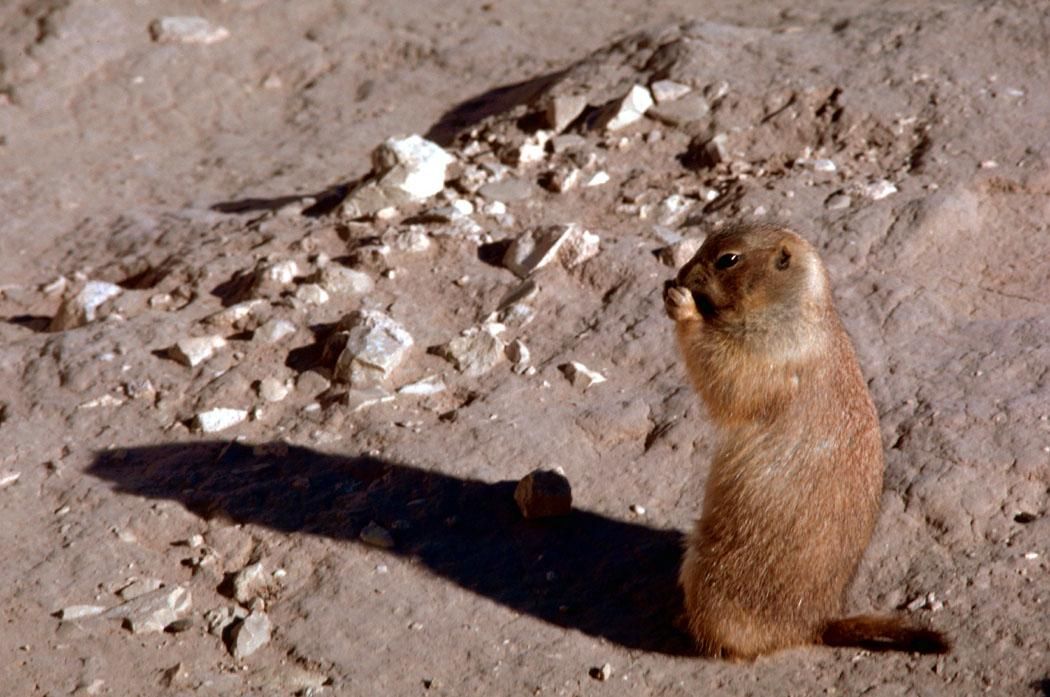
Black-tailed prairie dog at a glance
Cynomys ludovicianus SY-nuh-miss loo-doh-vis-ee-AY-nuss
- Type
- Mammal · ground squirrel
- Diet
- Herbivore
- Size
- About as long as a school ruler and a half (14 to 17 inches) and about the weight of a loaf of bread (1 to 3 pounds / 0.5 to 1.4 kg).
- Lifespan
- About three to five years in the wild, and up to around eight years in captivity.
- Conservation
- Least concern (IUCN); not federally listed, but the species now lives on roughly 5% of the range it held before 1800.
Eats grasses, forbs, roots, seeds
Prairie dogs eat plants, choosing forbs (broad-leaved flowering plants) and grasses with a lot of moisture in them. They graze a town down to stubble: the National Park Service reckons 250 prairie dogs eat about as much grass as a 1,000-pound cow.
Should you worry?
They will not bite you if you leave them alone, and the real hazard is invisible: prairie dogs can carry fleas that spread sylvatic plague, the same bacterium that causes bubonic plague in people. Cases are rare, but the rule is not optional. Never feed a prairie dog, never touch one, never reach into a burrow, and stay on the road or the trail. If you see a dead or sick one, do not go near it. Its fleas are looking for a new ride.
The first thing you notice about a prairie dog town is not the prairie dogs. It is the grass. Inside the town the grass is chewed down to stubble, with cone-shaped mounds of bare dug-up dirt scattered every few yards. Outside the town it stands tall. The line between the two is sharp enough to see from a car window, and on the South Unit Scenic Loop Drive at Theodore Roosevelt National Park the road runs straight through three large towns, so you cross that line six times without getting out.
That mowed grass is the reason other animals show up. When prairie dogs graze a town short, they take the pressure off the broad-leaved plants called forbs, which grass would otherwise crowd out. Forbs are better food, so bison and pronghorn walk into the town to eat them. A prairie dog town looks like a colony of small rodents and works like a salad bar for animals a thousand times their size. Badgers, coyotes, foxes, bobcats, snakes, and hawks come for a different reason, which is the prairie dogs themselves.
Underneath, the town is organized into families called coteries: one adult male, several adult females, and their young under two years old, sharing a network of tunnels with several entrances so there is always another way out. Coterie members recognize each other by touching faces, something close enough to a kiss that it is hard to call it anything else. A litter runs from one to six pups, born in spring and kept underground for about six weeks before they surface.
Then there is the barking, which is where the name came from. It is not a dog sound. It is a series of short, high squeaks, and it moves: one animal picks it up, then the next mound, then the one after that, until the whole town is calling and standing upright and watching you. Researchers who study these calls think they carry more than alarm, that different call patterns go with different kinds of threat. Sit in the car long enough and the calls stop, one mound at a time, and the town goes back to eating.
One thing the calls will not warn you about. Prairie dogs can carry fleas that spread sylvatic plague, and an outbreak can empty a town. Watch from the road. Do not feed them, do not touch them, do not put a hand near a burrow, and give any sick or dead animal a wide berth, because its fleas are already looking for the next warm thing to ride.
Did you know?
- Prairie dogs do not just bark, they bark specifics. Different threats get different call patterns, and researchers studying their calls believe the animals can encode the kind of predator approaching, not only that something is coming.
- The largest prairie dog town ever recorded covered about 25,000 square miles, an area bigger than West Virginia.
- Members of the same family group greet each other with something that looks like a kiss: a face-to-face touch that lets them check whether the other animal belongs.
- The barking is why they are called dogs. They are ground squirrels, related to marmots and chipmunks, and the genus name Cynomys comes from Greek words meaning 'dog mouse'.
Common questions
Is a prairie dog actually a dog?
No. It is a ground squirrel, in the same family as marmots and chipmunks. Early travelers on the plains named it for its bark, and the scientific name Cynomys means 'dog mouse' in Greek.
Why do prairie dogs bark at you?
It is an alarm call for the whole town. They make a series of short, high-pitched squeaky barks, and different threats get different call patterns, so a town can pass along what kind of danger is coming and not just that something is.
Are prairie dogs dangerous to kids?
Not by biting, if you leave them alone. The risk is their fleas, which can carry sylvatic plague. Do not feed them, do not touch them, do not reach into a burrow, and stay away from any animal that looks sick or is lying dead.
Why are bison and pronghorn always standing in the prairie dog town?
Because the food there is better. Prairie dogs graze the tall grass down, and the broad-leaved forbs that grass would normally crowd out get a chance to grow. Those plants are more nutritious, so bison and pronghorn come to the town to eat them.
What eats a prairie dog?
Badgers, coyotes, foxes, bobcats, snakes, and raptors like hawks and eagles. Black-footed ferrets eat almost nothing else, which is why one of North America's most endangered animals lives or dies with prairie dog towns.
Where we got this
- NPS — Prairie Dogs (Theodore Roosevelt National Park)
- NPS — Black-tailed Prairie Dogs
- NPS — Prairie Dogs: Pipsqueaks of the Prairie
- NPS — Wildlife Viewing (Theodore Roosevelt National Park)
- NPS — Plague
- NPS — Black-tailed Prairie Dog (Wind Cave National Park)
- NPS — Roberts Prairie Dog Town (Badlands National Park)
- NPS — Prairie Dogs (Lewis and Clark National Historic Trail)
- USFWS — Endangered Species Act Protection for the Black-tailed Prairie Dog Is Not Warranted (December 2, 2009)
- IUCN Red List — Cynomys ludovicianus (Least Concern)