Amphibians of Redwood National and State Parks
The 4 amphibians of Redwood National and State Parks. Their profiles carry sizes, diets, and whether you should worry.
Common questions
Which Redwood National and State Parks amphibians demand distance from a kid?
Coastal giant salamander, Ensatina, Pacific chorus frog, and Rough-skinned newt carry a rule worth reading. Coastal giant salamander: It can't poison you, but it can deliver a surprisingly painful bite if you pick one up and it feels threatened. Ensatina: It cannot bite or sting, but its tail oozes a sticky, milky poison when it is scared. Pacific chorus frog: It cannot bite or sting in any way that matters. Rough-skinned newt: Never put one near your mouth or an open cut. (per NPS species pages).
What do Redwood National and State Parks amphibians eat?
Coastal giant salamander eats mice, insects, worms, slugs, small snakes, other salamanders. Ensatina eats worms, ants, beetles, spiders, millipedes, snails. Pacific chorus frog eats spiders, beetles, flies, ants, small insects. Rough-skinned newt eats insects, worms, slugs, salamander and frog eggs, small fish. (per NPS species pages).
The strangest true thing about Redwood National and State Parks's amphibians.
Coastal giant salamander: A coastal giant salamander can grow up to 13 inches long, making it the largest salamander that lives on land anywhere in North America. Ensatina: It has no lungs. It breathes entirely through its skin and the lining of its mouth and throat, which is why it needs to stay in damp, shaded places and is never found far from moisture. (per NPS species pages).
-
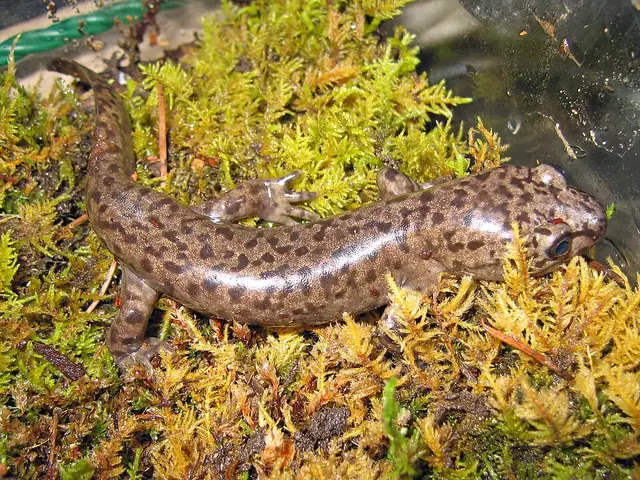 Amphibian
Coastal giant salamander
Dicamptodon tenebrosus
The largest terrestrial salamander in North America, a foot-long forest hunter that eats mice and other salamanders and can bark when it is grabbed.
-
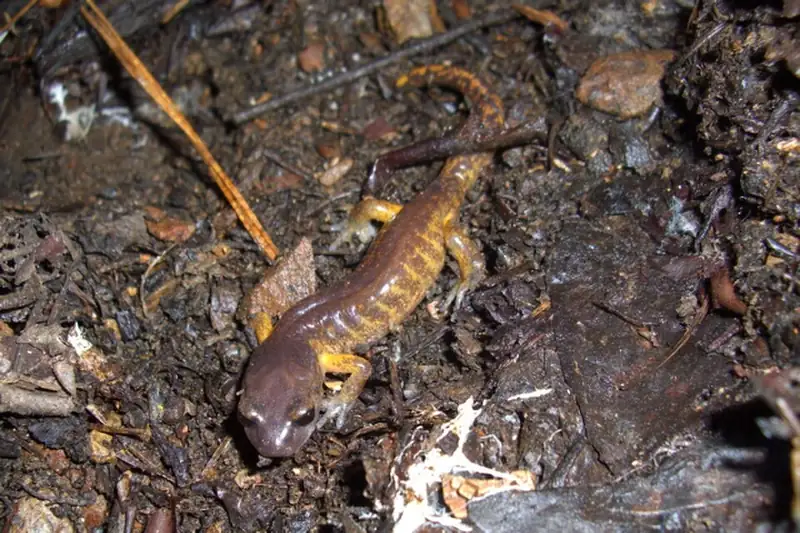 Amphibian
Ensatina
Ensatina eschscholtzii
A lungless salamander that breathes through its skin, a textbook 'ring species' whose subspecies loop around California's Central Valley without quite meeting.
-
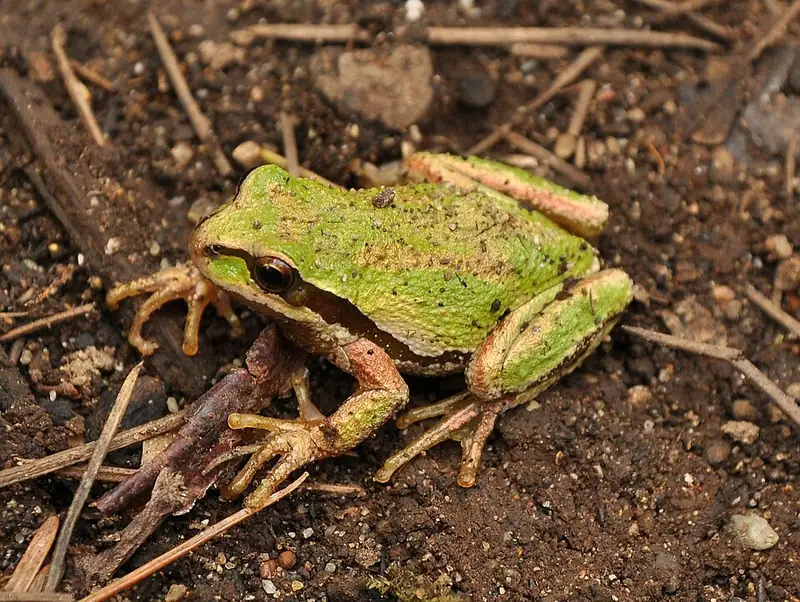 Amphibian
Pacific chorus frog
Pseudacris regilla
A two-inch frog that shifts between green and brown and calls the ribbit Hollywood dubs onto night scenes everywhere, from sea level to alpine ponds.
-
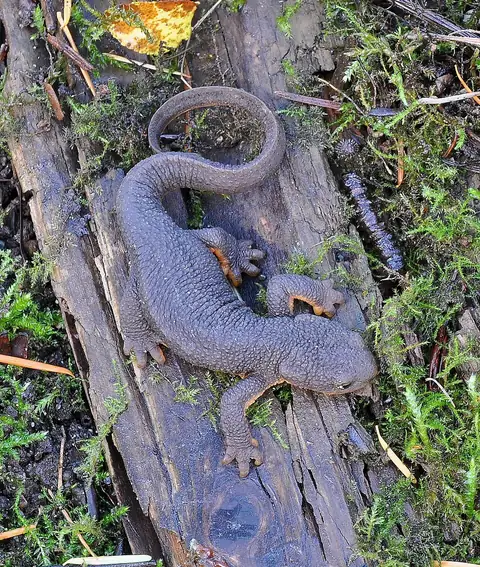 Amphibian
Rough-skinned newt
Taricha granulosa
A brown, warty-skinned newt with a bright orange belly that carries enough poison to kill a person, found in ponds and wet forests across the Pacific Northwest.