Rough-skinned newt
A brown, warty-skinned newt with a bright orange belly that carries enough poison to kill a person, found in ponds and wet forests across the Pacific Northwest.
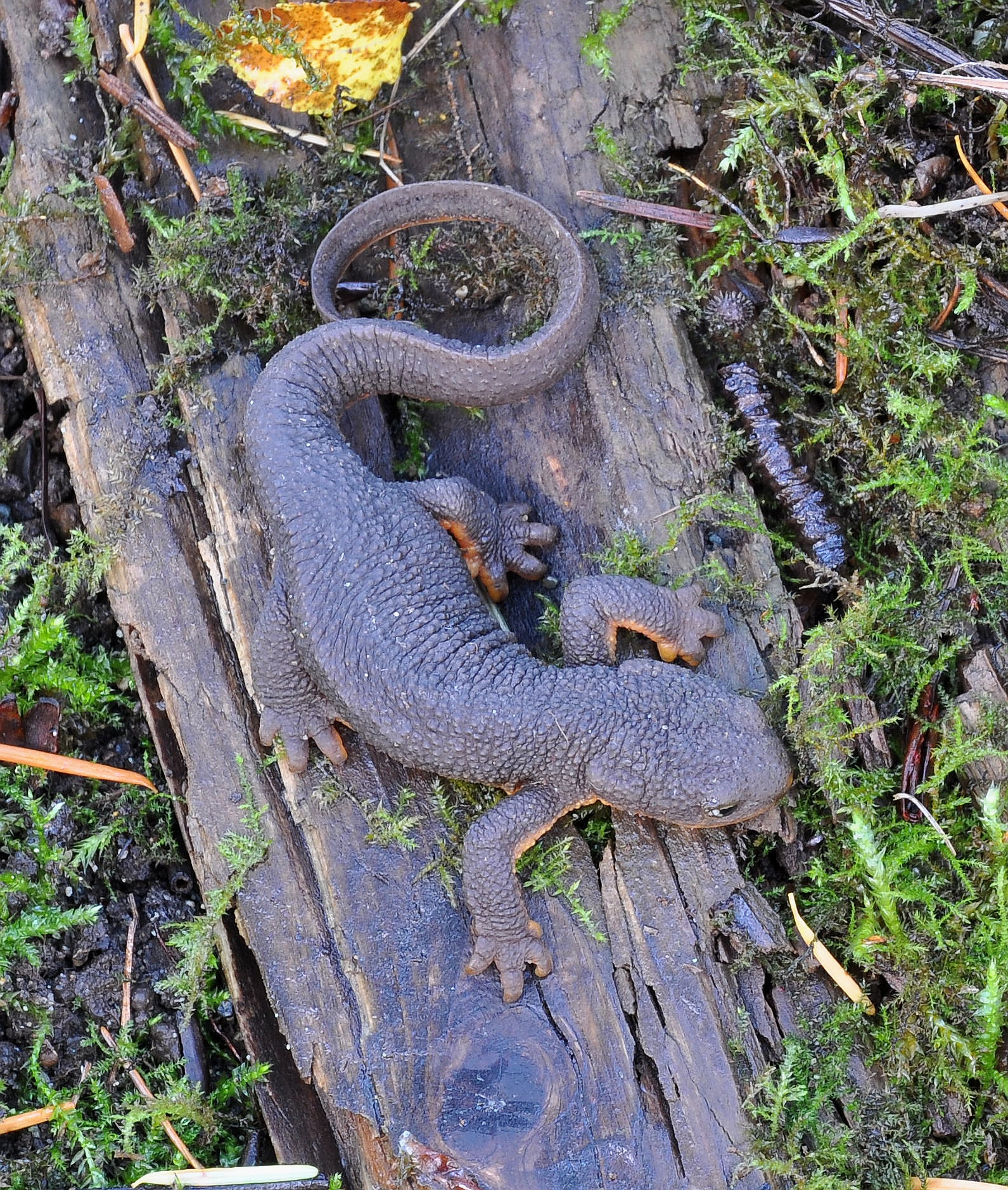

Rough-skinned newt at a glance
Taricha granulosa RUFF-skinned NEWT; Taricha granulosa is tuh-REE-kuh gran-yoo-LOH-suh
- Type
- Amphibian · newt
- Diet
- Carnivore
- Size
- About 5 to 8 inches long including the tail, close to the length of a dollar bill.
- Lifespan
- Around 12 years in the wild.
- Conservation
- Least concern
Eats insects, worms, slugs, salamander and frog eggs, small fish
It hunts slowly along pond bottoms and the wet forest floor, eating whatever small invertebrate it can catch, plus the eggs and larvae of other amphibians and even tiny fish.
Should you worry?
Never put one near your mouth or an open cut. Its skin carries tetrodotoxin, the same poison found in pufferfish, and swallowing one has killed an adult. Looking, holding briefly, and washing your hands afterward is safe. Keep dogs from mouthing one too.
At noon, when most salamanders are hidden under a log, a rough-skinned newt does the opposite. It walks across the open trail in no hurry at all, dark brown on top with a belly the color of a traffic cone, and it does not care who is watching. That confidence is not an accident. Its skin makes tetrodotoxin, the same poison found in pufferfish, in a dose strong enough that scientists estimate the skin of one newt could kill 25,000 mice. A raccoon, a bird, a curious dog: almost nothing that tries to eat this newt walks away from it.
Almost nothing, except one animal that has spent generations catching up. Common garter snakes in parts of the Pacific Northwest have evolved resistance to the toxin, a change in the same nerve channels the poison targets, so that swallowing a newt does not kill them the way it kills everything else. The newts in those same populations have answered back by making even more toxin, and the snakes there have kept evolving further resistance in turn. Biologists studying the two species have tracked this back-and-forth for decades and call it a coevolutionary arms race, one with no finish line: in a few populations the snakes have pulled ahead enough to eat newts that would drop any other predator in minutes.
The newt does not need the arms race everywhere. At Crater Lake, a local population called the Mazama newt had the whole lake to itself for thousands of years, the only real predator in water too new and too isolated for fish to reach on their own. It evolved less red coloring and less toxin than its relatives outside the crater, because inside the crater it did not need either. That changed once people started stocking the lake with fish starting in 1886, then crayfish in 1915. The crayfish have since spread across a growing share of the shoreline, eating newts and changing what grows on the lake bed along with them. A newt that walked around safely for millennia now shares its water with something that finally bites back.
Did you know?
- One rough-skinned newt carries enough tetrodotoxin in its skin to kill an estimated 25,000 mice, or, on record, one adult human who swallowed one in 1979.
- Toxin-resistant garter snakes are the only known animals today that can eat a rough-skinned newt and live.
- At Crater Lake, the newt's local population, the "Mazama newt," was the lake's only major predator before people put fish in the water starting in 1886, then crayfish in 1915.
Common questions
Is the rough-skinned newt dangerous to touch?
Touching it and then washing your hands is fine. The danger is if the poison gets in your mouth or an open cut, so keep it away from your face.
Why do you see this newt walking around in daylight when most salamanders hide?
Almost nothing wants to eat it. Its skin poison is strong enough to kill most predators, so it doesn't need to hide the way other amphibians do.
Can anything eat a rough-skinned newt?
In some places, common garter snakes have evolved resistance to the poison and can eat the newt and survive. It's one of the only animals that can.
What is a "Mazama newt"?
It's the name for the rough-skinned newts living in Crater Lake, which formed inside the collapsed volcano Mount Mazama. They evolved less toxin than newts elsewhere because the lake had no fish or crayfish to worry about until people added them.
What do I do if a newt gets in someone's mouth?
Call Poison Control at 1-800-222-1222 right away. Do not try to make the person throw up. If the person collapses, has a seizure, has trouble breathing, or cannot be woken, call 911. If skin poison gets in an eye, rinse it with room-temperature running water for 15 to 20 minutes.
Where it lives
Where we got this
- NPS — Amphibians of North Cascades National Park
- NPS — Amphibians and Reptiles of Olympic National Park
- NPS — Amphibians of Mount Rainier National Park
- NPS — Crater Lake, "What lives below the surface?"
- California Herps — Taricha granulosa (size, lifespan, toxicity estimate)
- Hanifin, Brodie & Brodie 2008, PLOS Biology — "Phenotypic Mismatches Reveal Escape from Arms-Race Coevolution" (garter snake/newt tetrodotoxin arms race, primary)
- Bradley & Klika 1981, JAMA — fatal newt poisoning case report (PubMed)
- NPSpecies — Taricha granulosa occurrence record, Redwood National and State Parks
- Poison Control: Poisoning from frogs, newts, toads, and salamanders
- Poison Control: Splashed a poison in your eye?
- Poison Control: when to call 911 (home page)