Desert kangaroo rat
A sand-dune rodent of Joshua Tree that never drinks water and dodges a striking sidewinder with a midair kick.
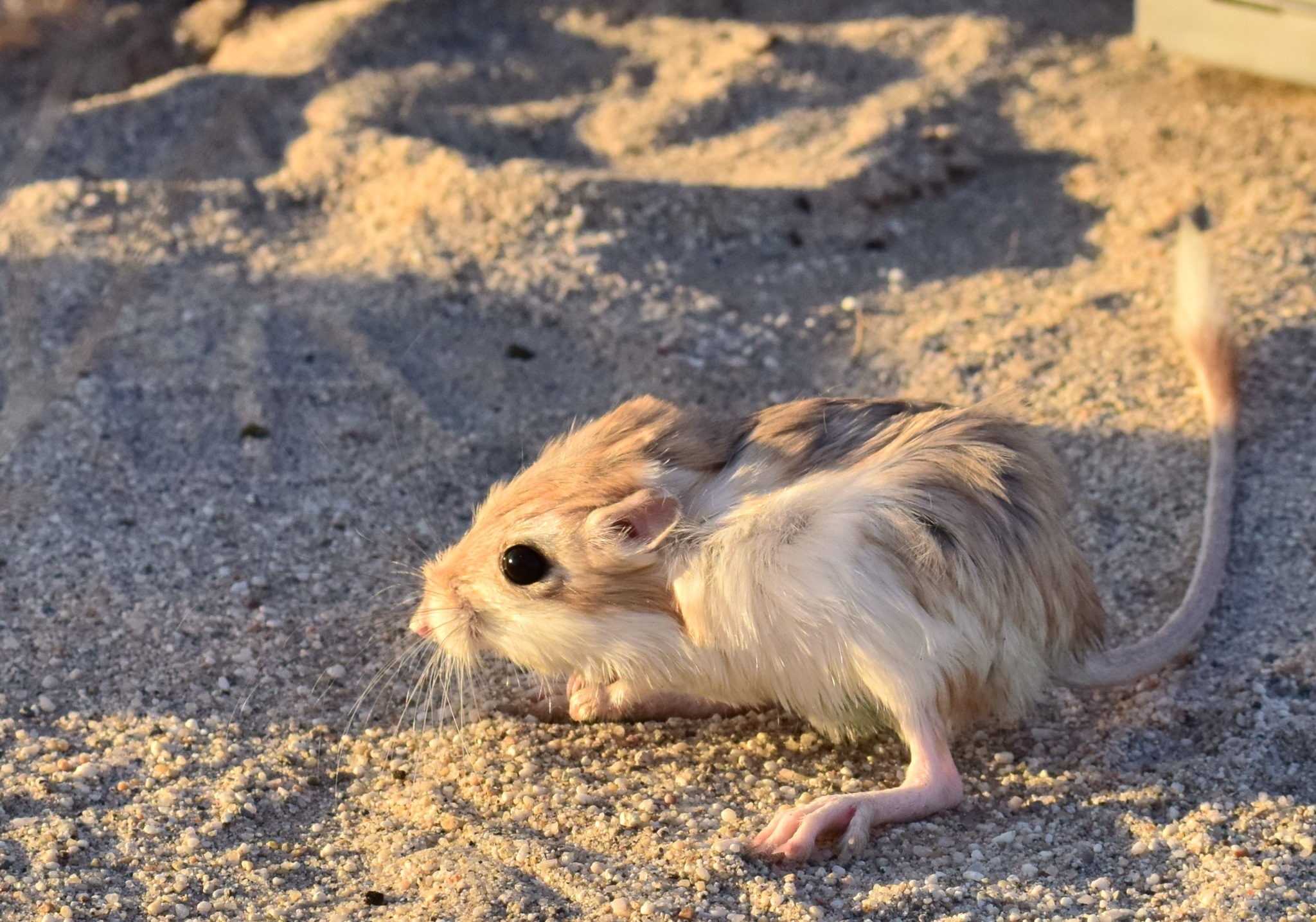

Desert kangaroo rat at a glance
Dipodomys deserti Dipodomys deserti is dy-POD-oh-miss deh-ZERT-eye
- Type
- Mammal · rodent
- Diet
- Herbivore
- Size
- About as heavy as a baseball (3 to 5 ounces / 83 to 148 g), with a body and tail together about as long as a school ruler (up to 13.5 inches / 342 mm), and more than half of that length is tail.
- Lifespan
- In captivity, desert kangaroo rats have lived 5.5 to 8 years; wild lifespans aren't well studied, but with owls, snakes, and foxes all hunting them, most likely live far less.
- Conservation
- Least concern
Eats dry seeds, mesquite pods, creosote-bush seeds, sage leaves
A desert kangaroo rat forages at night, stuffing fur-lined cheek pouches with dry seeds and carrying them back to storerooms inside its burrow. It prefers seeds and dried plant matter that yield the most water when digested, especially mesquite pods and creosote seeds.
Should you worry?
Not a danger. It's nocturnal, avoids people entirely, and its only weapon is a startled kick and a sprint into the dark. The real rule in the Mojave is about burrows in general, not this animal specifically: never reach into a rodent burrow, and look without touching any wildlife.
A sidewinder is coiled in the loose sand outside a Joshua Tree campground one warm night, and it strikes: an ambush that covers the distance to a foraging kangaroo rat in under a tenth of a second, faster than a person can blink. The kangaroo rat is already gone. High-speed cameras trained on real encounters like this one have caught the rat reacting in as little as 38 milliseconds, exploding upward seven or eight body lengths, twisting midair with its long tail to land feet-first, sometimes catching the snake with a kick on the way down.
That kind of reflex only works because the kangaroo rat isn’t thinking about it. Researchers who filmed dozens of these strikes found the fastest rats moved before the snake had finished its lunge, an instinct built entirely around those oversized hind legs and a tail that acts like a rudder in midair. It’s the same legs that give the animal its name and its whole way of getting around: it doesn’t scurry on all fours like a mouse, it hops.
The other trick this animal carries is stranger than the fight with the snake. A desert kangaroo rat never drinks. Its kidneys concentrate urine far beyond anything a person’s body could survive, and its nose is built to catch and recycle the moisture in every breath it exhales, so the water locked inside a dry mesquite pod or creosote seed is all the water it will ever need. Walk the sand flats of Joshua Tree at night with a flashlight and you might catch the eyeshine of one mid-hop, hauling a cheekful of seeds home to a burrow it has never, not once, needed a puddle to survive beside.
Did you know?
- Its reaction time to a striking rattlesnake can be as fast as 38 milliseconds, and researchers filming the encounters with high-speed cameras clocked full strikes at under 100 milliseconds, faster than a human eye blink.
- Its kidneys are so efficient, and its nose so good at recapturing moisture from exhaled air, that it can go its entire life without a single drink of water.
- It hops on its hind legs like its namesake instead of running on all fours, and it carries a mouthful of seeds in fur-lined cheek pouches back to underground storerooms.
Common questions
Do kangaroo rats drink water?
No. A desert kangaroo rat gets all the water it needs from the dry seeds it eats. Its body makes water from digesting them, and its kidneys and nose are built to waste almost none of it.
Is a kangaroo rat related to a kangaroo?
No. It's a rodent, not a marsupial. It just hops on big back legs the way a kangaroo does, which is where the name comes from.
How does a kangaroo rat escape a rattlesnake?
It reacts almost as fast as its nerves can fire, sometimes in less than a tenth of a second, and leaps straight up several body lengths, twisting in the air to land on its feet and sometimes kicking the snake away.
Are kangaroo rats dangerous to kids?
No. They're small, nocturnal, and want nothing to do with people. Just don't reach into any burrow in the desert.
What eats a desert kangaroo rat?
Snakes, owls, hawks, bobcats, spotted skunks, coyotes, and foxes all hunt desert kangaroo rats.
Where it lives
Where we got this
- NPS — Mammals (Joshua Tree National Park)
- U.S. Fish & Wildlife Service — Desert Kangaroo Rat
- IUCN Red List — Dipodomys deserti
- Whitford, Freymiller, Higham & Clark (2019) — Determinants of predation success, Functional Ecology
- UC Riverside News — High-speed videos capture how kangaroo rat escapes rattlesnake attack
- Animal Diversity Web: Dipodomys deserti