Gambel's quail
A ground-loving desert quail with a forward-curling black topknot that runs from danger in a dusty covey instead of flying.
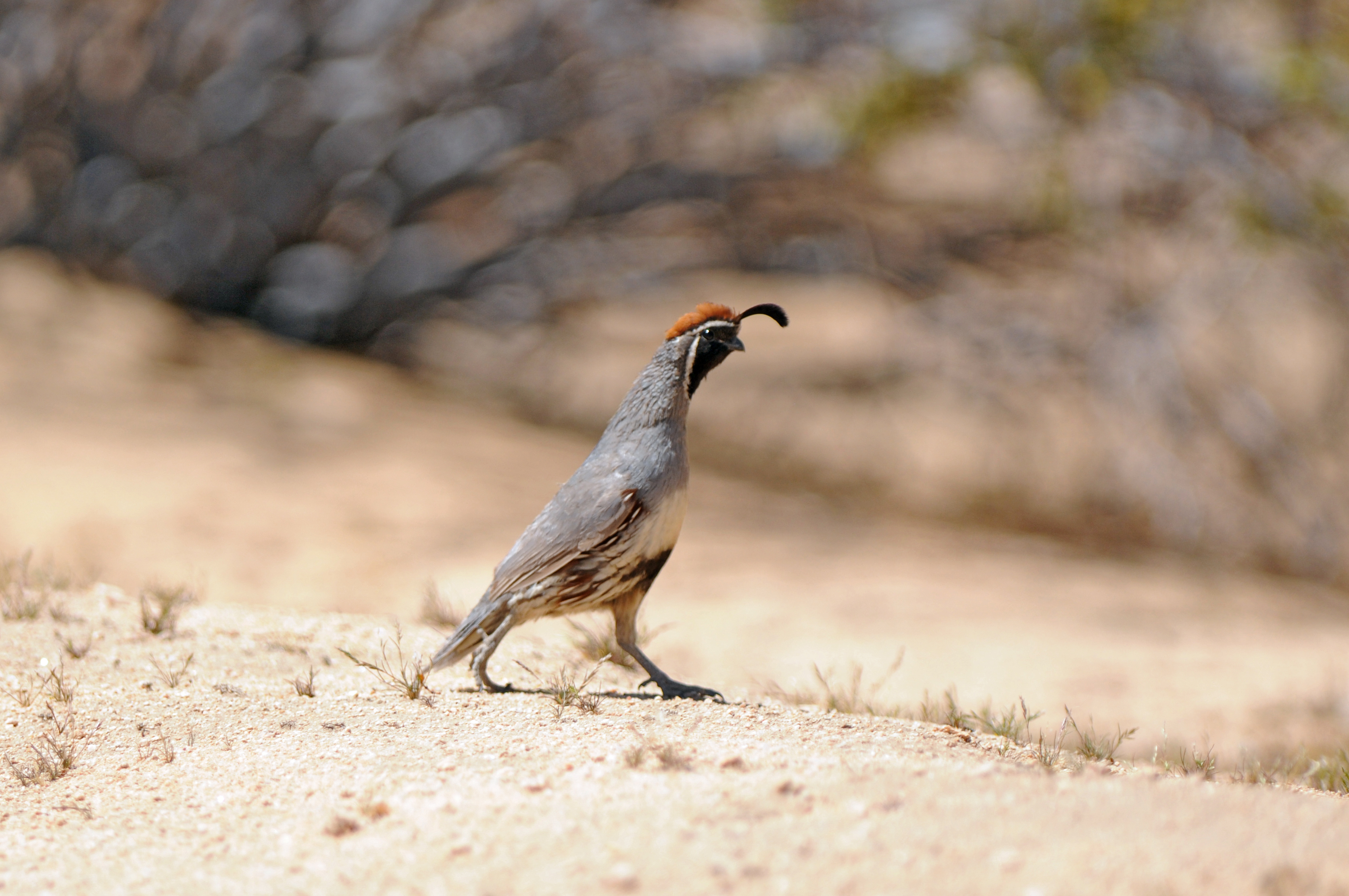

Gambel's quail at a glance
Callipepla gambelii GAM-buhlz kwayl; Callipepla gambelii is kal-ih-PEP-luh gam-BEL-ee-eye
- Type
- Bird · quail
- Diet
- Omnivore
- Size
- About as long as a school ruler (11 inches / 28 cm) and light enough to rest on your palm, weighing about as much as a baseball (roughly 6 ounces / 170 grams).
- Lifespan
- Most live only 1.5 to 2 years in the wild, though a banded bird has been recorded past 7 years old.
- Conservation
- Least concern
Eats seeds, leaves, berries, insects, cactus fruit
A Gambel's quail spends nearly all day walking and scratching through sand and leaf litter for seeds, leaves, and the occasional insect. It gets much of its water from that food and rarely needs to drink standing water at all.
Should you worry?
None. A Gambel's quail runs from people rather than toward them. If a covey crosses the trail, stop and let it pass. Never chase a covey or corner one against a rock.
A Gambel’s quail covey travels as a family unit, an adult pair with as many as sixteen young from earlier in the season still moving together into fall, so when the brush breaks open near Barker Dam it is rarely just one bird. A dozen small brown birds spill out at once, black topknots bobbing forward off their heads, running rather than flying across the open sand until the wash swallows them, the rising two-note call trailing behind them, one of the desert’s most recognizable sounds on Joshua Tree’s own bird list.
That family started as a clutch of ten to twelve eggs, incubated about three weeks, and the chicks that hatch out of it are working almost immediately. A Gambel’s quail chick can walk, peck at a seed, and follow its parents across open ground within about a day of cracking its shell, none of the helpless nest-bound weeks a robin or a jay spends as a chick. Nobody feeds a young quail bite by bite. It finds its own food from the very start, which is also why a whole covey can keep running the moment danger shows up. Every bird in it, even one a few days old, can already keep pace.
Near the Oasis of Mara, that’s what a covey scattering off the trail actually looks like: adults and chicks only days out of the egg, all cutting into the brush at the same speed, none of them waiting on the other. Stop and let it clear. What just blew past your ankles included at least one bird that hatched sometime this week.
Did you know?
- A Gambel's quail's topknot is made of six curved feathers overlapping so tightly it looks like one solid plume, black in males and a duller brown in females.
- A newly hatched chick can walk, peck at seeds, and keep up with its parents within about a day, one of the fastest starts of any desert bird.
- Joshua Tree National Park lists Gambel's quail as a common year-round resident, and its rising two-note call is one of the desert's most recognizable sounds.
Common questions
Are Gambel's quail dangerous to kids?
No. They run away from people. If a covey crosses your path, stop and wait for it to clear the trail.
Why do Gambel's quail run instead of fly?
Running takes less energy than flying and keeps the whole covey together and low to cover. They can still burst into flight if truly startled.
What do Gambel's quail eat?
Mostly seeds, leaves, and berries found on the ground, plus some insects. They get much of their water from this food instead of drinking.
How fast do Gambel's quail chicks grow up?
Fast. Chicks leave the nest within about a day of hatching, walk alongside their parents, and feed themselves from day one.
What is that bobbing black feather on top of a quail's head?
It's called a topknot, six feathers curved together into one forward-drooping plume. Both males and females have one.