Gila monster
A slow, heavy desert lizard covered in bead-like black and orange scales, one of the only venomous lizards in the U.S., found in the desert at Saguaro.
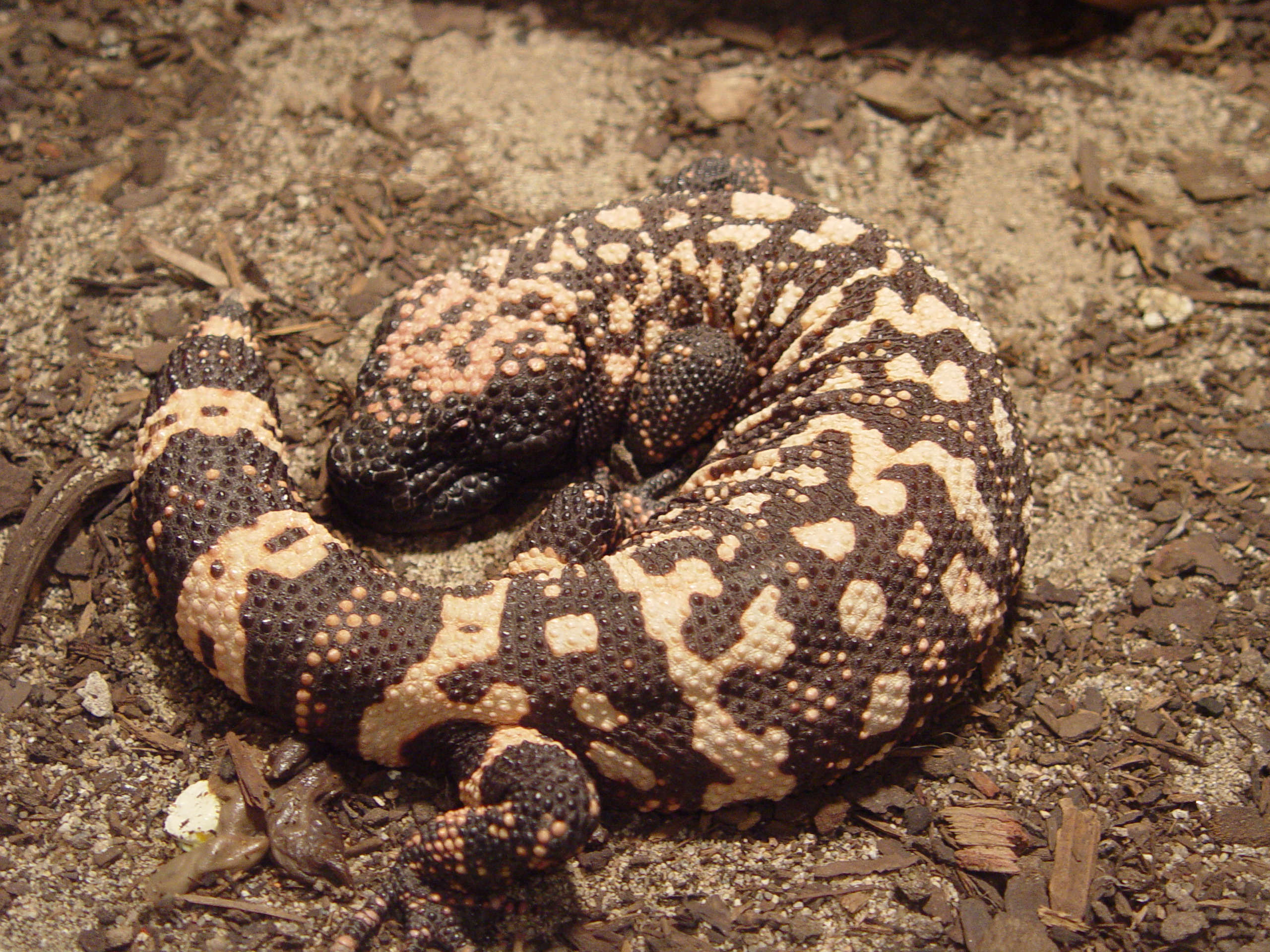

Gila monster at a glance
Heloderma suspectum HEE-luh MON-ster; Heloderma suspectum is hee-luh-DER-muh sus-PEK-tum
- Type
- Reptile · lizard
- Diet
- Carnivore
- Size
- From nose to tail tip it is about 1.5 feet long, close to the length of a kid's arm, and it can weigh a couple of pounds. It is one of the largest lizards in the United States.
- Lifespan
- Around 20 years or more in the wild.
- Conservation
- Near threatened (IUCN)
Eats bird eggs, reptile eggs, baby rabbits, young rodents, nestling birds
It hunts by smell, flicking its tongue to find nests, then eats eggs and helpless young animals. It can gulp down a huge meal at once and store the extra fat in its fat tail, then go weeks or months without eating.
Should you worry?
A Gila monster is venomous, but it is slow and would rather be left alone, so it is easy to stay safe: never touch it and never try to pick it up. Almost every bite happens to someone who grabbed one. If it bites, it holds on and chews the venom in, and that is very painful, so keep your hands to yourself and watch from a few steps away. Give it room to walk off and it will.
The Gila monster is one of the only venomous lizards in the United States, and it wears the news on its skin: heavy black scales beaded with bands of pink and orange, colors bold enough to read as a warning. It is a big, slow lizard, about a foot and a half from nose to tail, close to the length of a kid’s arm, and it is in no hurry. It hunts by smell, flicking its tongue to find nests, then eats eggs and helpless young animals: bird and reptile eggs, baby rabbits, nestlings. When it finds a meal it eats a great deal at once and stores the extra as fat in its thick tail, the way a camel stores fat in a hump.
That stored fat is why the Gila monster can vanish for so long. After one big meal it can live for weeks or months, and it spends most of the year underground in a burrow, coming up mainly in spring. Some spend more than nine of every ten days out of sight. Its venom is unusual, too. It is made in glands in the lower jaw rather than the upper, and it works into a bite through grooved teeth. Scientists who studied that venom used what they learned to help make a medicine for people with diabetes.
None of this makes the Gila monster a threat to a careful person. It is slow, and it would far rather be left alone than pick a fight. Almost every bite in the record happened to someone who grabbed one. The rule, then, is the easy one: never touch it and never try to pick it up. If it does bite, it holds on and chews the venom in, and that hurts badly, so keep your hands to yourself, watch from a few steps back, and give it room to walk away.
Did you know?
- A Gila monster stores fat in its thick tail like a camel stores it in a hump. After one big meal it can live for weeks or even months, which is why it spends most of its life resting underground.
- Its venom is made in glands in the lower jaw, not the upper, and it flows into a bite through grooved teeth. Scientists studied that venom and used what they learned to help make a medicine for people with diabetes.
- A Gila monster spends most of the year hidden in burrows and comes out mainly in spring. Some spend more than nine of every ten days out of sight underground.
Common questions
Are Gila monsters dangerous to kids?
They are venomous, but they are slow and shy and will not chase you. As long as you never touch or pick one up, you are safe. Look, take a picture, and leave it be.
Does a Gila monster bite hurt?
Yes, a lot. It bites and holds on, chewing the venom in. It is rarely deadly to a healthy grown-up, but it is a real emergency, so the safe move is to never handle one.
What does a Gila monster eat?
Mostly eggs and helpless baby animals it finds by smell, like bird and reptile eggs and baby rabbits. It eats a lot at once, then rests for a long time.
Why is it colored black and orange?
The bold colors are a warning. Bright patterns tell other animals, "I can defend myself, leave me alone."
What do I do if a Gila monster bites?
Go to an emergency room right away. Saguaro National Park calls every Gila monster bite a serious and painful medical emergency. Its mouth also carries bacteria that can infect the wound.