Yellowstone sand verbena
A white-flowered relative of desert sand verbenas found nowhere on Earth except a few beaches on Yellowstone Lake.

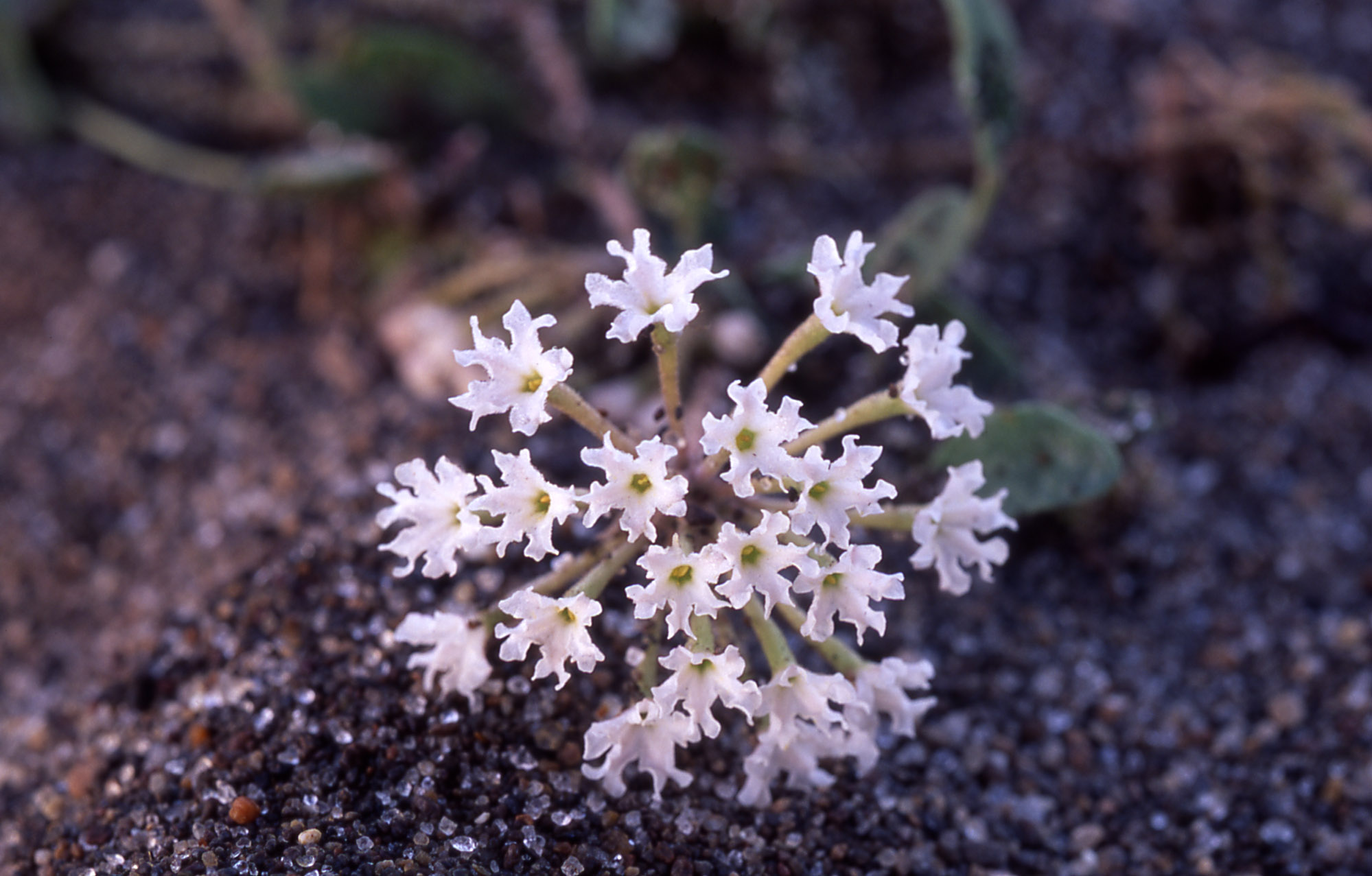
Yellowstone sand verbena at a glance
Abronia ammophila sand ver-BEE-nuh; Abronia ammophila is uh-BROH-nee-uh am-oh-FIL-uh
- Type
- Plant · wildflowers
- Diet
- Producer
- Size
- Grows low and flat, rarely rising more than 3 inches off the sand, about as tall as a stack of three or four checkers.
- Lifespan
- A perennial that regrows from the same deep taproot; a maximum wild lifespan has not been published.
- Conservation
- Not formally assessed by IUCN; a Wyoming state-tracked rare plant found in a single, very small area
A green plant that makes its own food by photosynthesis. A long taproot, reaching several feet down in a mature plant, pulls water from deep in the sandy shoreline.
Is it safe to touch?
Harmless, but easy to crush. Its entire known habitat covers less than two acres of lakeshore, and the park says trampling is the likely cause of its decline, so stay on marked paths near the beach.
Kneel down on a beach at Yellowstone Lake and you can find a plant that grows along the shore of this one lake and nowhere else on the planet. Its flowers are small and white, its leaves sticky, and the whole plant hugs the ground so closely that it rarely stands taller than a stack of checkers.
Its closest relatives are sand verbenas of warm places: the deserts of the Southwest, the beaches of the Pacific coast. Cold Rocky Mountain winters should have no business hosting one of them. Botanists studying the mystery point to what’s under the sand rather than on top of it: Yellowstone’s geothermal heat, warming the ground just enough that a warm-climate plant’s descendant could take root and stay, generation after generation, while its relatives held on to gentler climates everywhere else.
That entire population now covers under two acres, and a count found it fell from roughly 8,300 plants in 1998 to about 3,600 by 2010, probably from people and wildlife trampling the sand it needs, the park says. A boot print seems small. On a plant that has nowhere else to grow, it isn’t.
Did you know?
- It grows nowhere else on the planet except a few beaches along Yellowstone Lake.
- Botanists think geothermal warmth in the ground nearby may be why a plant related to warm-climate sand verbenas can survive Yellowstone's cold winters here and nowhere else close by.
- Its whole known population lives on under 1.5 acres of shoreline, and a count found the number of plants dropped from about 8,326 in 1998 to about 3,600 by 2010.
Common questions
Where does Yellowstone sand verbena grow?
On sandy beaches along Yellowstone Lake, and nowhere else in the world.
Why is it only found in Yellowstone?
No one knows for certain, but botanists think heat from the ground nearby, the same geothermal heat that powers Yellowstone's geysers, may be part of why this warm-climate plant's relatives can survive cold winters here.
Is Yellowstone sand verbena in trouble?
Its population has dropped a lot, from about 8,300 plants counted in 1998 to about 3,600 by 2010, probably from trampling by people and wildlife walking the shore where it grows.
What does Yellowstone sand verbena look like?
A low, flat plant with small white flowers and sticky leaves, growing so close to the sand it barely rises above it.