Ocotillo
A whip-thin desert shrub that looks dead most of the year, leafs out within days of rain, and wears red flowers in spring.

Ocotillo at a glance
Fouquieria splendens oh-koh-TEE-yoh; Fouquieria splendens is foo-KEER-ee-uh SPLEN-denz
- Type
- Plant · shrub
- Diet
- Producer
- Size
- Ten to twenty feet of nearly unbranched, spiny canes — two to three times as tall as an adult, and no wider than a person's arm at the base.
- Lifespan
- A long-lived woody shrub that survives drought by shedding its leaves rather than by dying back.
- Conservation
- Not federally listed
Eats sunlight, rainwater, carbon dioxide
Most of the year it stands leafless and waits. Rain pulls a crop of small leaves out of the stems within days, and the leaves drop again after a couple of dry weeks, so the plant spends only the good weeks making food.
Is it safe to touch?
The canes are armored with thorns along their whole length, and they are exactly the right height to catch a face. Admire the red flowers from a step back. Never grab a cane to pull yourself up a slope.
Most of the year an ocotillo looks like something that died a while ago. A fan of gray canes, each as thick as a broom handle and studded with thorns up its whole length, rising out of the ground with no trunk and no leaves. Then it rains, and within about two days the same canes are edged in small green leaves, and the plant has gone from a bundle of sticks to a leafy shrub. Two dry weeks later the leaves are gone again. NPS calls it a magic trick, and it is a fair description.
The trick is how the ocotillo spends its water. The canes are permanent and the leaves are disposable, so the plant only pays for photosynthesis during the weeks when there is water to spare. That is unusual in this desert, where the cactus strategy is to keep a thick water-storing body and do the chemistry at night. An ocotillo does neither. It has thin stems, no stored water to speak of, and the ordinary daytime photosynthesis that most plants use, which means it needs a lot of water while it is in leaf and shuts down completely when it is not. Botanists have argued about how that adds up.
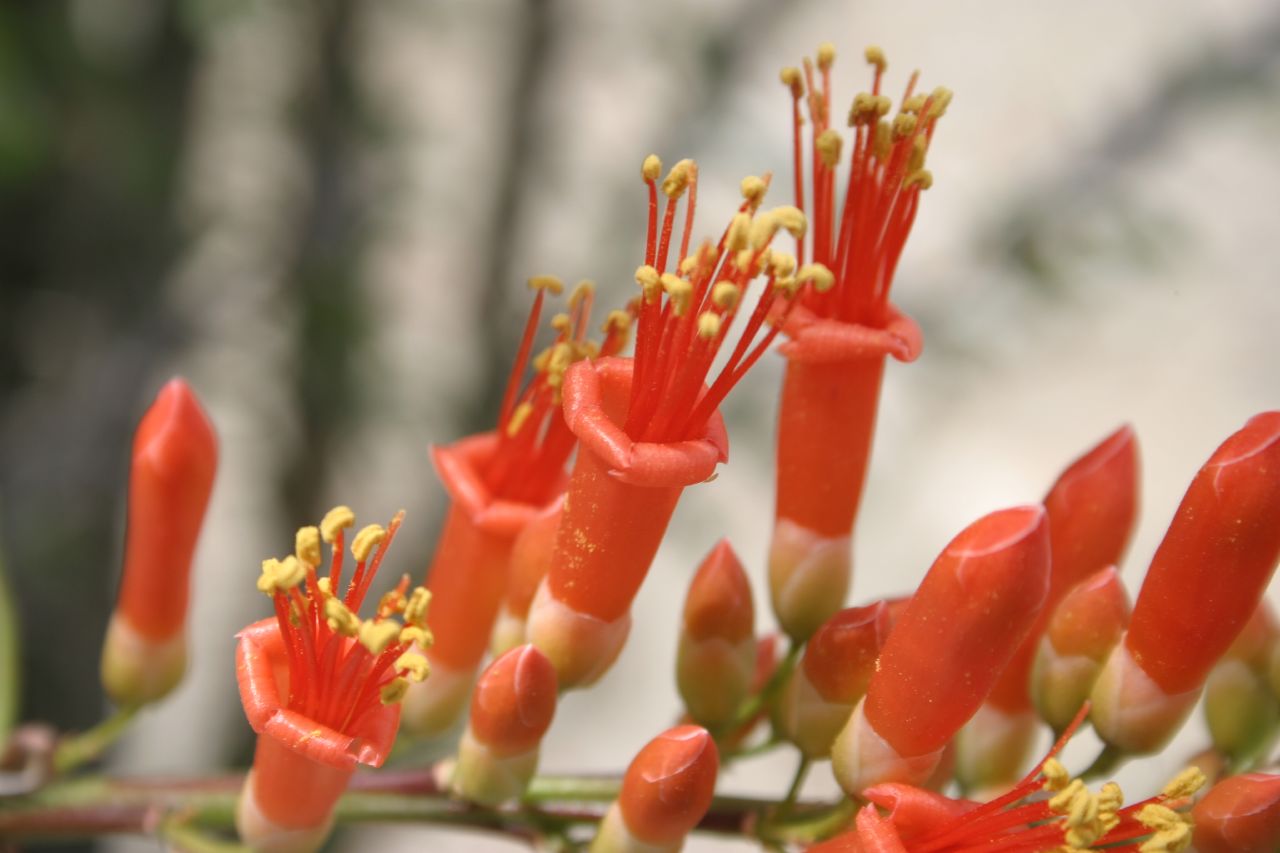
In spring the plant puts on the part most people come to see: a spike of red-orange flowers at the tip of each cane, blooming from the bottom of the slope upward as the season warms. Hummingbirds work them on their way north, and the ocotillo is one of the flowers that keeps producing even in a dry year, which makes it a reliable fuel stop rather than a lucky one. The flowers are worth a step back and a long look, because the canes are at exactly the height to catch a face, and the plant has no reason to care whether you were admiring it.
Did you know?
- NPS calls the change a magic trick: within 48 hours of rain, an ocotillo goes from what looks like a handful of dead sticks to a leafy green shrub.
- It is not a cactus. Its leaves use the ordinary daytime photosynthesis most plants use, not the water-saving night-shift chemistry of cacti, which makes an ocotillo in full leaf something of a puzzle for desert botanists.
- Ocotillo flowers are a critical fuel stop for hummingbirds migrating north through the desert in spring, in part because they bloom well even in dry years.
Common questions
Is the ocotillo dead?
Probably not. It is leafless for most of the year and looks like a bundle of gray sticks. After rain it grows a full set of small green leaves within a few days, then drops them again when the soil dries.
Is an ocotillo a cactus?
No. It is a shrub, in its own small plant family. It has thorns and can go months without leaves, but its flowers, leaves, and internal chemistry are all different from a cactus.
What visits ocotillo flowers?
Hummingbirds are the main pollinators, and ocotillo blooms are an important spring food for birds migrating north. Verdins and carpenter bees sometimes cheat by cutting a slit at the base of the flower to reach the nectar.
Why does the ocotillo have such long bare stems?
The stems are the plant's permanent structure, and the leaves are temporary. Growing leaves only when there is water to spare is cheaper than keeping them through a drought.