Utah prairie dog
The rarest prairie dog, found only in southwestern Utah. Bryce's meadows hold a reintroduced 600-animal population, asleep from October to March.

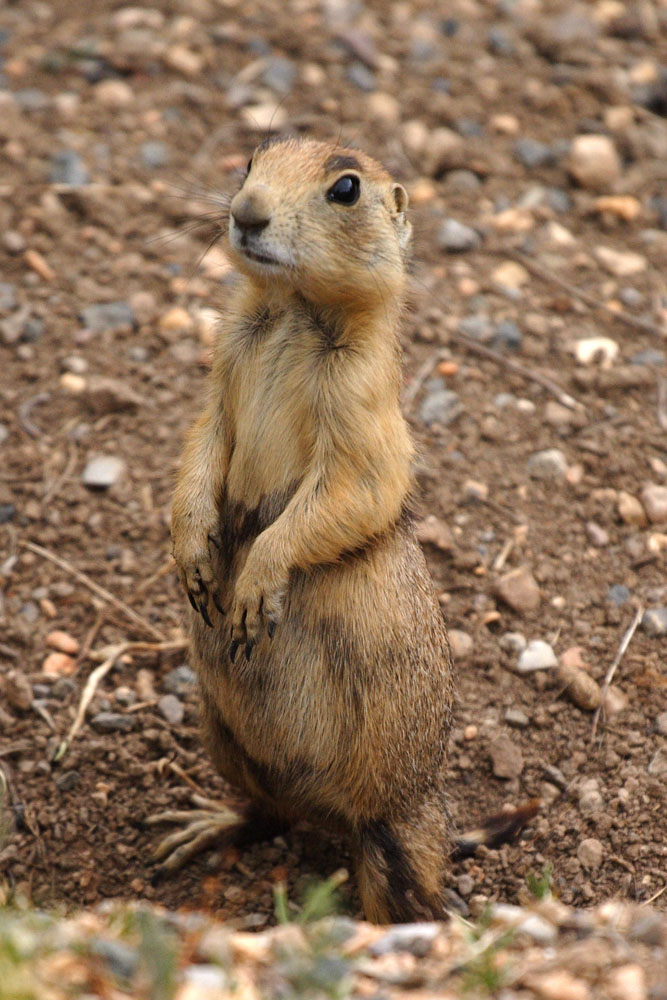

Utah prairie dog at a glance
Cynomys parvidens SY-nuh-miss par-VY-denz
- Type
- Mammal · ground squirrel
- Diet
- Herbivore
- Size
- About as long as a school ruler (12 to 16 inches / 30 to 40 cm), which is smaller than a cat and shaped like a small, low sack.
- Lifespan
- Few make it far. Fewer than 60% of pups survive their first year and only about 30% see a second birthday, so a four-year-old animal in a town is old.
- Conservation
- Threatened (U.S. Fish and Wildlife Service). Listed as endangered in 1973 and reclassified as threatened in 1984.
Eats grasses, forbs, seeds, insects
It grazes grasses and broad-leaved forbs and adds seeds and the occasional insect. Like every prairie dog, it mows a town down to stubble and eats the plants that grow back short and sweet.
Should you worry?
They will not chase you. The danger is smaller than the animal: its fleas can carry sylvatic plague, so do not touch a prairie dog, do not reach into a burrow, and stay well back from any animal that looks sick or is lying dead.
The meadow beside the park road looks empty in late October, and it is not. A Utah prairie dog town is a hole in the ground with the lights out. The animals go under in October and stay there until late March, and the grass around the mounds has been chewed down to stubble by the ones who did it.
Utah prairie dogs have the smallest range of the five prairie dogs, all of them North American. This one lives only in the southwestern corner of Utah, in a range that has shrunk by more than 90% in a century. They are 12 to 16 inches long, clay to reddish-brown, with a short white-tipped tail and a black stripe above each eye that separates them from the other four species.
A town is a set of family territories: one dominant male, several adult females, and the young of the past two years, each family with its own burrows three to six feet deep and up to fifteen feet long. Every burrow has more than one door. When something comes, the town posts lookouts. A badger or a rattlesnake gets barked at and chased. A hawk gets pushed off the mound. Then the animals drop into the nearest hole and the whole town goes quiet in a few seconds.
The barking is not noise. Prairie dogs have one of the most thoroughly decoded animal languages, with different calls for different predators and calls that appear to carry detail about what the predator looks like. Pups cannot say much until they are four or five months old. Fewer than 60% of them live to see their first birthday.
They were nearly lost. Estimates put 95,000 animals in the 1920s and 3,000 by the 1970s, after poisoning, plague and the plowing of grassland. The species went on the endangered list in 1973 and was reclassified as threatened in 1984. Bryce Canyon brought them back, and the park now counts more than 600 animals in 10 towns, in the meadows along the road near the visitor center. On a sunny summer day a few of them stand up on their hind legs to watch you.
Watch from the road. The fleas on a prairie dog can carry sylvatic plague, and an outbreak can empty a town in a season. Do not feed them, do not touch them, and give any sick or dead animal a wide berth.
Did you know?
- A Utah prairie dog colony is called a town, and each family inside it holds its own territory. The family is one adult male, several adult females, and the young of the past two years.
- Their alarm calls carry detail. Researchers have decoded different calls for different predators, and calls that appear to describe what the predator looks like, not just that one is coming.
- Only four other prairie dogs exist, all in North America, and the Utah prairie dog is the one with the smallest range. The black stripe above each eye is the field mark that separates it from the rest.
- The whole town disappears in October. Long, harsh winters on the plateau put every animal underground until late March, which is why a fall or winter visitor sees an empty meadow and no prairie dogs at all.
Common questions
Why can't I see any Utah prairie dogs in October?
Because they are underground. Utah prairie dogs hibernate from October to late March, and the meadows along the park road are empty all winter. Come back in summer and the same ground is a town again.
Is a Utah prairie dog a dog?
No. It is a rodent in the squirrel family, related to marmots and chipmunks. The name comes from the bark, which sounds like a small dog.
How is it different from other prairie dogs?
It has a black stripe above each eye, a short white-tipped tail, and it lives only in the southwestern corner of Utah. Its range has shrunk by more than 90% in the last century.
Are Utah prairie dogs endangered?
The U.S. Fish and Wildlife Service lists the species as threatened. It was listed as endangered in 1973 and reclassified as threatened in 1984, and it is still one of the rarest mammals in the United States.
Where can we see them at Bryce Canyon?
In the meadows along the road, close to the visitor center, on sunny summer days. The park's reintroduced population is more than 600 animals across 10 towns. Watch from the road and keep your distance.