Pacific marten
A tree-climbing weasel relative of the old-growth canopy, whose coastal population was feared extinct for 50 years before a trail camera caught one in 1996.
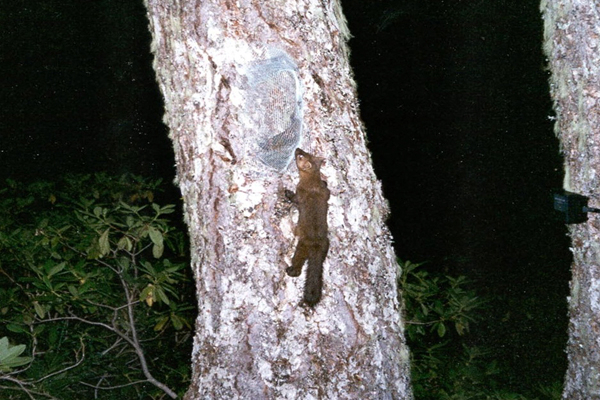

Pacific marten at a glance
Martes caurina PASS-if-ik MAR-ten; Martes caurina is MAR-teez kaw-RYE-nuh
- Type
- Mammal · mustelid
- Diet
- Carnivore
- Size
- About as long as a loaf of French bread, not counting its tail (19 to 25 inches / 48 to 65 cm body length), and light enough that a full-grown one weighs less than a housecat (up to about 4 pounds / 1.8 kg).
- Lifespan
- Wild martens typically live several years; a well-documented individual lifespan for this species is still being confirmed.
- Conservation
- Least concern (species-wide); the coastal Humboldt marten population is federally Threatened
Eats squirrels, mice, voles, birds, insects, berries, carrion
A marten hunts both on the ground and up in the branches, moving fast enough through the treetops to run down a Douglas squirrel. It kills small prey with a quick bite to the back of the neck and will also eat berries, carrion, and the odd bird's egg when meat is scarce.
Should you worry?
None. Martens are shy, fast, and avoid people; a kid is very unlikely to get close enough for it to matter. Never leave food out at a campsite, since a marten that gets used to human food loses its fear of camps.
Around Crater Lake and Lassen, the Pacific marten is doing fine, quick enough through the canopy to run down a Douglas squirrel and finish the chase with one bite to the back of the neck. On the Redwood coast, the same species spent fifty years as the marten nobody could find. Logging had taken so much of the old-growth forest between Oregon and Six Rivers National Forest that no one produced a confirmed sighting, not one, until a biologist checking a bait station in 1996 got a photograph nobody expected: a marten, alive, climbing the trunk in the dark.
That photograph didn’t lead to a comeback. Surveys since have found the coastal, or Humboldt, marten holding on in just four small patches of forest across Oregon and California, none of them holding more than a hundred animals, which is why the federal government listed the population as threatened in 2020. Fifty years of not being seen, it turns out, was the marten running out of forest, not hiding in it.
The 1996 photograph is still the whole case file on the coastal population. A grainy trail-camera print, maybe still pinned near a Redwood visitor-center desk, is the only proof for fifty years that the animal hadn’t already gone the way everyone assumed it had.
Did you know?
- The Humboldt marten subspecies survives in four small pockets of Oregon and California forest, and every one holds fewer than 100 animals.
- A marten's home range for one male can cover about 6 square miles of forest, all of it patrolled from the ground up into the branches.
- Fishers, a bigger relative in the same family, are one of the few animals that hunt martens where the two overlap.
Common questions
Are Pacific martens dangerous to kids?
No. They're shy, quick, and want nothing to do with people. You're far more likely to see a photo of one on a ranger-station wall than the animal itself.
What do Pacific martens eat?
Mostly small animals: squirrels, mice, voles, and birds, plus insects and berries when meat is scarce.
Why did people think the Humboldt marten was extinct?
Decades of logging removed most of its old-growth forest habitat, and no one confirmed a sighting for about 50 years until a 1996 trail-camera survey found one.
Is a marten the same as a weasel?
They're close cousins. Martens, weasels, otters, and fishers are all in the same family, the mustelids, but a marten is bigger than a weasel and built for climbing trees.
Where do Pacific martens live?
In old-growth and mature forest with plenty of downed logs and tree cavities to den in, from Redwood's coastal fog belt to the higher, drier woods around Crater Lake and Lassen.