Westslope cutthroat trout
Montana's state fish, a headwater trout with a red jaw slash, restored to Yellowstone and Glacier streams after nonnative stocking nearly wiped it out.
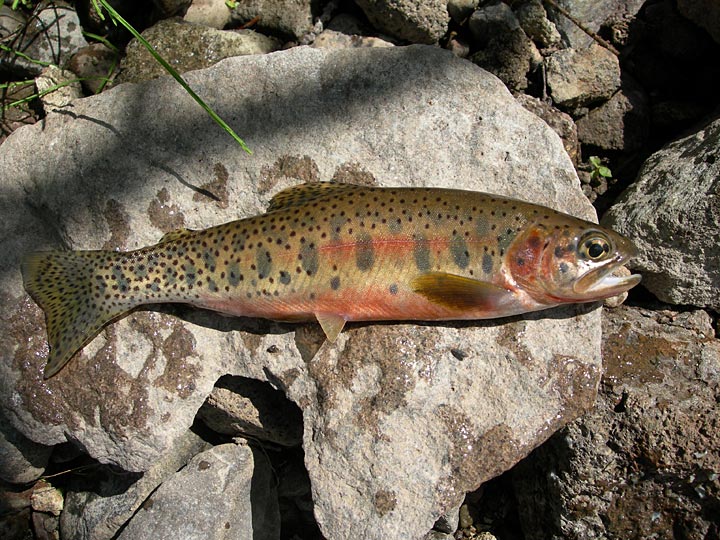

Westslope cutthroat trout at a glance
Oncorhynchus clarkii lewisi Oncorhynchus clarkii lewisi is on-koh-RIN-kuss KLAR-kee-eye LOO-iss-eye
- Type
- Fish · trout
- Diet
- Carnivore
- Size
- Most run 6 to 16 inches long, about the length of a school ruler and then some. A few grow past 18 inches.
- Lifespan
- In Montana, the oldest of 475 fish aged from 29 headwater streams was 8 years old.
- Conservation
- Not warranted for federal listing (USFWS, 2003); a Montana Fish of Special Concern
Eats aquatic insects, zooplankton, occasional small fish
It sips insects off the surface of a stream or lake and picks nymphs and zooplankton out of the current, spawning each spring in a gravel nest called a redd.
Should you worry?
None. In Yellowstone, all native cutthroat trout are catch and release only. A kid who catches one should keep it wet, unhook it gently, and let it go.
A concrete wall crosses East Fork Specimen Creek in Yellowstone’s Gallatin Range, low enough to miss from the trail, built in 2006 for one reason: to keep every nonnative and hybrid trout in the Madison drainage on the downstream side of it. Above the wall, crews poisoned the water clear of anything that wasn’t a westslope cutthroat, then stocked the creek with fish descended from the one population in the park that had stayed pure, a short, tucked-away stream now called Last Chance Creek.
It should have been simple after that. It wasn’t. By 2019, hybridized trout had worked their way upstream past the concrete anyway, breeding with the fish the wall was built to protect. In 2021, crews came back and chemically treated the lower creek a second time, killing everything in that stretch to clear the hybrids out again. A trout with a red slash under its jaw, greenish gray and speckled toward the tail, needed a wall and two poisonings just to hold one short piece of stream.
Elsewhere in the park, the same fish is getting a different kind of chance. Since 2017, biologists have released about 75,000 westslope cutthroat into three lakes on the upper Gibbon River that had never held a native-fish restoration project before. Wade into Grebe Lake on a July evening and the fish rising to a dry fly might be one of Montana’s own state fish, home again in water it lost a century ago.
Did you know?
- Westslope cutthroat trout are Montana's state fish, sharing the title, as the "Blackspotted Cutthroat Trout," with the Yellowstone cutthroat.
- The fish once ranged through nearly all of Montana west of the Continental Divide and the upper Missouri drainage, but now occupies less than 5% of that historic range.
- Before restoration work began, the only place in Yellowstone with genetically pure westslope cutthroat was one small stream, Last Chance Creek, plus a population introduced to the Oxbow and Geode Creek complex in the 1920s.
Common questions
What do westslope cutthroat trout eat?
Mostly aquatic insects and zooplankton, picked out of the current or off the surface of a stream or lake.
Are westslope cutthroat trout native to Yellowstone?
Yes. They are one of Yellowstone's native trout, though nonnative stocking and interbreeding nearly eliminated them from park streams by the 1930s.
How can you tell a westslope cutthroat trout from a rainbow trout?
Look for a red or orange slash mark under the jaw. It is greenish gray with irregular dark spots concentrated toward the tail, and people still sometimes mix it up with a rainbow trout.
Why did Yellowstone build a fish barrier on East Fork Specimen Creek?
To keep nonnative and hybridized trout from swimming upstream, so biologists could rebuild a pure population of westslope cutthroat behind it.
What eats a westslope cutthroat trout?
For cutthroat trout as a whole, larger fish and wading birds such as herons eat the young. Bears catch adults.