Arctic grayling
A native trout relative with a tall, sail-like dorsal fin, gone from Yellowstone's rivers for 80 years and only now being put back.
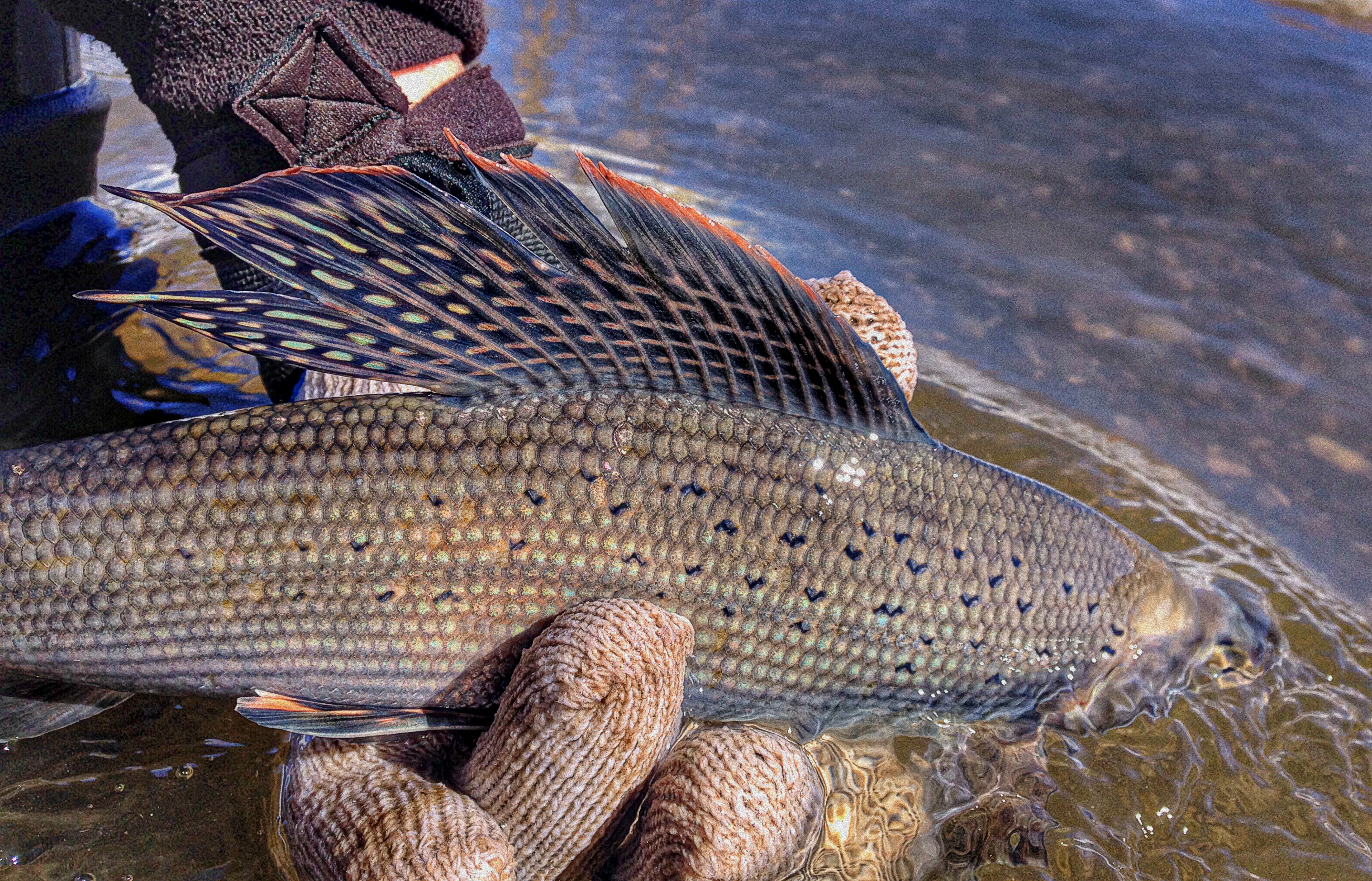

Arctic grayling at a glance
Thymallus arcticus Thymallus arcticus is thy-MAL-us ARK-tih-kuss
- Type
- Fish · grayling
- Diet
- Insectivore
- Size
- Most run about a foot long; a large one can reach 24 inches, roughly the length of a skateboard deck.
- Lifespan
- In Alaska's larger rivers it can live up to 32 years, but Montana's smaller, faster-growing river populations rarely live past 5 or 6 years.
- Conservation
- Not warranted for federal listing as the Upper Missouri River population (USFWS, 2014); a Montana Species of Concern
Eats insects, insect larvae, small fish, fish eggs
It cruises just under the surface of cold, clear water and rises to snatch insects, using its tall dorsal fin to steer and stop short in the current.
Should you worry?
None. In Yellowstone, all Arctic grayling are catch and release only.
A dorsal fin as tall as a small sail breaks the surface of Grebe Lake, fringed in red and flecked with spots that flash turquoise and orange when the light catches them right. That fin is the whole story of an Arctic grayling: no trout in the park is built anything like it.
For most of the last century, that fin was missing from Yellowstone’s rivers entirely. Arctic grayling swam into the park about 8,000 to 10,000 years ago, riding the meltwater behind retreating glaciers, but by the time anyone was counting, river-dwelling grayling had disappeared from every stream in the park. The only fish left were lake-bound, holding on in just three places: Cascade, Grebe, and Wolf lakes. When biologists released grayling into upper Grayling Creek in 2015, it was the first time a river-dwelling grayling had swum in a Yellowstone stream in more than 80 years.
Since 2017, roughly 170,000 more have gone into Wolf, Grebe, and Ice lakes alongside 75,000 westslope cutthroat, restocking water above Virginia Cascades that biologists had already cleared of nonnative fish. Every one of them is catch and release only. Hook one on a July evening and watch that sail-fin come up flashing out of the Gibbon, then let it go and watch which way it swims.
Did you know?
- Arctic grayling get their name and their fame from a single fin: a tall, sail-shaped dorsal fin, often fringed in red with iridescent spots.
- Before glaciers finished melting, Arctic grayling and westslope cutthroat trout swam into what is now Yellowstone about 8,000 to 10,000 years ago, then got sealed off from other rivers by waterfalls and watershed divides.
- At Glacier National Park, Arctic grayling are not native. Park managers stocked them directly into park waters, along with rainbow trout, brook trout, and kokanee, in a program that ran until 1971.
Common questions
What do Arctic grayling eat?
Mostly insects snatched near the surface, and sometimes small fish or fish eggs.
Are Arctic grayling native to Yellowstone?
Yes, but river-dwelling grayling disappeared from the park's streams entirely until biologists began reintroducing them to Grayling Creek in 2015.
How do you tell an Arctic grayling from a trout?
Look for the tall, sail-like dorsal fin. No trout in the park has one shaped like it.
Are Arctic grayling native to Glacier National Park?
No. They were stocked directly into Glacier's waters as part of a program that continued until 1971.
What eats Arctic grayling?
Pike and trout eat grayling. So do bald eagles, ospreys, river otters, and mink.
Where it lives
Where we got this
- NPS — An Approach to Conservation of Native Fish in Yellowstone
- NPS Yellowstone — Westslope Cutthroat Trout and Fluvial Arctic Grayling Restoration
- NPSpecies — Arctic grayling at Yellowstone
- NPS Glacier — Fish
- NPS Yellowstone — 2026 Fishing Regulations
- Alaska Dept. of Fish and Game — Arctic Grayling Species Profile
- U.S. Fish & Wildlife Service — Upper Missouri River Arctic grayling not warranted for listing
- Animal Diversity Web: Thymallus arcticus