White-winged dove
The dove whose cooing fills Tucson springs, and which carries pollen between saguaro flowers as it drinks.
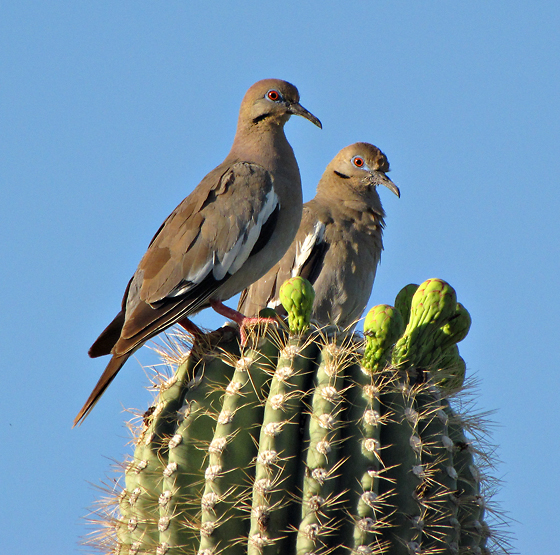

White-winged dove at a glance
Zenaida asiatica WYTE-wingd DUHV; Zenaida asiatica is zen-ay-EE-duh ay-zhee-AT-ih-kuh
- Type
- Bird · dove
- Diet
- Omnivore
- Size
- About 11.5 inches long with a wingspan near 19 inches — a bit longer than a ruler and noticeably chunkier than a city pigeon.
- Lifespan
- A strong flier that can travel long distances to water every day, which is how it lives in desert without drinking from a puddle.
- Conservation
- Not listed under the Endangered Species Act; abundant in the desert Southwest
Eats saguaro nectar, saguaro fruit, seeds, berries
It moves from saguaro flower to saguaro flower sipping nectar, then switches to the fruit a month later. Nectar and fruit together make up most of its spring and early summer diet, and both are produced in enormous numbers.
Should you worry?
No danger at all. It is a seed-and-fruit eater that wants nothing to do with people. It is worth teaching kids the sound, because they will hear it long before they see the bird.
In late spring in Tucson, the most common bird sound in the city is not a song at all. It is a hollow, three-note coo that people write down as who-cooks-for-you, repeated until it becomes part of the background, and it belongs to the white-winged dove. The bird is not much to look at until it flies: gray-brown, a little chunkier than a pigeon, with a thin white edge along the folded wing that opens into a bold stripe when it takes off. Mostly you hear them.
What the dove is doing in a saguaro forest is drinking. The saguaro’s white flowers open at night and stay open into the next morning with a pool of nectar at the base, and the doves go flower to flower taking it, which is exactly what the cactus is paying for: pollen carried from one plant to the next. That is the dove’s job, and it is a big one, because a saguaro that is not pollinated makes no fruit, and the fruit is the whole summer for a long list of animals.
The part that gets repeated wrong is what happens next. Plenty of kid-friendly sources will tell you the dove eats the fruit and plants the next generation. NPS says the opposite. Seeds eaten by a dove or a quail are completely digested, while seeds eaten by a coyote or a cactus wren pass through unharmed and get deposited across the desert. So the dove pollinates and the coyote and the wren plant. A bird that does one job well is worth more than a story that gives it two.
Did you know?
- It pollinates the flowers it drinks from, carrying pollen from one saguaro to the next in May and June. The seed job belongs to other animals: NPS says a coyote or cactus wren passes saguaro seeds intact, while a dove or quail digests them completely.
- The white patch on the wing looks like a thin white border when the wings are folded, then becomes a bold stripe in flight.
- When the wingtips clap together at takeoff, a flock of doves sounds like applause.
Common questions
How does a dove help a saguaro?
By pollinating it. The dove drinks nectar at the open flowers and carries pollen to the next one. It does not spread the seed: NPS says seeds eaten by a dove or quail are completely digested, while a coyote or cactus wren passes them unharmed.
What does a white-winged dove sound like?
A hollow, repeated coo often written as who-cooks-for-you. In spring in Tucson the calls are so constant they can drown out other birds.
Do white-winged doves stay in Tucson all year?
Most leave for the winter and return in spring, though some remain in neighborhoods and along rivers. A November visit is late for them.
Why do doves need to fly so far?
They eat dry seeds and need water daily. Their answer to desert living is strong flight: they commute to water rather than live beside it.