The morning the eagle had breakfast
Port Angeles smelled like lavender before we understood why. It was the third week of July, and nearby Sequim runs a lavender festival every summer, so half the vendor stalls we passed had bundles of it drying on strings, and the smell followed us down the street and into the van and stayed there for a day. Little kept a sprig in the cup holder until it went brittle.
Port Angeles was our base for the high side of the park. We drove up to Hurricane Ridge the first morning, out of town before the road filled, and went straight through to the top with no wait at all. The Olympics stood across the valley with snow still on them in July. Coming back down in the early afternoon we passed the other version of the day: a line of cars stopped along the ridge road waiting to get up, long enough to lose an afternoon in. We had the luck of being early.
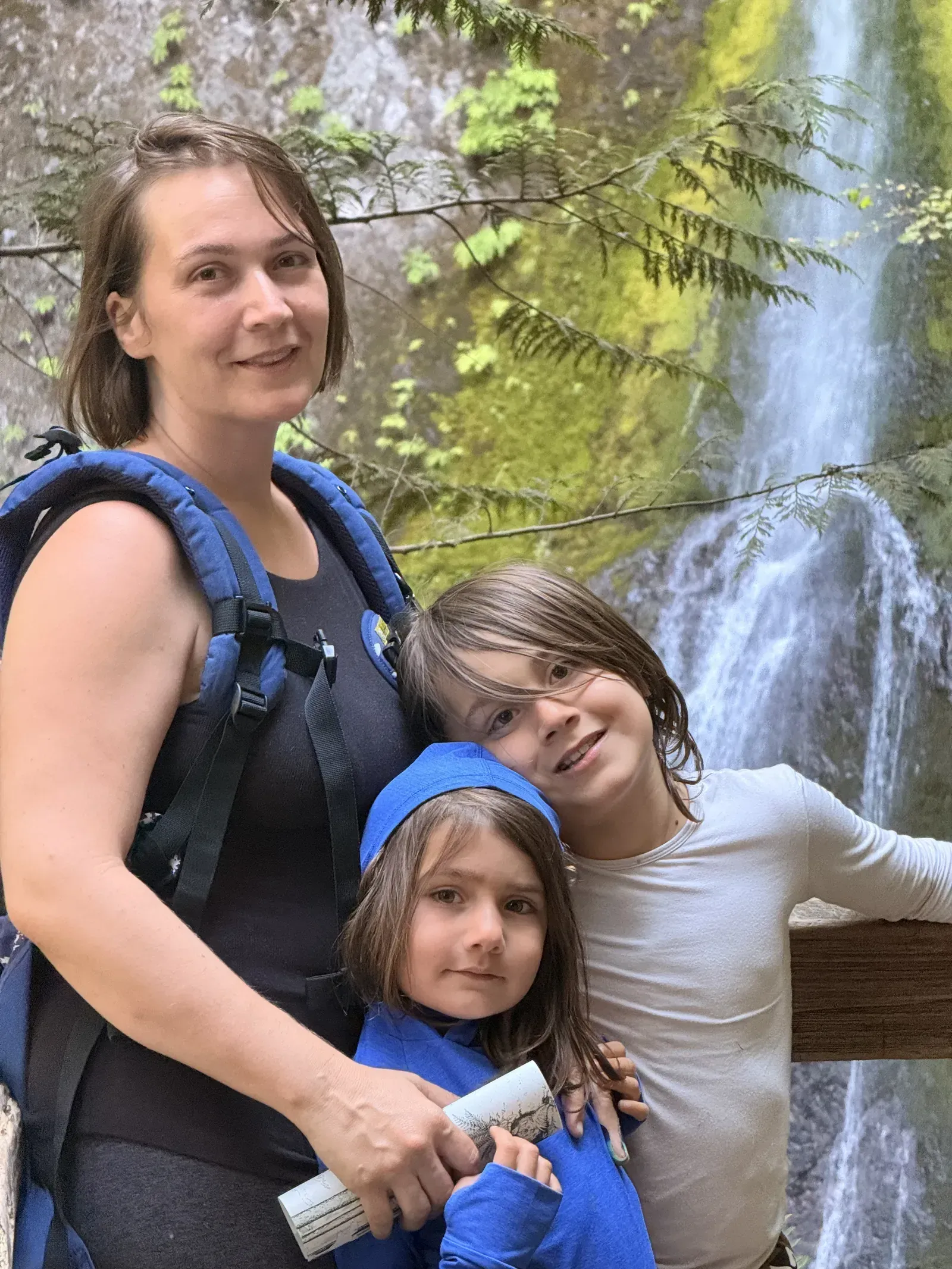
The next day we pointed the van west on US 101, the road that does the whole peninsula if you let it, and stopped at Lake Crescent to walk before the coast. The lake is long and deep and cold, glacier-cut and clear enough that you can watch the bottom fall away from the shallows. We walked up to Marymere Falls through the old growth, then sat at the lodge on the water for a crab boil. Erika had a drink and watched the light go flat on the water and said this was the part of the plan she’d keep. Big and Little went quiet over the crab, working the shells with their hands, and stayed quiet a long time, which from those two is the loudest review there is.
We took the van up to Neah Bay, onto the Makah Reservation, and camped the night on the beach. Our site sat under an eagle’s nest we didn’t fully clock until morning, a heap of sticks in the top of a shore tree. We roasted marshmallows that evening with a man from Indiana who was working his way around the whole country with no route and no end date and built a better fire than ours. We talked across it until the bag was empty and the light was gone.
In the morning three bald eagles came off the nest and started calling to each other over the water. I had my coffee and no idea what I was watching. One of them kept up a hard, high call, and then it tipped off its branch and dropped, hit the water, and came up with a fish, and carried the fish to a tree a little down the beach to eat it. I have seen eagles before. I had never seen one hunt, never seen one work for the meal and then sit down to it like anybody else. Big heard the calling and pushed the van door open in his sleep clothes and stood in the cold to watch the rest of it, and neither of us said much, because there wasn’t a version of saying it that would have added anything.
Once it settled onto the branch with the fish, the beach went back to gulls and surf. I finished the coffee. Big went back to bed. Nobody was in a hurry to make it a day.
When we did move, we spent it on Makah land, because all of it is: the Cape, the beach, the water, the road in. From the overlook at low tide we could see the lighthouse out on Tatoosh Island. The Makah Cultural and Research Center is the tribe’s own museum, and it holds the Ozette collection, thousands of cedar and wood and bone objects a mudslide sealed in wet clay some five centuries ago and kept whole until storms in the 1970s cut the bank away and gave them back. Fishhooks. Combs. A whale saddle inlaid with sea otter teeth. The room we kept circling back to was the full-size longhouse built inside, cedar-planked and dim and long, big enough that you feel how a house on this coast carried a lot of people through a lot of winter. We were quiet in there too. It is not a ruin and not a story that ended. It is the Makah’s own building, with their own museum around it, and we were guests in it. We drove to Mora for the night.
At Sol Duc we walked in to the falls, where the river folds over a ledge and comes apart, dropping in more than one place at once, and we stood on the bridge and took the spray. The hot springs we caught almost by accident. Word went around the campground that evening about open slots, and we joined the group that talked its way in. The pools smell faintly of sulfur and run warm rather than hot. Big and Little made straight for the big pool, found other kids inside ten minutes the way they always do, and swam and hollered and splashed until we called them out. It was the loudest we’d been all week, and nobody minded.
We slept at Sol Duc and made for the Hoh early, and early wasn’t early enough. By nine the line to get into the rainforest ran more than two hours. We sat in it. The Hoh earns the wait: moss hangs off every branch in ropes and sheets and the whole forest reads green the way deep water reads blue. Once the van was in the campground we didn’t move it for two days. The first day was a short walk. The second we took the Hoh River Trail, six miles out and back, after a place Erika heard about at a TED talk years ago. One Square Inch of Silence, the acoustic ecologist Gordon Hempton called it, a spot he marked deep in the valley and defended by asking that no human-made sound reach it, on the theory that one defended square inch keeps the miles of quiet around it.
We didn’t find the marker. I left the trail and pushed toward the GPS point and reached the coordinates, and there was nothing there to find, or nothing I could find. What there was, was the quiet. Off the trail the Hoh goes so silent that the silence stops being the absence of sound and becomes a thing with weight, pressing in, and it turned me around fast: the trunks stood identical in every direction, no trail-shine on the ground, no gap of daylight to aim at. I stopped. I could hear my own pulse and nothing past it. For a minute I was honestly not sure I could find my way back out. Then I picked the faint downhill the ground gave me and followed it until the trail came back under my feet. We finished the six miles together. Big and I cut new walking sticks along the way, and Little turned two lengths of wood into a pair of claves and kept a beat with them the last stretch, a small dry knock that carried a long way in air that quiet.
Kalaloch was the last stop, and we spent it low. We walked out to the Tree of Life, the spruce holding on over a hollowed-out bluff with its roots hanging in open air and no ground under the middle of it, still green, still growing on nothing. Then it rained most of a day and we stayed in and dried out and read, and after a week of parks nobody argued for more than that.
This morning we drove south off the peninsula and down the coast. There are towns along the water we want to see, and Big and Little have been promised the beach.
Where this happened: Olympic National Park · Our podcast episode