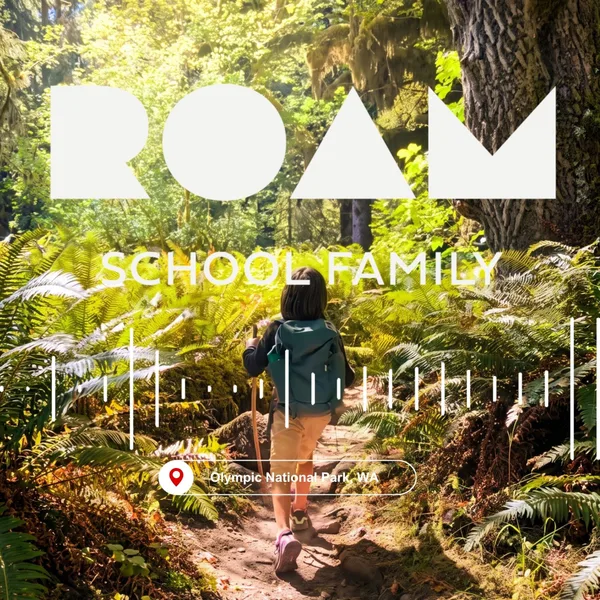
Olympic National Park | Why is quiet so hard to find?
Listen now on: Apple Podcasts Spotify YouTube RSS.com
Summary
A short written summary of the episode — not the full transcript. Press play above for the whole thing.
Before we drive in, Erika has Big and Little stop moving and count how many seconds pass before they hear something a human made. It is the same measurement Quiet Parks International uses to rate a place: not silence, but the gap between “noise intrusions” — a plane, an engine, a voice.
Big hears that gap differently than most people do. He can pick out every instrument inside a piece of classical music by ear. In a crowded restaurant, or a visitor center running its orientation film too loud, the same ears take in everything at once, and his heart rate climbs. There is no eyelid for an ear — hearing is the sense that keeps working in the dark, around corners, while you sleep, what researchers call “standing sentinel.” Big’s is a specialist’s copy of the ordinary kind.
We drive it: the Hoh Rainforest, wearing moss thick enough that trees grow new roots straight down into it; the sea stacks off Cape Flattery, the actual edge of the country; Hurricane Ridge, where an avalanche lily gets six weeks of growing season and the wind never once stops. Three ecosystems in one park, because the ocean’s moisture hits the mountains, rains itself out on the way up, and leaves the far side dry.
Sound recordist Matt Mikkelsen, executive director of Wilderness Quiet Parks at Quiet Parks International, talks us through Gordon Hempton’s One Square Inch of Silence — a single spot deep in the Hoh, marked with a red stone in 2005, protected by nobody’s law, only by whoever visits and cares enough to leave it alone. “It’s protected because people care,” Mikkelsen tells us, “not because it’s official.”
Big’s number, from the start of the drive, was six. Six seconds in a parked van before a human sound broke in. Everyone has a version of that number, whether or not anyone ever told them they’re allowed to notice it — and everyone is allowed to leave a loud room and go find a quieter one.
This peninsula — the rainforest, the coast, the mountains we drove through today — is the homeland of the Hoh, Jamestown S’Klallam, Lower Elwha Klallam, Makah, Port Gamble S’Klallam, Quileute, Quinault, and Skokomish, eight tribal nations who hold treaty rights here and still live on this land now.
The place
Olympic National Park — Three parks in one: alpine ridge, rain forest, and wild Pacific coast, hours apart on the US 101 loop.
Who helped
- Matt Mikkelsen Sound recordist, executive director of Wilderness Quiet Parks at Quiet Parks International