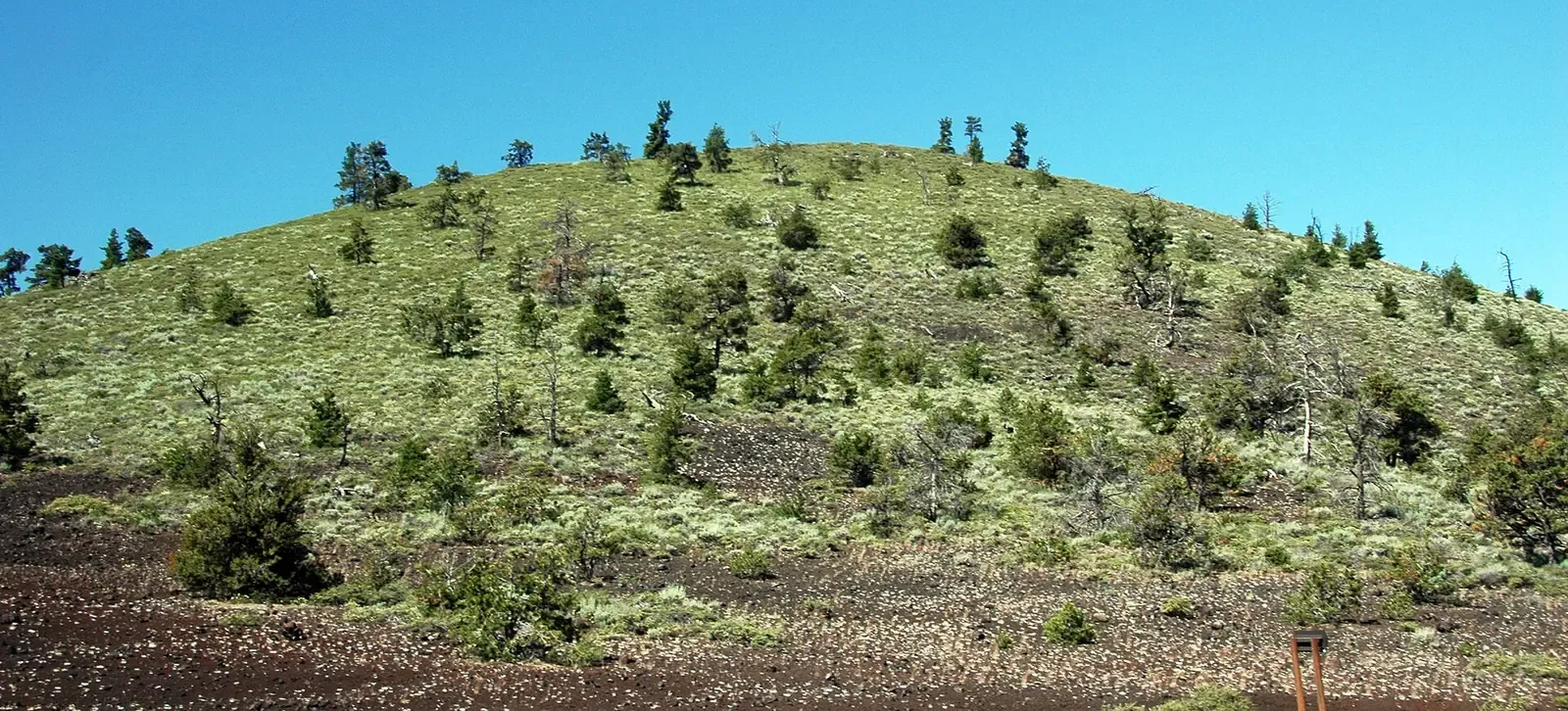
The oldest cinder cones are the ones with trees on them
This was Erika’s idea. Grand Teton is behind us and Theodore Roosevelt is ahead of us and neither of them is anywhere near here, and she argued for a few hundred miles out of our way on the grounds that we had already done Lava Beds and Lassen and Yellowstone and it would be strange to skip the one that still looks like it happened last week. The highway west out of Idaho Falls runs flat across sage and center-pivot circles for a long time before anything happens to it. The sign for Atomic City points off to the south. Forty-one people lived there at the 2020 census, on 0.079 square miles of ground. The town was called Midway until about 1950, when it renamed itself to bring the Atomic Energy Commission out from Washington. The Commission picked Idaho Falls. Atomic City has since disincorporated.
Farther on is Experimental Breeder Reactor I, where on December 20, 1951, a power plant made usable electricity out of atomic fission for the first time anywhere and lit four light bulbs with it. The published hours for this season are nine to five, seven days a week, free, through Labor Day. The door was closed. We stood in the lot a minute and got back in the van.
We came into Craters of the Moon around midday. Coolidge set this aside in 1924 as a weird and scenic landscape peculiar to itself, which is the kind of government sentence that gets written once and then never improved on.
We started at the visitor center with the Junior Ranger books. Big finished his fast. Little finished hers fast too. Neither took anything like the time I had budgeted.
A ranger talked about the caves. Two of them are open and the rest are shut for the bats. You need a free permit, and the screening is stricter than I expected: anything that has been in any underground space anywhere cannot come into these caves, washed or not. Eleven bat species are documented in the park, and about three quarters of the hibernating ones found here have been Townsend’s big-eared.
Big and Little asked her where you go to see pikas. She said she had never heard of anyone seeing one here.
After that, the film, which is mostly about what the lava does. There are two kinds and you will walk on both. Pahoehoe, said pah-hoy-hoy, means ropy in Hawaiian, and it is the smooth stuff that went over the ground like batter and stiffened in folds. Aa, said ah-ah, means hard on the feet, and the Park Service says walking on it has been compared to walking on millions of cups and saucers stacked in a loose pile.
Then the loop road, in the van.
Devils Orchard is a half mile of pavement laid through broken lava, level the whole way. Erika read every sign on it with Big and Little and they worked out loud through what each one meant. What is now called Craters of the Moon is part of the homelands of the Shoshone-Bannock people, who stored meat in the lava tubes that hold ice all year. She stopped at the trees that had grown up twisted out of the rock, and had the two of them naming the different lava back and forth against Lava Beds and Lassen and Yellowstone until it was one subject instead of four parks.
At Tree Molds the trail runs two miles out and back and the molds themselves are a full mile in. We did not get to them. A flow came through here while the trees were standing, knocked some of them down and burned them and closed over the space where they had been, so what is left in the rock is the hole a tree used to occupy. We turned around short of that and I am told they are worth the walk.
Inferno Cone is four tenths of a mile round trip and a hundred and sixty-four feet of loose black cinder going up at a pitch that makes you shorten your steps. The summit is 6,181 feet. The Park Service says the climb can be hazardous in high winds, and the wind at the top was the heaviest we have stood in this year. It came across the summit in slabs. Big threw rocks up into it and watched them get carried off the side of the mountain. Little went along the top looking for the things that broke the wind, a rock set the right way, a plant low enough to sit behind, and found several.
There is a tree up there, curved over. We sat down next to it and looked.
You can see cinder cones in every direction from that spot. Some are bare sorted rubble with nothing living on them at all. Some carry pale lichen. Some are grown over in low trees, thick enough to read as an ordinary hillside. We put them in order, oldest to youngest, by how much was growing on them.
That is a method. A flow kills everything in its path, and afterward the plants come back slowly, so the order we put them in was the order they erupted in. Geologists date the flows here the same way. Lichen goes first, at a millimeter or two of diameter in a year. Covering a lava flow takes thousands.
In August of 1969, one month after Apollo 11 landed, four astronauts flew into Arco and walked around out here: Alan Shepard, Edgar Mitchell, Joe Engle, Eugene Cernan. They were pilots, not geologists. They came to learn enough of this ground to describe the other ground correctly once they were standing on it.
We came down the cinder in long sliding steps. That is the good part. We left near sunset, and the road back to Idaho Falls runs due east. The sun went down behind us the whole way, in the mirror.
Where this happened: Craters of the Moon National Monument and Preserve