Beargrass
A mountain plant that is not a grass but a lily, sending up a tall creamy plume only every few years, its tough leaves woven into watertight baskets and hats.

Beargrass at a glance
Xerophyllum tenax BAIR-grass; Xerophyllum tenax is zeer-oh-FIL-um TEN-aks
- Type
- Plant · wildflower
- Diet
- Producer
- Size
- The flower stalk stands waist to chest high, up to about 3 to 5 feet, topped with a dense creamy plume.
- Lifespan
- A long-lived perennial. A single clump lives many years but flowers only once every several years.
- Conservation
- Not formally assessed by IUCN; common in western mountains
A green plant that makes its own food from sunlight, gathering energy over several years in a tough clump of leaves before spending it on one tall flower stalk.
Is it safe to touch?
Harmless. The leaves have fine sawtooth edges that can give a paper-cut-like nick if you pull them through your hand, so run a finger gently along one to feel the teeth rather than gripping and pulling.
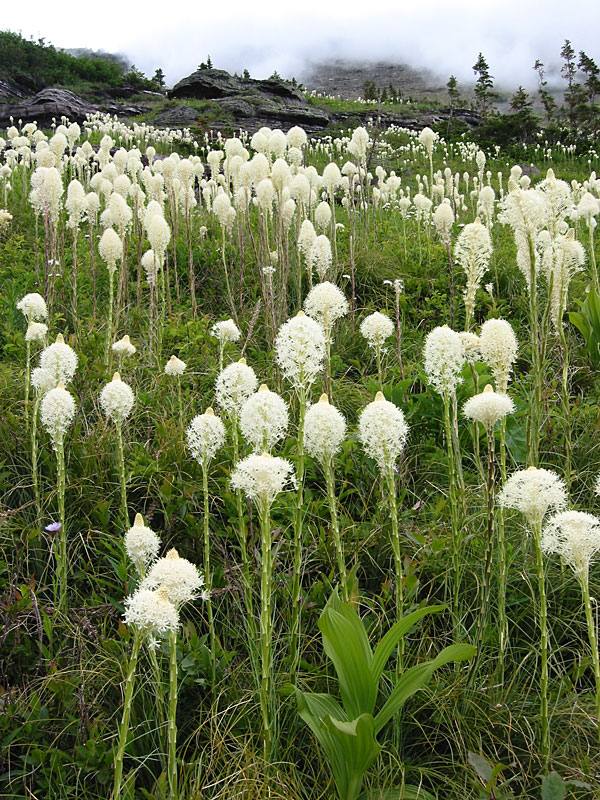
A high slope at Mount Rainier can stand thick with tall white torches one summer and carry almost none the next. The torches are beargrass, and the reason they come and go is that each plant flowers only once every several years, saving up energy in between. When enough plants happen to bloom in the same season, a whole hillside lights up with creamy plumes standing waist to chest high, and a year later that same hillside can be a plain green clump of leaves. Catching a big beargrass year is a matter of timing and luck.
The name is misleading. Beargrass is not a grass at all. It belongs to the lily family, and what looks from a distance like a single fat white flower is a dense plume of hundreds of tiny lily blossoms packed onto one tall stalk, opening from the bottom up. Down below, the part people call grass is a thick clump of long, tough, wiry leaves.
Those leaves are the reason beargrass has mattered to people here far longer than any park has existed. Northwest nations prize them for weaving, splitting and working the tough, flexible blades into baskets and hats so tight they hold water. Run a finger gently along one leaf edge and you will feel the fine sawteeth that make it strong. Then look back up at the plume. Most years this plant stands quiet, storing everything for the one summer it decides to spend it all.
Did you know?
- Despite the name it is not a grass at all. It is a member of the lily family, with a tall stalk of hundreds of tiny creamy flowers.
- A single plant blooms only once every several years, so a slope can be nearly bare of flowers one summer and covered in white plumes the next.
- Northwest peoples prize the tough, flexible leaves for weaving, making watertight baskets and hats so tightly woven they can hold water.
Common questions
Is beargrass really a grass?
No. Despite its name and its grassy leaves, beargrass is a member of the lily family. Its tall stalk holds hundreds of tiny flowers packed into a creamy plume.
Why do some years have so many beargrass flowers and others so few?
Each plant saves its energy and blooms only once every several years. When many plants happen to bloom the same summer, a whole slope can fill with white plumes at once.
What are beargrass leaves used for?
Northwest peoples weave the tough, flexible leaves into baskets and hats. Woven tightly enough, beargrass items can even hold water.