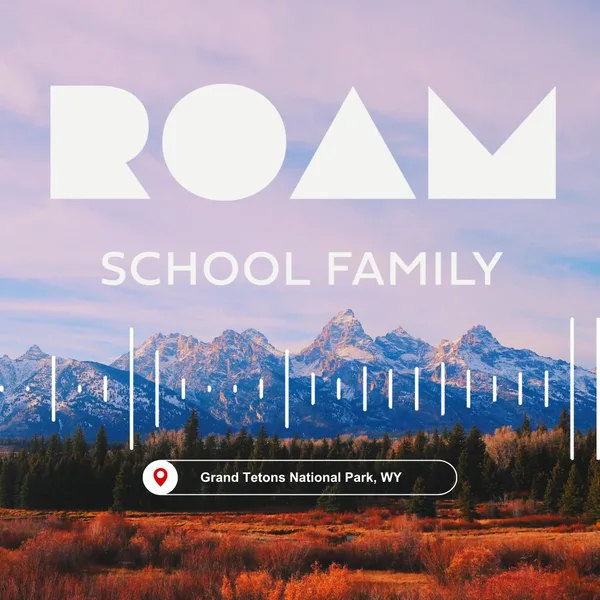
Grand Teton National Park | How do we find the way home?
Listen now on: Apple Podcasts
Summary
A short written summary of the episode — not the full transcript. Press play above for the whole thing.
The hotel room had real beds. A bathtub. An ice machine down the hall that rumbled all night like something breathing. We had come out of the park to sleep indoors, and after the lights went out, Little asked from the far bed: can we sleep in Teddy?
Teddy is the van. Twenty feet of him.
She was asking whether we could go back to the thing that moves. Jackson Hole is a hallway, and the wall on its west side rises more than 7,000 feet straight off the floor. Elk walk up into the mountains in spring and back down in fall. Pronghorn migrate too, on a route older than any road here. Portions of it are 6,000 years old. They travel up to 150 miles, and a pronghorn can run 55 mph.
A fawn does not know the way. She learns it by walking beside her mother, one valley at a time, until the route is in her legs. If a fence crosses that route with its bottom wire too low, she cannot crawl under, and the line stops. One fence. That is how thin a migration is.
Our own migration looks different. Big memorizes the campsite number so he can find his way back. Little still wants a house, with her own room and a yard. We do not know where we are going yet.
Grizzly 399 raised 18 cubs beside a highway because the animal most likely to kill a cub, a big male, would not come near people. Or so the people who watched her thought. It was less dangerous, not safe. In October 2024 a vehicle hit and killed her.
The sound room at the Laurance S. Rockefeller Preserve. Little sat cross-legged in the middle of the floor and listened to the forest for ten minutes. Big left when the thunder got loud. Leaving is allowed.
Before we left, people told us, kindly, not to drag kids this young around the country. They were wrong. The Eastern Shoshone and Shoshone-Bannock are still here, two of the 24 nations with ties to this place, where people have lived for more than 11,000 years. Mardy and Olaus Murie bought the Murie Ranch in 1945 after years of following caribou and elk. Mardy stayed 58 years.
Pico Iyer, who lost his parents’ house to wildfire, says home “would have to be whatever I carried around inside me”. The outro points listeners to the Wyoming Migration Initiative’s migration map.
Then the van door. Can we sleep in Teddy tonight? Yeah, bug. We can.
See the migration maps the episode describes
The place
Grand Teton National Park — A 7,000-foot wall of rock rising straight off Jackson Hole, with flat lake hikes and roadside views that suit short legs.