Varied thrush
A ringing single whistle from deep, shaded old-growth forest, and a bird so well hidden most visitors only ever hear it.
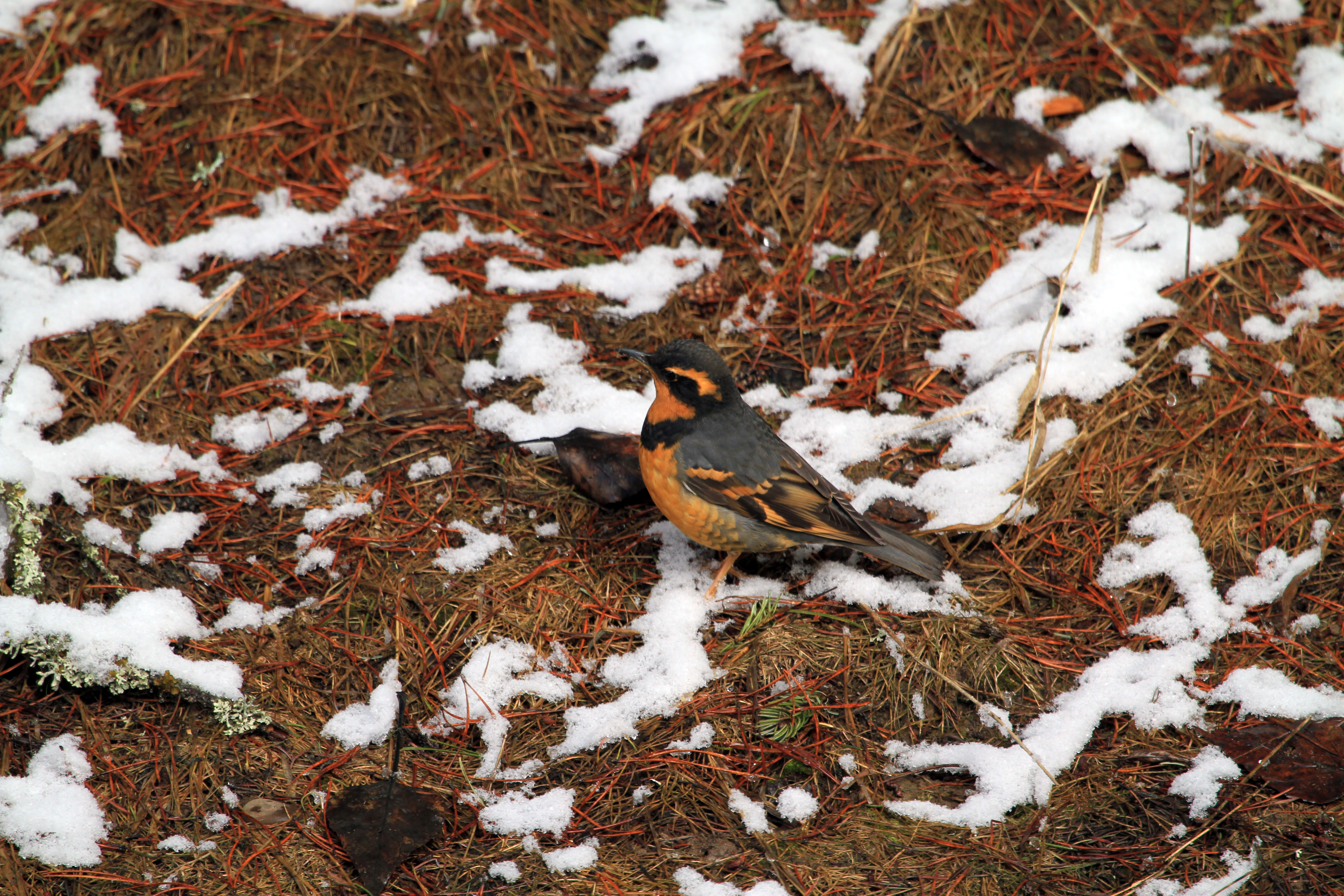

Varied thrush at a glance
Ixoreus naevius VAIR-eed thrush; Ixoreus naevius is ik-SOR-ee-us NEE-vee-us
- Type
- Bird · songbird
- Diet
- Omnivore
- Size
- About the size of an American robin but rounder and shorter-tailed, close to the length of a dollar bill nose to tail (8.3 to 10.2 inches / 21 to 26 cm), with a wingspan a bit wider than a school ruler is long (13.4 to 15 inches / 34 to 38 cm).
- Lifespan
- Most live only a few years in the wild. The oldest on record, tracked through bird banding, was at least 4 years and 9 months old.
- Conservation
- Least concern (IUCN), but listed by Partners in Flight as a Common Bird in Steep Decline — its North American Breeding Bird Survey trend shows roughly a 32% population decline from 1966 to 2019.
Eats insects, spiders, earthworms, berries, acorns
A varied thrush forages mostly on the ground, hopping across the forest floor and flipping leaves and twigs aside with its bill to expose insects and other invertebrates hiding underneath. In fall and winter it switches to berries and acorns, which is part of why some winters bring far more of them south than others.
Should you worry?
None. A varied thrush is shy and keeps to deep cover; it will not approach a person. The only real "danger" is disappointment: it sings constantly from thick branches but rarely shows itself, so a kid hunting for the bird making that sound may never actually see it.
The whistle sounds almost electronic, like something blown underwater: one long note held flat for about two seconds, a pause, then another whistle from somewhere else in the canopy on a completely different pitch. A family can stand under old-growth conifers in Olympic for ten minutes, hearing four or five of these crisscross overhead, and never find the bird making any of them. Look straight up into the wet, mossy branches. Nothing moves.
The hiding isn’t an accident. A varied thrush breeds in the densest, shadiest conifer stands, singing from deep inside the cover rather than from an open branch the way a robin might, which is why the National Park Service describes it as a species “heard much more often than seen.” It doesn’t even repeat itself to make the search easier: across one singing bout the same bird rarely holds the same pitch twice, so every whistle can sound like a new stranger calling from somewhere else in the grove.
Whether a family hears one whistle or fifty depends on a cycle nobody had mapped until a 2022 study tracked it: the number of varied thrushes wintering along the coast swings up and down on a rough two- to three-year rhythm tied to how wet the previous spring’s breeding season was, not to the size of the acorn crop, as birders had long assumed. Some winters the old-growth rings with whistles from every direction. Other winters the same grove goes quiet, and the rain that caused it fell a year before anyone noticed.
Did you know?
- A varied thrush's song is a single sustained whistle, but the bird rarely sings the same pitch twice in a row across a singing bout, which keeps neighboring males from tuning it out.
- Some years the species turns up far outside its normal Pacific coast winter range, all the way into the eastern United States and Canada, in what birders call an irruption.
- The male's orange-and-slate coloring is broken by a dark band across the chest, like a robin wearing a bib, which is one reason the two species get confused at a glance.
Common questions
What does a varied thrush sound like?
One long, ringing whistle on a single flat note, held for about two seconds, then a pause, then another whistle on a different pitch. It can sound almost electronic, like a whistle blown underwater.
Why do people call it a "ghost bird" of the forest?
Because you hear it constantly in wet, mossy, old-growth forest but rarely spot it. It sings from deep inside shaded conifers instead of an open branch.
Is a varied thrush the same as a robin?
No, though they're close cousins and similar in shape and size. A varied thrush has a dark band across its orange chest and blue-gray, not brown, feathers on its back.
Where would we actually see one at Olympic or Redwood?
Listen more than you look. Walk a shaded old-growth trail in spring and stop when you hear the whistle. It's more common to hear one than to catch it out in the open.