The hole and the sky
We left Zion in the dark and came out the east side with the tunnel behind us and the plateau opening up all the way to the horizon. The rain was done. For two days the country had been red rock and water, and then it was pale grass and long sight lines and a road that ran straight at a sky with nothing in the way of it.
The turn for Page comes after Kanab, on US-89, and the town sits above the river with a dam at one end and a lake behind it. We parked where the signs said to park and walked. Horseshoe Bend is 1.5 miles round-trip over a hardened path, and the path goes up over a rise, and you cannot see anything from the lot, which is the whole trick of the place. The parking is on City of Page land and the city charges for it; the national park pass does not cover it. Then the ground falls away, and there below is the Colorado, a thousand feet down, making a bend so nearly a circle that the rim closes on itself. The overlook is in Glen Canyon National Recreation Area. There are railings at the platform and none along the trail, and a sign that asks you to keep track of your children, which I read twice.
We stood there a while. Little wanted to know how long the river had been doing that, and I said a very long time, and she said how long, and I did not have a number that would hold up. Big counted the people at the railing and then counted them again.
From Page we took the road south, and the detour that we still talk about was a museum. The Navajo Nation is not a small thing you pass through. It is the largest land base held by any tribal nation in the United States, and it spills across three states, and the Hopi Reservation sits inside its borders, entirely surrounded by it. You can read that sentence in a pamphlet. It does something different when you have been driving through it for two hours.
The museum began with the emergence story, on video, in a small theater with the lights down. Then a replica hogan, the round house with the door facing east, built out in the open so you can walk around it and see how the whole thing is one room. Then the art and the textiles, the rugs with their patterns and their small deliberate mistakes, and the silver. And then the new Code Talkers exhibit, which is the part that stayed with all four of us. The men who built the code out of a language the government had spent decades trying to erase, and the decades it took before the country said their names out loud. Big read every panel. Little asked why anyone would keep it secret and then understood, before I finished explaining, and said oh, and went quiet.
We came out into the late afternoon and drove south to Flagstaff with the sun going down behind us.
That night we ate at Josephine’s Modern American Bistro, on Humphreys Street a few blocks off downtown. It was a proper dinner, the kind we had not had in weeks. Then the campground, and the cold, which was the first real cold of the trip. Flagstaff sits at 6,900 feet and November means business.
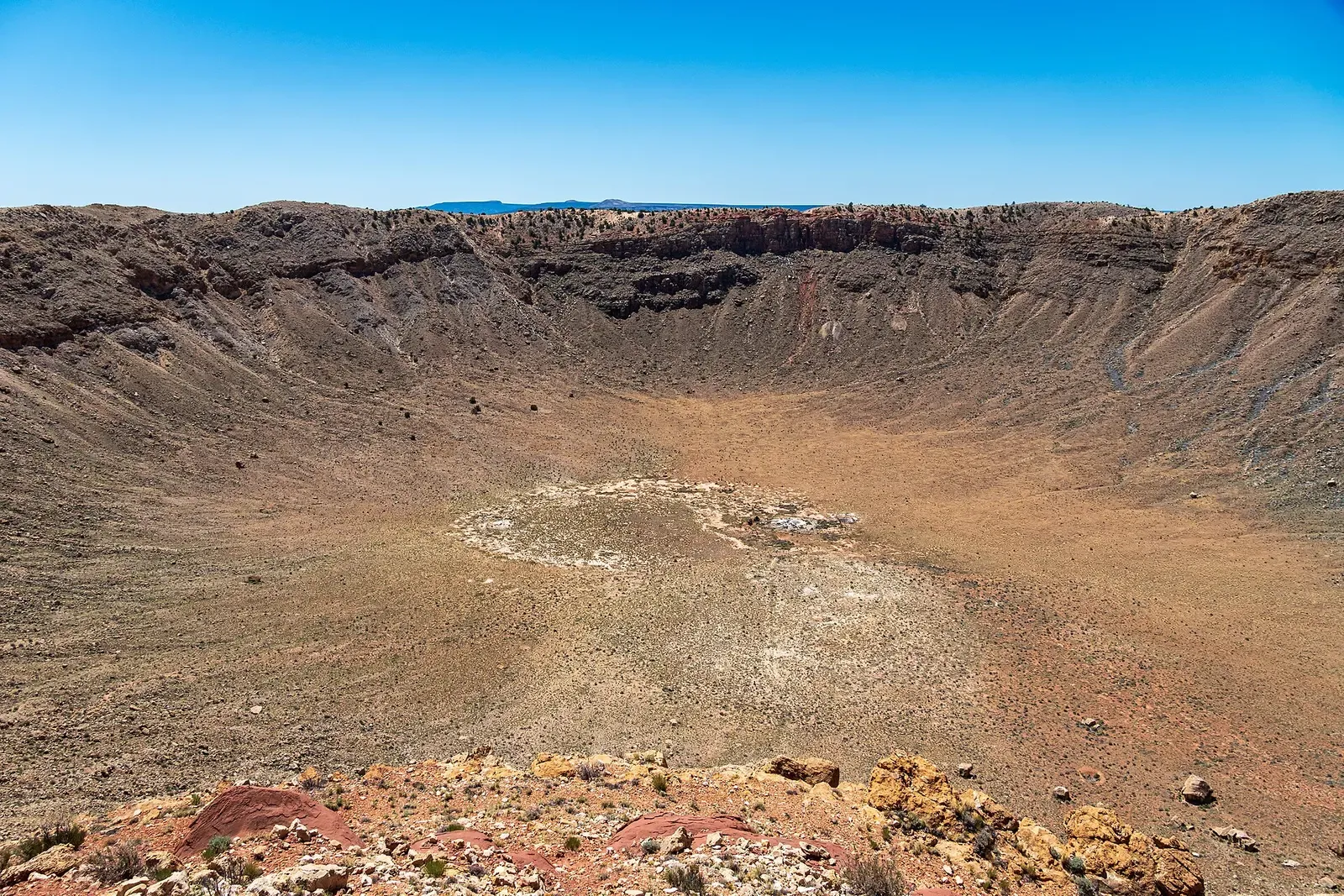
The next morning we went to Meteor Crater.
It is a strange thing to drive up to a private attraction and find one of the most important geological sites in North America behind a gate with a parking fee. The visitor center is a museum: the 4D movie, the tour along the rim, the discovery center that held Big and Little for a long time, and the cases of iron fragments the size of a fist. We did all of it. The numbers on the tour are the ones that land. Fifty thousand years ago a rock perhaps 150 feet across came in at 26,000 miles an hour, exploded with the force of two and a half million tons of TNT, and left a bowl three-quarters of a mile across.
The land story is the part I did not expect. The crater is not a park. Daniel Moreau Barringer, a mining engineer from Philadelphia, was sure there was an iron meteorite under the floor and filed a mining claim; in 1903 he received a 640-acre land patent signed by Theodore Roosevelt. He spent the rest of his life digging for something that had vaporized on impact. The mining venture failed. The crater stayed in the family, and the Barringer Crater Company still owns it and runs the visitor center today. In 1967 it was designated a National Natural Landmark. The bowl is 550 feet deep now, less than it was, because a lake formed in the bottom and the sediment settled.
We had errands in town after that, the kind that pile up when you have been living out of a van for months, and then we drove up to Lowell Observatory in the dark.
Lowell is on a hill above town, and the museum is small and good, and the 7:45 planetarium show was the best hour of the week. The presenter took us across a clear sky: Cassiopeia in her chair, the Little Dipper pouring nothing, Aquarius, Pisces, Capricorn, and Jupiter, bright and unmistakable and sitting where he said it would be. The room made the noise a room makes when everyone finds the thing at once.
After the show everyone went outside to the telescopes and the line formed and nobody complained about it. It was cold, properly cold, the kind that gets into your shoes. We stood in it for forty minutes with our hands in our pockets and the sky doing its slow turn overhead. When we got to the front, the volunteer said look, and stepped back, and there was Saturn in the eyepiece. The rings were there. That is the whole of it: the rings, a small bright thing with a line through it, and four of us taking turns at a ladder in the dark.
Little went last. She looked for a long time, and then she stepped down and said nothing at all, and we walked back to the van in the cold with the whole sky over us and the town lights below.