The gate and the gift
The gate opened at eight. We were at it at 5:20, engine off, fewer than twenty cars in line in the dark. I had been up since 4:30 for no reason except that sleeping in the parking lot of a missile range did not seem like the day for it.
We had been driving toward national parks. This was the detour. Trinity Site sits inside White Sands Missile Range and opens to the public on the third Saturday in October, and this was that Saturday. The rest of the year it is closed because it lies inside the impact zone for military testing. We had looked at the calendar and moved everything else around it.
So we sat. The sky came up slowly and without much color in it. Then it was light enough to see the line. The line was short.
The week before had handed us things.
We were on the field on the tenth for a morning of the Balloon Fiesta, which that year ran October 3 to 11. We caught one morning of it and no more. The balloons went up in waves, and the field emptied out behind them, and by the time the last one was a dot we were walking back to the van with the rest of the crowd.
Old Town on the eleventh. This is Tiwa Pueblo country, with Sandia and Isleta the pueblos closest to the city. The Rattlesnake Museum took a morning: Big read every placard in the place, top to bottom, and Little sorted the tumbled rocks by color until they were in rows.
The ride was on the twelfth, and it was not part of the Fiesta. We had a six a.m. entry at the balloon grounds. We went up with a pilot and stayed up about an hour. The city came apart under us into streets and yards and then into the river and then into open ground with nothing on it. We came down in a residential construction area, on dirt. The crew packed the balloon and gave a brief toast. Then the ride back to the fairgrounds and lunch at a Mexican place.
We camped on the Rio Grande just north of Taos. The river there is narrow and fast. A man nearby had two rainbow trout tied in the water on a stringer, alive, moving against the current. He saw Big and Little watching and he brought the fish up on the bank and showed them what to do with a trout. How to hold it. Where the knife goes. What to take out and what to leave. He cooked it there at his site, and then he walked the cooked fish over to the van and handed it to us.
He had not asked for anything. Big and Little went back to our table and folded paper for a while, and then they carried a handful of origami ninja stars down the row to his site. That satisfied everyone.
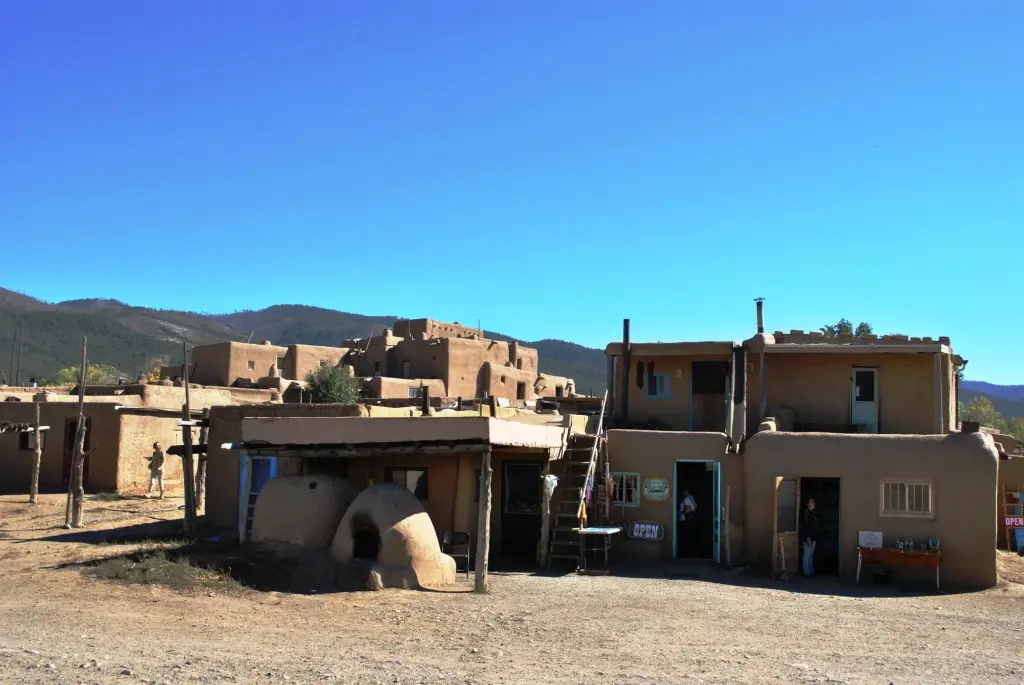
We went to Taos Pueblo the next day. Early afternoon, the sun high and the adobe the color of the ground it came from. People live and work here. It is not a set. They have lived here for more than a thousand years, and the tour covers that thousand. It has been a World Heritage Site since 1992.
We ate lunch first, at the home of a local owner. Chili, and Erika’s and my first fry bread in New Mexico. The chili was what Big and Little talked about afterward.
The hours are 9 a.m. to 4 p.m. Guided tours start at 9 and run about every twenty minutes, and we joined one. The guide was a Pueblo member, and he took the last thousand years and did not skip the parts with flags in them: the Spanish, the Mexicans, the Americans, each one arriving and each one with its own idea about who the Pueblo belonged to. He told it from the inside, which is a different thing from a plaque.
The rules are on the sign and they are plain. Personal photography is allowed. No photographs of tribal members without permission.
Old Town in Santa Fe, then the hill up to Los Alamos and the Bradbury Science Museum, which covers the Manhattan Project and the laboratory as it is now. We stood at the historic gate. Then a timed ticket at Meow Wolf, which took the rest of the afternoon.
Socorro was the last stop before the gate. A self-guided bike tour, the plaza, the playground, the public library. We stayed at the Rodeo in Socorro.
And then it was Saturday.
The line moved at eight and we drove about nineteen miles through the desert to a parking lot half a mile from ground zero. A bus took us out to the McDonald Ranch House, where the plutonium core was assembled and then carried to the tower. The landmark includes the ranch house, the base camp, and ground zero. The lead archaeologist for the site was there. He answered questions about the ranch house and offered to help with a podcast we hope to make about the visit. The rooms are small. The core was put together in one of them and then driven across the ground we had just driven across. The bus ride out was quiet. The desert through the windows was pale and flat, with the mountains far off and nothing moving except the bus.
We rode back and walked to ground zero.
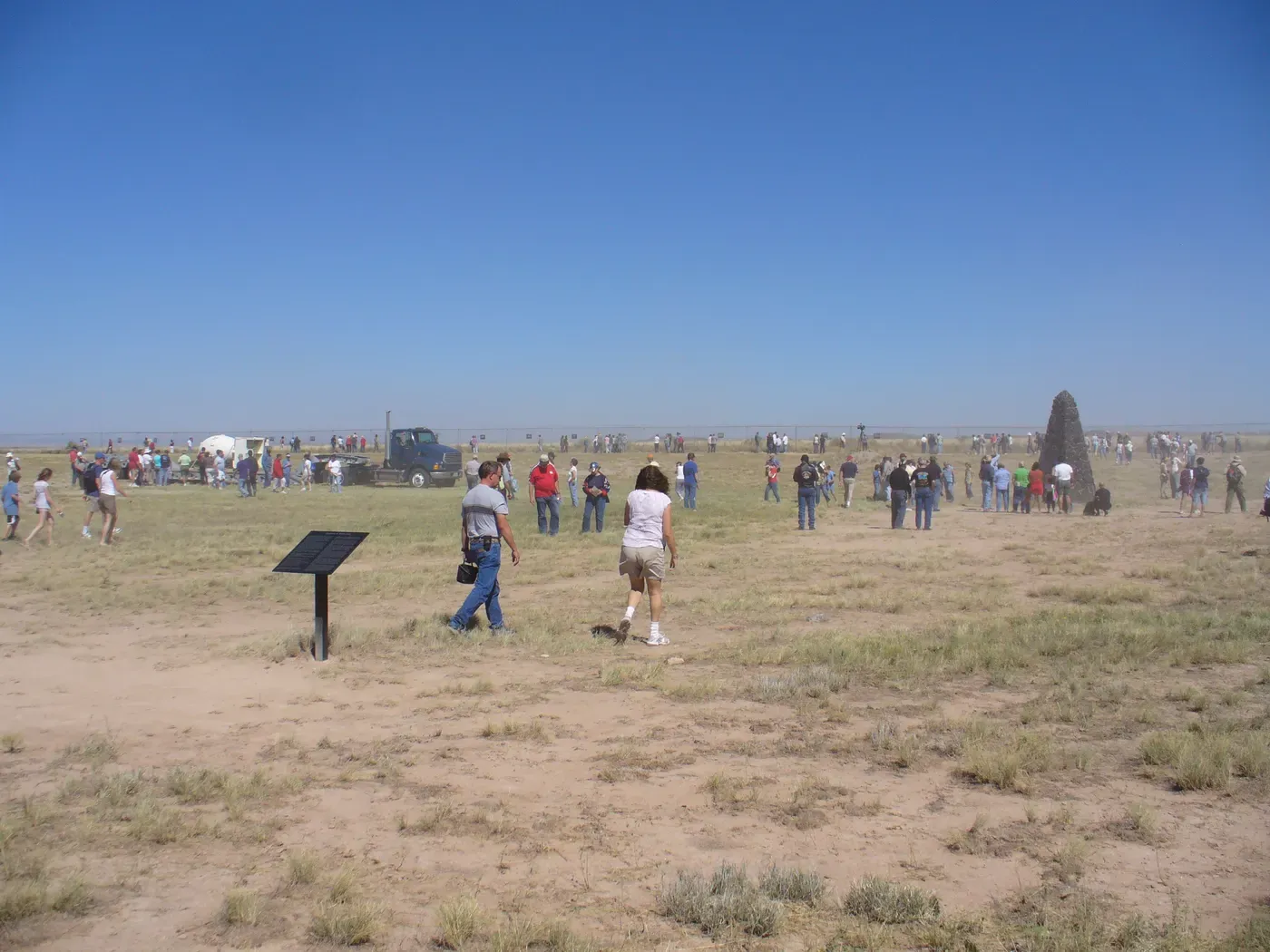
There were tents. There was a plaque. There was the obelisk, made of lava rock, standing on flat ground with the mountains far off on all sides. There was a long line for photographs, and the people in it were quiet in the way people are quiet at a grave they do not have a claim on. I waited in that line while Erika, Big, and Little worked the tents and talked to people around the site.
Along the fence ran a row of photographs on stands, frames of the thing from the first fraction of a second out to thirteen seconds, the fire and the dust and the black column going up. You look at those and then you look up and there is the same ground and the same sky.
We found pieces of trinitite in the dirt, green and glassy, sand that had been melted and had cooled where it landed. We took them to the science tent and a man ran a Geiger counter over them. The needle moved and he told us what it was saying. Then we washed our hands and got back on the bus.
Trinity is inside a working missile range. The security was visible everywhere, and it did not let you forget where you were. Demolition testing still happens out there on the ground beyond the fences.
On July 16, 1945, at 5:30 in the morning, the first atomic bomb was detonated here, on a steel tower a hundred feet tall. The missile range had been established a week earlier. The tower was gone afterward. The crater in the sand was half a mile across. Sand in the crater had been fused by the heat into a glass-like solid, the color of green jade, and the Park Service says the material was given the name trinitite. The Army put the obelisk up in 1965.
The test was not announced. The people living downwind in the Tularosa Basin, which is Mescalero Apache homelands, saw the light and heard the sound and were not told what had happened. They have been asking for recognition and for care ever since. The Tularosa Basin Downwinders Consortium works for those families now.
Just outside the gate, a few people stood with signs. They were not there to welcome anybody. They were tired of buses coming to look at the place where it happened, and they were collecting money for the downwind cause. We drove past them.