Twenty-Nine Palms Band of Mission Indians
A nation today
Background
Early surveys in the 1850s noted native settlements at the Oasis that should have become reservation land. In 1875 the state of California filed a claim on the whole Oasis, and then sold it to the Southern Pacific Railroad without the permission or knowledge of the people living there. When an Indian Agent surveyed for a reservation in 1909, the United States Land Office told her the state had already claimed the land and sold it to the railroad, so no reservation could be established at the village. The 1895 executive order that did come created 160 acres of rock and sand, a mile south of the Oasis in the rocky foothills, on land with no water that no one ever farmed, and the people stayed at the Oasis. Chemehuevi led by Jim Mike and Serrano led by Jim Pine lived at the Oasis together and intermarried, and the descendants of Jim Mike and his brother William Mike make up the Band's membership today. William Mike's oldest son, Lily Mike, led the band in the twentieth century, joined the Mission Indian Federation, and in the 1930s mounted an attempt to win back the Oasis land, which failed once ownership had moved from the railroad to private owners.
Visit and learn
Twenty-Nine Palms Band of Mission Indians's own site
Tribal lands have their own laws. Check the nation's site before you visit.
Parks on its homelands
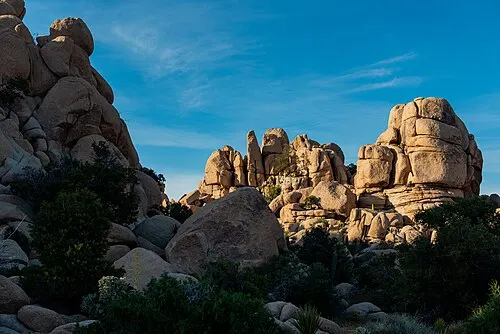
Joshua Tree National ParkThe Twenty-Nine Palms Band of Mission Indians is descended from the Chemehuevi, whose territory once covered parts of California, Utah, Arizona, and southern Nevada. Its 1895 reservation was established at Twentynine Palms, and the tribe says it has a strong relationship with the desert country that includes Joshua Tree National Park. Source
Programs
Tribal Administration
The Administration handles the day-to-day needs of the tribal membership and the Tribe's government functions, and runs Tribal Welfare, Tribal Enrollment, Tribal Archives, Finance, Grants Administration, Economic Development, Tribal Law and Policy, Environmental Protection, Cultural Resources Management and Historic Preservation, Emergency Management, and the Department of Public Safety. Offices are at 46200 Harrison Place, Coachella, California, open Monday to Friday, 9am to 5pm, closed on tribal and federal holidays.
Historic Preservation Office
The Tribe's Historic Preservation Office keeps weekday business hours and closes on tribal and federal holidays.
Sources
- https://www.govinfo.gov/content/pkg/FR-2026-01-30/html/2026-01899.htm
- https://www.29palmstribe.org/about/tribal-history/
- https://www.29palmstribe.org/departments/tribal-administration/
Checked September 2026.