Soboba Band of Luiseño Indians
A nation today
Background
Before Mexican and American settlement the people of Soboba were almost self-sufficient, farming land irrigated by surface water from the San Jacinto River, from two of its tributaries, Poppet and Indian Creeks, and from more than forty perennial springs, which together sustained gardens, animals and orchards. The Band's account calls its people the Sovovatum. Mission San Luis Rey established Rancho San Jacinto in about 1815 as its furthest cattle ranch and brought Luiseño people in as ranch labor, and some of the valley's Cahuilla inhabitants who were present at the time intermarried with them. When the missions were secularized the rancho was granted in 1842 with a stipulation that the new owner not prejudice the Indians established on the land, but from 1868 the heirs began selling off pieces, and by 1880 the people of Soboba held no legal claim to their land or their water. An executive order from President Chester Arthur on June 19, 1883 set aside 3,172 acres including the Soboba village and the adjacent hills. The reservation now runs to nearly 9,000 acres, of which roughly 600 are residential, and an elected five-member tribal council governs it.
Where they were, and where they were put
- From
- The San Jacinto Valley. The Nation's own words: "Since time immemorial the descendants of the Soboba people are those whom have lived on and occupied the land that is presently known as the cities of San Jacinto, Hemet, Valle Vista and Winchester."
- To
- The same place, held without title for 31 years and finally in trust.
- Year
- 1911
The people farmed on surface water from the San Jacinto River, the Poppet and Indian Creeks, and "more than forty perennial springs". The 1842 grant of Rancho San Jacinto Viejo to Jose Antonio Estudillo carried a stipulation that the new owner "shall not in any manner prejudice the Indians who are established on said land". From 1868 the Estudillo heirs began selling, and by 1880 most of the rancho lands were gone. The Nation litigated the title, and Byrne v. Alas in 1888 followed the 11 September 1911 deed recorded in Riverside County by 51 landowners.
Source: Soboba Band of Luiseno Indians, official site (read 2026-10-03)
Visit and learn
Soboba Band of Luiseño Indians's own site
Tribal lands have their own laws. Check the nation's site before you visit.
Parks on its homelands
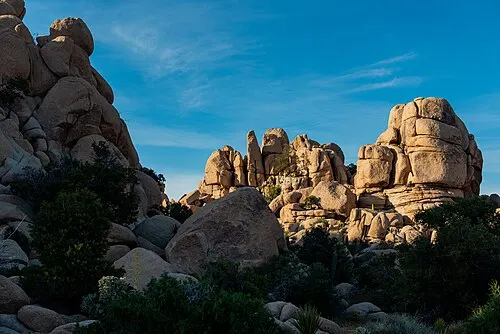
Joshua Tree National ParkThe Soboba Band of Luiseño Indians says its people have inhabited the land around San Jacinto, Hemet, and Valle Vista since time immemorial, and the reservation lies at the base of the San Jacinto Mountains. The band's members descend from both Cahuilla and Luiseño ancestry. Source
Programs
Cultural Center and Research Library
It began in 2003 as an Administrative for Native Americans grant and was originally called Cham-Mix Poki, house of our culture, housed in modular trailers near the Tribal Hall. In 2009 it was restructured and renamed. It holds documents, newspapers, photographs, books, audiovisual materials and three-dimensional objects, and in 2020 it took a two-year Institute of Library and Museum Services grant to steward and digitize large parts of the collection. The Band's page notes the center was operating with limited access during COVID-19 restrictions.
Cultural Resource Department and THPO
Established in 2004 for the preservation of tribal cultural resources and historic properties within the Luiseño and Cahuilla traditional use areas. Staff consult with local, state and federal agencies whose permits could affect those resources, and the Tribal Historic Preservation Officer carries out the state historic preservation officer functions within tribal lands, including Section 36 CFR Part 800 and Section 106 of the National Historic Preservation Act, and identifies and nominates properties to the National Register.
Cultural Garden
Formally established under the Cultural Resource Department in 2018 and still managed by it. The garden is split into native plants on one side and seasonal fruits and vegetables on the other, and the harvested produce goes to Soboba Tribal Elders. The Band's page describes it as a food sovereignty project used in programs with other tribal departments.
Sources
- https://www.govinfo.gov/content/pkg/FR-2026-01-30/html/2026-01899.htm
- https://soboba-nsn.gov/about-us
- https://culture.soboba-nsn.gov/history
Checked September 2026.