Ramona Band of Cahuilla
A nation today
Background
The Band's history page gives the pronunciation Kah-we-ah for Cahuilla and the translation "masters" or "powerful one," and divides the people into Desert, Mountain and Pass bands and into two moieties, the Wildcat and the Coyote, made up of roughly a dozen patrilineal clans, each with its own name, territory and common ancestry. Until about 1580 the Anza Valley lay beside a larger body of inland water called Lake Cahuilla. When that lake evaporated it increased the desert character of the valley. A Spanish expedition led by Juan Bautista de Anza came through in 1774 looking for an overland route from Sonora to Alta California, and the valley was renamed from Cahuilla Valley in 1926. The Red Hawks hand crew, formed in 2012, does fuels reduction and fire suppression for BLM, BIA and USFS lands across California, and the Band's Environmental Department runs entirely on grants.
Visit and learn
Ramona Band of Cahuilla's own site
Tribal lands have their own laws. Check the nation's site before you visit.
Parks on its homelands
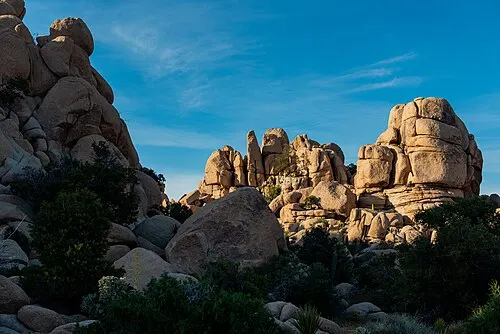
Joshua Tree National ParkThe Ramona Band of Cahuilla says Cahuilla people have lived in the Anza Valley for more than two thousand years and that the band's members descend from the Apapatchem Clan. The reservation was established in 1893. Source
Programs
Red Hawks hand crew
Established in 2012 and in continuous service since, the crew's stated goals are to protect and preserve the Band's natural resources, create a safer environment on the reservation and surrounding areas, and assist those in need. Its members hold Firefighter 2 certification and most have advanced qualifications such as sawyer and EMT. It has been dispatched across California through the BIA's Southern California Agency task force for fire suppression, incident mop-up and burned area emergency rehabilitation, and the Band says it wants to develop the crew into a Type II hand crew available anywhere in the United States.
Environmental Department
The department's stated purpose is to balance the environmental needs of the present against future development and protection of the Tribe's lands. It is an entirely grant-funded department, and staff work routinely with federal, state and tribal partners to bring in the resources to implement environmental projects.
Community park
In 2012 the Tribe partnered with the Bureau of Indian Affairs to turn an undeveloped parcel of reservation land into a community park, because the tribal community had no playground or park facilities on the reservation. Phase I, an outdoor basketball court, is complete. Phase II, a playground and picnic gathering area, is planned once more funding is secured.
Sources
- https://www.govinfo.gov/content/pkg/FR-2026-01-30/html/2026-01899.htm
- https://ramona-nsn.gov/about/history/
- https://ramona-nsn.gov/departments/rbc-red-hawk/
- https://ramona-nsn.gov/departments/epa/
Checked September 2026.