Nez Perce Tribe
A nation today
Background
At the 1855 treaty negotiations at Walla Walla the Tribe insisted on retaining its inherent rights and won about 7.5 million acres as its exclusive reservation. Once gold was found, mass trespass and theft took place inside that reservation, and a second treaty in 1863 cut it to about 750,000 acres, with a third in 1868 dealing mainly with timber trespass. The federal government stopped making treaties in 1871, then imposed the Allotment Act, sending a surveyor to assign parcels to individual members and declaring the remainder open for non-Indian settlement. An 1893 Agreement locked that arrangement in, which is why today's reservation is what the Tribe calls a checkerboard, with tribal allotments intermingled with non-Indian parcels. Through every one of those steps the Tribe kept the right to fish at its usual and accustomed fishing stations and to hunt, gather and graze livestock on open and unclaimed land outside the reservation boundary. Government dates to a constitution the Tribe adopted in 1948 and runs through a nine-member elected executive committee, the NPTEC, alongside a General Council of adult citizens that meets twice a year to review the committee's reports. Nimiipuu is the Tribe's own name for its people and Nimipuutímt for its language, and the greeting the Tribe puts at the head of its Culture page is ta'c 'éetx papáyn, welcome.
Visit and learn
Tribal lands have their own laws. Check the nation's site before you visit.
Parks on its homelands
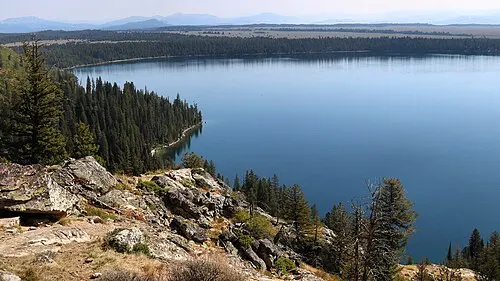
Grand Teton National ParkThe Nez Perce are among the peoples NPS says were harvesting the Grand Teton valley's seasonal riches when Europeans arrived, and the park says these people camped near rivers and lakes, mostly in the northern part of what is now the park. Source
Programs
Niimiipuu Language Program
The Tribe's language program publishes the writing system its Advisory Board of Elders chose, explaining that Nimipuutímt is written without capitals except for English personal names, that it has five vowels that can be short or long, and that a stress mark goes over the vowel that carries the emphasis. The page teaches each vowel with practice words, including háham for men and lamáta for Whitebird, Idaho. The Tribe also points to nimipuutimt.org for more.
Department of Fisheries Resources Management
The department runs on almost 200 employees and an annual budget over $20 million, and its work area covers north-central Idaho, northeastern Oregon and southeastern Washington, matching the Tribe's homelands. It runs the Nez Perce Tribal Hatchery, the Clearwater River Coho Restoration Project, the Lostine River Supplementation Project, the Johnson Creek Artificial Production Enhancement and the Fall Chinook Acclimation Project, and co-manages the Kooskia and Dworshak national fish hatcheries. Its Harvest Management Division sets seasons and monitors harvest on the basis of the fishing rights the Tribe holds under the Treaty of 1855.
Sources
- https://www.govinfo.gov/content/pkg/FR-2026-01-30/html/2026-01899.htm
- https://nezperce.org/about/history
- https://nezperce.org/about/
- https://nezperce.org/government/general-council/
- https://nezperce.org/about/culture/
Checked September 2026.