Morongo Band of Mission Indians
A nation today
Background
The Band's first reservation was 640 acres, established in 1865, and for more than a decade the land was known as the Malki Reservation before a presidential executive order of May 15, 1876 created the Morongo Indian Reservation. The reservation now spans nearly 40,000 acres of ridgelines, canyons and open space, with cattle still grazing the backcountry as they have for decades, and the Band says it was the first tribe in the nation authorized by the Federal Energy Regulatory Commission to own a participating transmission line, through Morongo Transmission LLC, which it credits with tripling the capacity of 48 miles of power line. Tribal Members elect a seven-member Tribal Council, and the Band is organized across 17 government departments. Its cultural heritage site publishes language learning under three of its own names, Cahuilla 'ÍVILLU'AT, Cupeño PÁ'ENEXILY and Serrano MAARRÊNGATWICH, all of which the Band places in the Uto-Aztecan family, and carries the statement Mu Chemqal, we are still here.
Visit and learn
Morongo Band of Mission Indians's own site
Tribal lands have their own laws. Check the nation's site before you visit.
Parks on its homelands
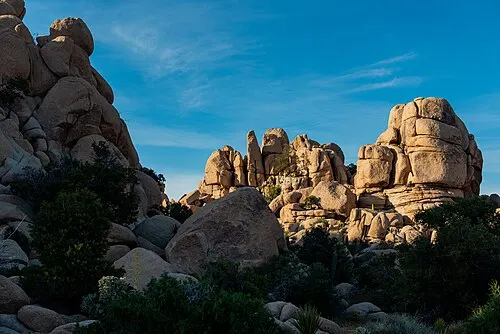
Joshua Tree National ParkThe Morongo Band's own history says its name is believed to come from the Serrano word Marringa and says the Serrano who came down from the north joined the Cahuilla already living in the San Gorgonio Pass. The band sits in traditional Cahuilla territory at the foot of the San Gorgonio Mountains. Source
Programs
Language program
The Band's cultural heritage site offers learning pages for three languages, Cahuilla 'ÍVILLU'AT, Cupeño PÁ'ENEXILY and Serrano MAARRÊNGATWICH, and describes the work as keeping the languages alive for future generations. It classifies all three as Uto-Aztecan languages spoken within the western United States and Mexico.
Morongo Band of Mission Indians Archive
The archive states that its purpose is to preserve the Tribe's cultural heritage and history and to serve as a depository for materials related to the tribe and the Cahuilla, Serrano and Cupeño people, with book, academic journal and basket collections among its largest. The archive accepts donations of physical materials or of copies made by digitization.
Environmental Protection Department
The department's programs are Tribal Air, Tribal Water, Pollution Prevention and Resource Conservation, and it says it combines traditional knowledge with current technology to manage the reservation's natural resources. It also runs a Native American internship for college and high school students on environmental projects, and publishes guides on air quality, composting, native landscaping, invasive plants and household hazardous waste.
Education Services
The Band runs accredited private college preparatory schools on the reservation: Morongo School, which serves kindergarten through grade eight across three campuses in Banning, California, and the Center for Advanced Studies, an alternative education program from kindergarten through grade twelve. It also runs an after-school study hall and a tutoring and independent study program.
Sources
- https://www.govinfo.gov/content/pkg/FR-2026-01-30/html/2026-01899.htm
- https://morongonation.org/about-us/
- https://morongoculture.com/
- https://morongoculture.com/language/
Checked September 2026.