Hidatsa (Nuxbaaga)
A people
Background
Three closely related village groups spoke the Hidatsa language in distinct dialects: the Hidatsa Proper, whose own name for themselves meant willows, the smaller Awatixa, and the Awaxawi, the most separate in culture and dialect, who lived south of the Knife River and stayed close to the Mandan. French and English traders called the Hidatsa Gros Ventre by mistake, and Lewis and Clark called the Awatixa village the Little Minnetaree Village against the Grand Village of the Minnetaree. The three groups were drawn into one at the mouth of the Knife River by 1833. The smallpox epidemic of 1837 scattered them, and they joined the Mandan moving up the Missouri to establish Like-a-Fishhook Village in 1845. Hidatsa is Hiráaca.
Visit and learn
Tribal lands have their own laws. Check the nation's site before you visit.
Parks on its homelands
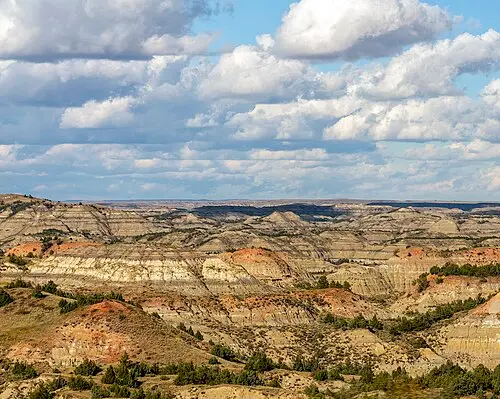
Theodore Roosevelt National ParkNPS calls the Mandan and Hidatsa the most significant peoples of the badlands in historic times, and records that their traditional bison hunting grounds included the Little Missouri River basin. The park's own archaeology runs from Archaic spear points of Knife River flint, dated 5,500 BCE to 500 CE, to a Late Prehistoric bison processing camp. Source
Programs
Hiráaca Maa Aru Cáawi
A nonprofit dedicated to saving the Hidatsa language, which the Nation's language page describes as offering classes and materials to help people learn it, with the goal of a program that teaches adults to speak Hidatsa fluently so that they can go on to teach the language or share culture.
Maagarishda Hidatsa II-IRE
A children's Hidatsa learning nest, described on the Nation's language page as an independent community business supporting the language program for children, with elders volunteering and sharing their gifts.
Sources
- https://www.nps.gov/thro/learn/historyculture/cultural-history.htm
- https://www.mhanation.com/history/
- https://www.mhanation.com/language/
Checked September 2026.