Fort Mojave Indian Tribe
A nation today
Background
The Fort Mojave Indian Tribe's reservation is in three pieces, in Mohave County, Arizona, next to Needles, California, and in Clark County, Nevada, with tribal headquarters in Needles. A United States military post opened on the east bank of the Colorado River in 1859 as Camp Colorado and was soon renamed Fort Mojave; after the fort closed in 1891 its buildings were turned into a boarding school, which operated until 1930. Government runs through a chairman, a vice chairman, a secretary and three council members, and the Tribe's own department list includes an Agriculture, Land and Water Resources office, a GIS department, a realty department, a roads department and a tribal court. Its land and water department says about half the reservation is under intensively farmed, irrigated agriculture, with upland cotton and alfalfa hay as the dominant crops, and that the average annual rainfall in the lower Colorado River valleys is four inches. Joshua Tree National Park names the Aha Macave among the peoples whose traditional use area covers park lands.
Visit and learn
Fort Mojave Indian Tribe's own site
Tribal lands have their own laws. Check the nation's site before you visit.
Parks on its homelands
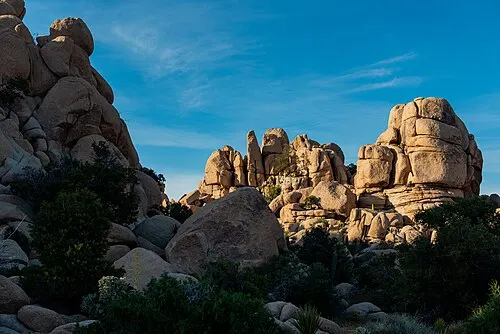
Joshua Tree National ParkThe Fort Mojave Indian Tribe calls its people the Pipa Aha Macav, the people by the river, and says their trade networks once reached the Pacific Ocean. Their reservation runs nearly 42,000 acres along the Colorado River. Source
Programs
Agriculture, Land and Water Resources
The department publishes a description of the lower Colorado River valley climate and a crop table for the reservation's irrigated acreage. Upland cotton and alfalfa hay dominate, with cotton seed, Bermuda grass seed, Sudan, okra seed, wheat, barley, milo and other hays also produced. Roughly half the reservation is under intensive irrigated farming.
Ava Ich Asiit Tribal Library
The library, at 1605 Plantation Road in Mohave Valley, Arizona, states that it is open to the public and serves all age groups, with a library card issued in the user's name needed for its services and parental supervision for children under 12. Services include story time, arts and crafts, monthly community awareness presentations, a summer reading program, computer lab access and a multipurpose room used for meetings, trainings and workshops.
Aha Macav High School
Aha Macav High School, at 1589 Plantation Drive in Mohave Valley, Arizona, operates as the Pillar Academy for Business and Finance, a public charter high school serving grades nine through twelve. It offers personalized academic programs based on each student's initial evaluation and high school credit recovery.
Sources
- https://www.govinfo.gov/content/pkg/FR-2026-01-30/html/2026-01899.htm
- https://www.fortmojaveindiantribe.com/about-us/
- https://www.fortmojaveindiantribe.com/tribal-council/
- https://www.fortmojaveindiantribe.com/tribal-departments/
- https://www.fortmojaveindiantribe.com/tribal-departments/agriculture-land-water-resources/
- https://www.nps.gov/jotr/learn/historyculture/native-americans.htm
Checked September 2026.