Cheyenne River Sioux Tribe
A nation today
Background
The Tribe's own history places it among the seven bands of the Titunwan, People of the Plains, one of the Oceti Sakowin of the Lakota, Dakota and Nakota Nation. Four of them live here: the Mnicoujou Planters by the Water, the Oohenumpa Two Kettle, the Itazipco Without Bows and the Siha Sapa Black Foot. Its home page describes the Lakota Nation as over three million acres with three major waterways in it, the Missouri, the Cheyenne and the Moreau, in central South Dakota. It states that the present land base was established by the 1851 and 1868 Fort Laramie Treaties and the Sioux Act of 1889, and that before those instruments the bands living there knew no boundary to their territory and moved with the bison.
Parks on its homelands
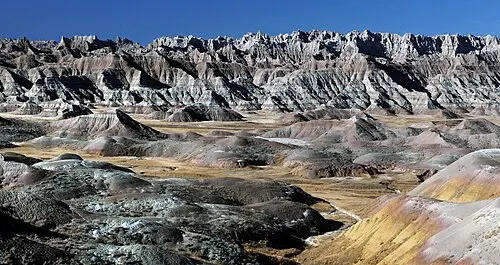
Badlands National ParkThe Cheyenne River Sioux Tribe's own history says its reservation's land base was set by the 1851 and 1868 Fort Laramie Treaties, and that the four Lakota bands living there knew no boundary to their territory before that, travelling the plains in search of bison. Source
Sources
- https://www.govinfo.gov/content/pkg/FR-2026-01-30/html/2026-01899.htm
- https://www.cheyenneriversioux.com/history
- https://www.cheyenneriversioux.com/
Checked September 2026.