Arikara (Sahnish)
A people
Background
Etienne Veniard de Bourgmont spent several years with the Sahnish and in 1714 described three Sahnish villages on the west bank of the Missouri above the Niobrara River and 40 villages farther upriver on both banks. La Verendrye's son reached the Sahnish villages at the mouth of the Bad River in 1743 and was met by the Little Cherry Band of Sahnish. Lewis and Clark met the Sahnish at the mouth of the Grand River in 1804 and found three villages numbering about 3,000. In 1856 the fourth smallpox outbreak struck the Sahnish at Star Village on Beaver Creek. The move up to join the Mandan and Hidatsa at Like-a-Fishhook Village came in 1862. The Sahnish belong to the Caddoan linguistic group, alongside the Pawnee, Caddo, Wichita, Anadarko, Skidi, Tawakoni and Waco. Arikara is the Nation's name for Sahnish, and the Nation's language page pairs it with an Arikara Project app and with recordings and handouts from past classes.
Visit and learn
Tribal lands have their own laws. Check the nation's site before you visit.
Parks on its homelands
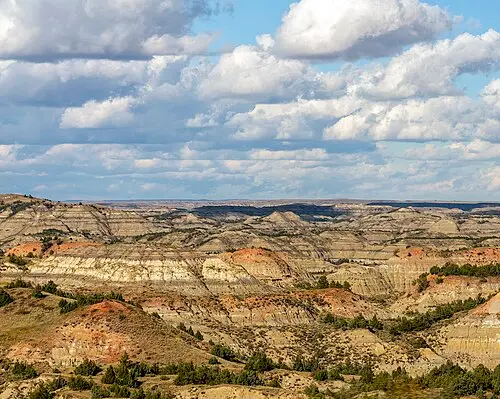
Theodore Roosevelt National ParkArikara people reached this country in stages up the Missouri, arriving at the river that took their name, the Arickara River of 1723, and the Grand River today, where MHA calls them the Sahnish. The fourth smallpox outbreak struck in 1856, in the Star Village at Beaver Creek, and in 1862 the Sahnish moved up to join the Mandan and Hidatsa at Like-A-Fishhook. Source
Programs
Arikara Project
One of three language sites the Mandan, Hidatsa and Arikara Nation's Culture and Language Department built and maintains, alongside the Hidatsa Project and the Mandan Project, for learning resources on the three languages. The Nation's language page also offers past class recordings and handouts for anyone who missed an Arikara class.
Sources
- https://www.nps.gov/thro/learn/historyculture/cultural-history.htm
- https://www.mhanation.com/history/
- https://www.mhanation.com/language/
Checked September 2026.