The Wave
Our episode: [Detour] The Wave | We won the permit lottery. Now what?
The Wave sits 0.28 miles south of the 37th parallel. That one line of latitude organizes the whole day. Wire Pass Trailhead, where you leave the truck, is at 37.01907, -112.02478, which is 1.32 miles north of the line and therefore Kane County, Utah. The rock is in Coconino County, Arizona. You park in Utah, walk into Arizona, and the permit is issued by the BLM Arizona Strip Field Office, not the Kanab Field Office that manages the parking lot you started from.
Check your own geotag before you drive. BLM’s visit page for Coyote Buttes North prints its coordinates as 37.04242, -112.512256. That point is about 28 miles west-northwest of the actual formation and it lands in Utah. A family navigating to the agency’s published numbers ends up in the wrong state. Use 36.9959611, -112.0063318.
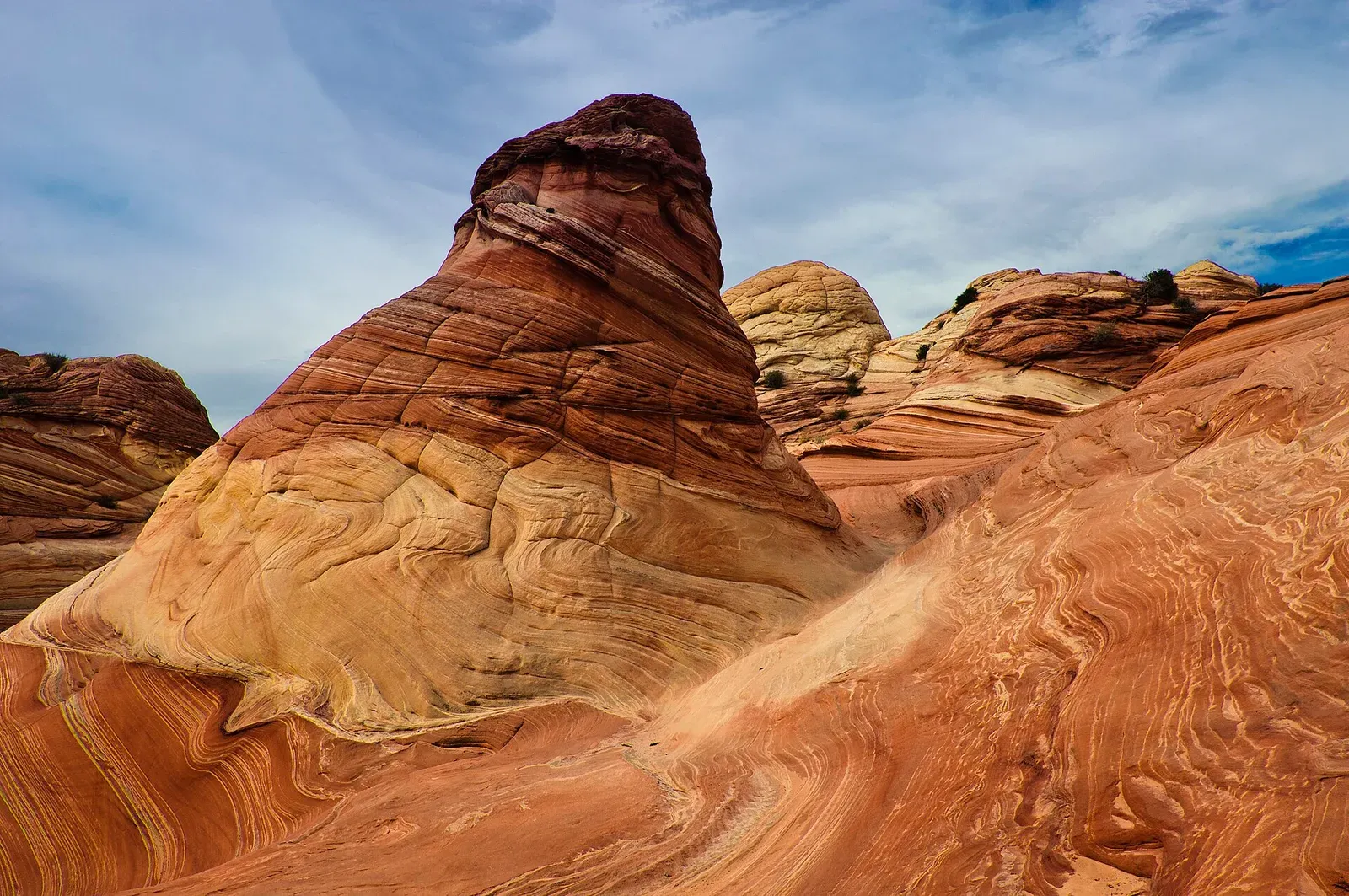
The formation is in Coyote Buttes North, inside the Paria Canyon-Vermilion Cliffs Wilderness, inside Vermilion Cliffs National Monument, 280,000 acres proclaimed by Bill Clinton on November 9, 2000. The rock is Navajo Sandstone: wind-blown dune sand turned to stone, and the stripes are the preserved faces of those dunes, which USGS documents as eolian sand and, at Zion, as Jurassic-aged cross-beds from ancient sand dunes.
How the bowl itself got carved is an open argument in the literature, and it is worth knowing which side you are quoting. Loope and colleagues, 2008, cited in BLM’s own science plan, concluded the troughs “could not have been formed by flowing water.” The IUGS geoheritage listing says the form “initiated with water incision along a prominent joint,” with wind now the predominant erosional force. Both hold at different stages, and the version that works for a kid standing in it is: water opened the crack, wind carved the bowl, and the wind is still working.
The BLM Vermilion Cliffs Junior Ranger book (Arizona Strip District, February 2025) prints two Southern Paiute words. Angkar Mukwanikant is red cliffs, the name for the Vermilion Cliffs. Tumpituxwinan is storied rocks, for what English calls rock art. The book states in the present tense that those sites are sacred and that tribal members travel to them for ceremony. Separately, BLM’s 2018 programmatic agreement lists the tribes the agency consults across Arizona, among them the Hopi, the Kaibab Band of Paiute Indians, the Navajo Nation, the Paiute Indian Tribe of Utah, and the San Juan Southern Paiute. That is a consultation list and nothing more; it is not a statement about whose homeland this is.
Access is by lottery only. BLM admits 64 people or 16 groups per day, whichever comes first: 48 people in 12 groups through the advanced lottery, 16 people in 4 groups through the daily lottery. As of BLM’s published fee schedule the application costs $6 and is non-refundable, the permit is $7 per person per day, and a dog is another $7. We entered twice and drew on the second try. A woman we met at the trailhead had been entering for eight years.
We based in Kanab, which is the practical answer for a family: it is the nearest town to the trailhead and it is where the Kanab Field Office sits — the office that manages the parking lot you start from, even though the permit comes from the Arizona Strip office. We came at it from Las Vegas and stayed a week, June 8 to 15, and The Wave was one day of it.
The reason to build in a spare day is not only the lottery. Kanab is also the town nearest Best Friends Animal Sanctuary in Angel Canyon, which runs tours of the grounds and takes volunteers, and the Best Friends Roadhouse is a hotel built for people traveling with animals. A day there is a good use of the day you did not draw a permit for.
The walk is 6.4 miles round trip, and BLM’s word for it is strenuous. There is no shade, no water, and past the trailhead almost no signage, which is deliberate. Permit holders navigate by a printed sheet of landmark photographs. Big carried ours and found the two buttes shaped like teepees without help. House Rock Valley Road is unpaved and 4WD may be required when it is wet. Day use only, sunrise to sunset.
Two inches under sand hot enough to burn a bare foot, the sand is cool. That is how the lizards get through an afternoon out here. Big picked up a Moqui marble, held it, and put it back.