Ute
A people
Background
Before European contact the Ute were a loose confederation of bands. The Southern Ute Indian Tribe's own history puts the Mouache and Caputa bands in today's Southern Ute Tribe at Ignacio, Colorado, the Weenuchiu in the Ute Mountain Utes at Towaoc, Colorado, and the Tabeguache, Grand, Yampa and Uintah bands in the Ute Indian Tribe on the Uintah-Ouray Reservation. It calls the Ute the oldest residents of Colorado, gives their country as the mountains and vast areas of Colorado, Utah, Wyoming, eastern Nevada, northern New Mexico and Arizona, and places them among the Numic-speaking peoples of the Great Basin. That history gives the area as encompassing the Numic-speaking territories of Oregon, Idaho, Wyoming, eastern California, Nevada, Utah, Colorado and northern Arizona and New Mexico. The same history uses the word Nuche for the Ute people. Colorado, Utah and northern New Mexico are Ute country today. NPS describes the Ute as a people who have lived across modern-day Utah and Colorado, traditionally moving between high elevations in the summer and low elevations in the winter, following the movement of animals and the growth of plants. Great Sand Dunes carries a Ute name for the dunefield alongside its Jicarilla Apache and Navajo names. The park lists the Southern Ute, the Ute Mountain Ute and the Ute Indian Tribe of the Uinta and Ouray Reservation among the regional tribes it consults, saying those tribes share their traditional knowledge and culture with park staff and through public programs.
Parks on its homelands
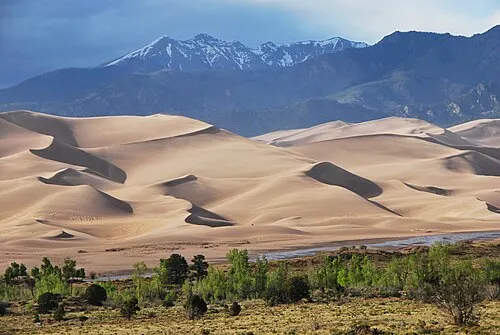
Great Sand Dunes National Park and PreserveSo-wop-a-wot, "where the sand is," is the Ute name the park gives the dunefield. The tribes the park consults include the Southern Ute Indian Tribe, the Ute Mountain Ute Tribe and the Ute Tribe of the Uinta and Ouray Reservation, and the park says those tribes share their traditional knowledge through consultation with staff and public programs. Source
Affiliations
Great Sand Dunes National Park and Preserve
The park treats the Ute as one of the peoples of the dunefield and carries a Ute name for it alongside the Jicarilla Apache and Navajo names. It consults the three Ute governments rather than a single Ute body.
Sources
- https://www.nps.gov/meve/learn/historyculture/people.htm
- https://www.southernute-nsn.gov/history/
- https://www.nps.gov/grsa/learn/historyculture/affiliated-tribes-of-great-sand-dunes.htm
Checked September 2026.