Quapaw Nation
A nation today
Background
The Quapaw are one of the Dhegiha, a larger group that split into the Quapaw, Osage, Northern Ponca, Ponca, Kansa and Omaha. That group lived together near the confluence of the Ohio and Wabash rivers, near present-day Evansville, Indiana, and later along the confluence of the Missouri and Mississippi rivers near present-day St. Louis, where the people came upon the river in a dense fog. The Nation's own name page sets out a comparison of the Quapaw name across related languages, credited to a Quapaw Tribal Member, including o-ga-xpa as the Quapaw term for their own people and the same form appearing in Osage and Omaha usage, and it notes the early colonial names Akansa and Arkansa. The Nation's language page points to an English-to-Quapaw dictionary, a Quapaw audio lexicon, and a body of historical written work on the language dating back to 1827, including a vocabulary list compiled by Robert Rankin, whose work the University of Kansas has made publicly available. It also publishes a reading and pronunciation guide based on the International Phonetic Alphabet, Quapaw stories from 1890 to 1894, and a set of reminiscences. Tribal administration sits at 5681 South 630 Road in Quapaw, Oklahoma.
Visit and learn
Tribal lands have their own laws. Check the nation's site before you visit.
Parks on its homelands
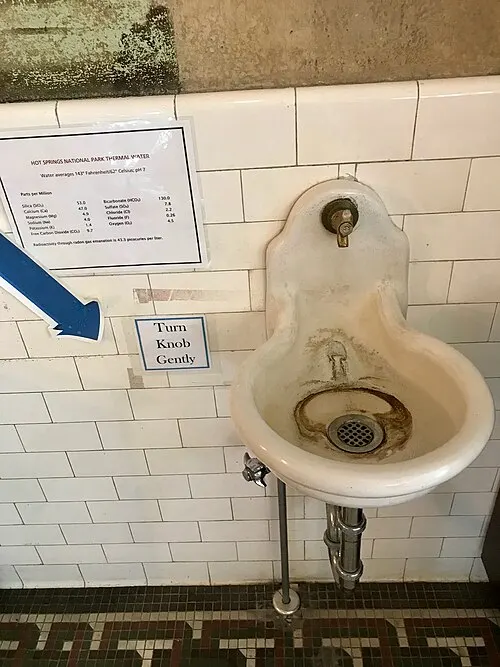
Hot Springs National ParkThe Quapaw Nation's own account of its name says its people floated down the Mississippi into Arkansas after a braided grapevine rope broke on the crossing, and gives Ogáxpa as the word for that, the downstream people. The same page records that the people were called the Akansa or Arkansa in early colonial days. Source
Programs
Quapaw Language
The Nation's language program maintains the Quapaw website and blog, an English-to-Quapaw dictionary, and a Quapaw audio lexicon whose recordings were made by Native Quapaw speakers who grew up speaking Quapaw as a first language and later learned English. The Nation says the recordings are meant to supplement the work of its language teachers and students. It also hosts a Robert Rankin dictionary, an IPA-based reading and pronunciation guide, Quapaw stories from 1890 to 1894, Quapaw reminiscences, and a guide to typing the Quapaw writing system.
Environmental Department
The Nation describes the department as dedicated to protecting human health, the environment and the cultural heritage of the Quapaw people, working through scientific methods and community outreach on water quality, air quality, recycling, solid waste and Superfund site issues affecting Quapaw tribal lands. The Nation's site lists fifteen departments, this one among them: Tribal Administrative Office, Accounting, Community Health, Enrollment, Education, Family Services, Housing, Human Resources, Information Technology, Public Safety, Quapaw Language, Realty and Trust, Social Services, and Tags.
Sources
- https://www.govinfo.gov/content/pkg/FR-2026-01-30/html/2026-01899.htm
- https://quapawnation.com/401/Quapaw-Nation-Tribal-Name-Origin-and-His
- https://quapawnation.com/758/Quapaw-Language
- https://quapawnation.com/8/Departments
Checked September 2026.