Pokagon Band of Potawatomi
A nation today
Background
Kchémnedo gave the human people something no other part of creation can have, which is the ability to exercise free will, and a neshnabé is therefore free to choose the decisions that steer his own path. The Pokagon culture page holds the Seven Grandfather Teachings beside that idea, and names the seven as Wisdom, Love, Respect, Truth, Honesty, Humility and Bravery. It also notes that place names across northern Indiana and southwestern Michigan keep recording the Pokagon connection to that ground, and that the Band works black ash basket making and the old games alongside its language and cultural programs through the Department of Language and Culture. The history the Band gives runs through the 1833 Treaty of Chicago, which set the terms for removal from the Great Lakes, the 1836 Treaty of Washington between the Odawa and Ojibwe that ceded land in the north, and the Potawatomi Trail of Death, which the Band records as killing one in ten of roughly five hundred people. The Band traces itself to a small group with Leopold Pokagon among their leaders who earned the right to stay in their homeland, and to a move into Silver Creek Township near present-day Dowagiac, Michigan, bought with annuity money accrued under earlier treaties. Brigadier General Hugh Brady later threatened to force the Band out of Michigan.
Visit and learn
Pokagon Band of Potawatomi's own site
Tribal lands have their own laws. Check the nation's site before you visit.
Parks on its homelands
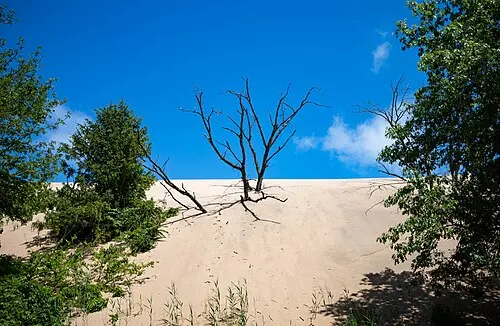
Indiana Dunes National ParkPokagon people call themselves Neshnabek, the original or true people, and their Potawatomi were the Keepers of the Fire in the Three Fires Confederacy. Their ancestors moved from north of Lakes Huron and Superior to the shore of the mshigme, the Great Lake covering Wisconsin, southern Michigan, northern Indiana and northern Illinois. Congress reaffirmed the Band's federal recognition on September 21, 1994, a day its citizens now mark as Sovereignty Day. Source
Programs
Ėthë Bodwéwadmimwat language department
The department works on revitalizing Bodwéwadmimwen, the ancestral language of the Bodéwadmi people, and states that goal plainly. It employs Pokagon citizens as language apprentices who are learning the language with the intention of becoming teachers and cultural stewards, starting with the students at Zagbëgon Academy. The Tribe's own page publishes a pronunciation guide for the vowel sounds of Potawatomi.
Simon Pokagon Research Library
The library is named for Simon Pokagon, one of the Band's earliest leaders and authors, who wrote Queen of the Woods and spoke at the 1893 World's Fair in Chicago. The Band's Department of Education moved the library to a digital platform so every citizen can reach it, funded by a grant from the Institute of Museum and Library Services, and the Band expects more digital books and resources to follow. Access is by tribal ID number and date of birth, with a PB prefix on the number.
Dowagiac River Restoration Project
The Band's Environmental Quality department runs a restoration project on the Dowagiac River with a published story map of the river's environmental condition inventory and a progress page for the work.
Sources
- https://www.govinfo.gov/content/pkg/FR-2026-01-30/html/2026-01899.htm
- https://www.pokagonband-nsn.gov/our-culture/
Checked September 2026.