Nooksack Indian Tribe
A nation today
Background
A Tribe's own page says the Nooksack name comes from a place name in its language and translates as always bracken fern roots, and the Tribe's place-name work gives the source: Nuxwsá7aq, Anderson Creek and the area at its mouth. That work runs from the original Nooksack language, Lhéchalosem, and it names a mountain, Kweq’ Smánit, as Mt. Baker and gives that as white mountain, and a village, Kwánech at Everson, as lots at the bottom. The Tribe's history says the Nooksack occupied the Nooksack River watershed from the high country around Mt. Baker to the salt water at Bellingham Bay and on into Canada, that research has identified 25 traditional winter village sites, most of them in four clusters between modern Lynden and the mouth of the South Fork above Deming, and that a population of roughly 1,200 to 1,500 people 250 years ago has become about 2,000 enrolled members today. The Nooksack were party to the Point Elliott Treaty of 1855 but were granted no reservation, so in 1970 the Tribe took title to four buildings on an acre of land in Deming that became the Nooksack Reservation, and full federal recognition came in 1973; about 2,400 acres remain in trust, and roughly half of the enrolled members live on or near them.
Visit and learn
Nooksack Indian Tribe's own site
Tribal lands have their own laws. Check the nation's site before you visit.
Parks on its homelands
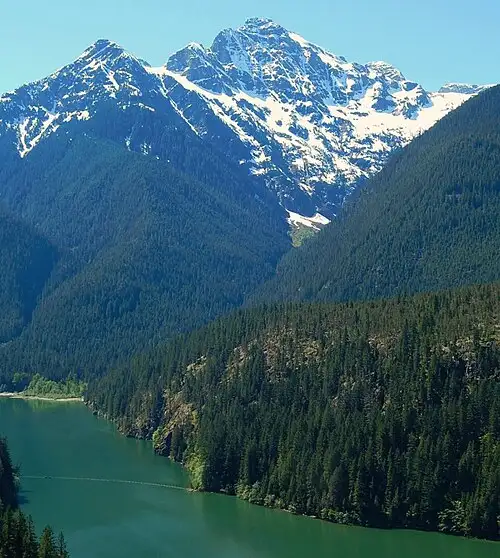
North Cascades National ParkThe Nooksack name is a place name in the Nooksack language and translates as always bracken fern roots. Their territory ran from Georgia Strait on the west to the country around Mt. Baker on the east, and research has identified 25 traditional winter village sites. Source
Programs
Culture Program
The Tribe's culture program publishes the names remembered and recorded for places in the original Nooksack language, Lhéchalosem, each with a short etymology in brackets, drawn from the book Nooksack Place Names: Geography, Culture and Language by Allan Richardson and Brent Galloway, published by UBC Press in 2011. The list runs from Nuxwsá7aq, the source of the tribal name, through the three forks of the Nooksack River and peaks including Mt. Baker and Mt. Shuksan to shoreline camps and village sites at Sumas and Whatcom Creek.
Sources
- https://www.govinfo.gov/content/pkg/FR-2026-01-30/html/2026-01899.htm
- https://nooksacktribe.org/about/
- https://nooksacktribe.org/cultural-resources/culture-program/
Checked September 2026.