Jornada Mogollon
A people
Background
White Sands uses the name for the people who farmed the Tularosa Basin after the Archaic period. It is an archaeologists' name, not a people's own name for itself. The park dates their presence in the basin from about 200 CE, puts the occupation at about 1,200 years, and ends it when they moved out of the basin by about 1350 CE. They did not return. Housing changed across that span, from circular pithouses dug into the ground and framed with wood beams to square houses with adobe mud walls. NPS calls the switch from woven fiber baskets to clay pottery the most significant change in the archaeological record between the Archaic period and them. An NPS science page places the Mogollon in mountain and canyon country across eastern Arizona, western New Mexico, far northwestern Texas and northern Chihuahua, with a distinctive cultural pattern running from about A.D. 200 to about A.D. 1450. No present-day nation is named as descended from the Jornada Mogollon.
Parks on its homelands
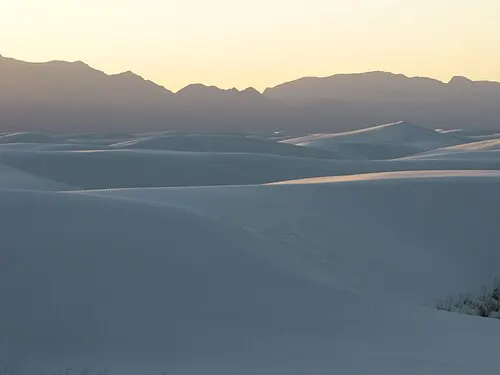
White Sands National ParkThe gypsum dunefield was a source of plaster for adobe house walls, much like drywall today, and the large gypsum crystals at Lake Lucero were used as window panes in Pueblo villages across the Tularosa Basin and northern New Mexico. The Jornada Mogollon, the name archaeologists give the basin farmers who followed the Archaic period, moved out of their villages roughly 600 to 700 years ago and did not return. Source
Affiliations
White Sands National Park
The park holds Jornada Mogollon sites inside its own boundary and gives the culture its own history page. Its people page records that people have been in the basin for over 23,000 years, and that Apache bands moved in more than 700 years ago, after the Jornada Mogollon had left.
Sources
- https://www.nps.gov/whsa/learn/historyculture/jornada-mogollon.htm
- https://www.nps.gov/whsa/learn/historyculture/people.htm
- https://www.nps.gov/subjects/swscience/mogollon.htm
Checked September 2026.