Chickasaw Nation
A nation today
Background
The Nation's history page opens with movement rather than place, describing a run from migration to what is now Mississippi, Kentucky, Alabama and Tennessee in prehistoric times through to the purchase of a new homeland in south-central Oklahoma in the mid 1800s, and naming Hernando de Soto in 1540 as the first European the Chickasaw met. The 1837 Treaty of Doaksville called for the Chickasaw to be resettled among the Choctaw in Indian Territory, and in 1856 the Chickasaw separated from the Choctaw to restore direct authority over their own affairs, adopting a constitution at Good Spring, now Tishomingo, and setting up executive, legislative and judicial departments filled by popular election. Tribal leaders established the capital at Tishomingo and chose a governor rather than a chief to serve as the supreme executive power, a term the Nation's history explains was used from 1856 to 1906. After Oklahoma statehood in 1907 the President of the United States appointed the Nation's principal officers, and Congress reversed that in 1970 with legislation letting the Five Tribes elect their own, a change the Nation's constitution of 1983 put into a three-department system of government. A two-story brick building put up in 1858 in Tishomingo housed the governor and the judicial and legislative offices until it was condemned as unsafe in 1894 and demolition began in 1897.
Leaders the Nation names
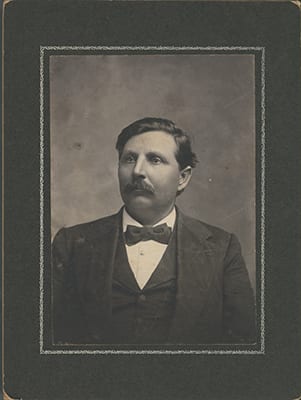
Douglas H. Johnston
the Chickasaw Nation's first appointed representative, 1906 to 1939
The Nation's own words: "born the same year we established the 1856 government, was the first man to serve in this capacity. Governor Johnston served the Chickasaw Nation from 1906 until his death in 1939 at age 83." The office was an appointed representative, not a governor's term, which is why it runs thirty-three years.
Chickasaw Nation, Turn of the Century (read 2026-10-03)
Published by the Nation on its own history page. chickasaw.net states no reuse terms, and its image handler serves only 301x400 however the query is written, although the original is at least 1726x2293. Both are recorded rather than resolved.
Visit and learn
Chickasaw Council House Museum
The museum stands on the Capitol grounds and holds the 1855 log cabin that was the first Chickasaw council house built in Indian Territory and the place where the 1856 constitution was signed, alongside artifacts on Chickasaw history and contemporary Chickasaw artwork. Its gift shop carries Chickasaw language materials and work by Chickasaw artists. Open Tuesday through Saturday, 9 a.m. to 4 p.m. and closed on federal holidays, with group tours by reservation and a limit of 14 people per tour. The phone number is (580) 371-3351.
https://chickasaw.net/Services/Culture/Chickasaw-Council-House-Museum
Tribal lands have their own laws. Check the nation's site before you visit.
Parks on its homelands
Mammoth Cave National ParkThe Chickasaw Nation's own history places its people in what is now Mississippi, Kentucky, Alabama and Tennessee before removal, and says the Nation was resettled among the Choctaw in Indian Territory by the 1837 Treaty of Doaksville before separating from the Choctaw in 1856. Source
Programs
Heritage Series
A set of documentary films, short history film projects and educational videos about the Chickasaw Nation and its people from European contact to the present, with separate educational resources for teachers built around the film projects. The Tribe's page names four of the films, and sends viewers to ChickasawFilms.com for the rest of the catalog.
Sources
- https://www.govinfo.gov/content/pkg/FR-2026-01-30/html/2026-01899.htm
- https://chickasaw.net/Our-Nation/History
- https://chickasaw.net/Our-Nation/History/Indian-Territory
- https://chickasaw.net/Our-Nation/History/Chickasaw-National-Capitol
- https://chickasaw.net/Our-Nation/History/Present-Day
Checked September 2026.