Heart Mountain
What this place is
Heart Mountain is the War Relocation Authority site in Park County, Wyoming, midway between Cody and Powell on Highway 14A. The camp opened on August 12, 1942 and closed on November 10, 1945. A total of 14,997 people were confined there. The peak population was 10,767 on January 1, 1943, which made it the third largest community in Wyoming.
It is officially the Heart Mountain World War II Japanese American Confinement Site. Congress has considered it as a unit of the National Park System more than once — the Heart Mountain Relocation Center Study Act of 2009 would have directed the Interior to study exactly that — and it is still not one. What it is, is a National Historic Landmark, approved by the Secretary of the Interior on September 20, 2006. The landmark district is 123.93 acres, of which the Bureau of Reclamation owns 73.93 and the Heart Mountain Wyoming Foundation owns 50. The Foundation is a nonprofit and it charges admission.
It is one of the few of the ten confinement sites with original buildings still standing, and the site of the largest single draft resistance movement in American history.
The land it was built on
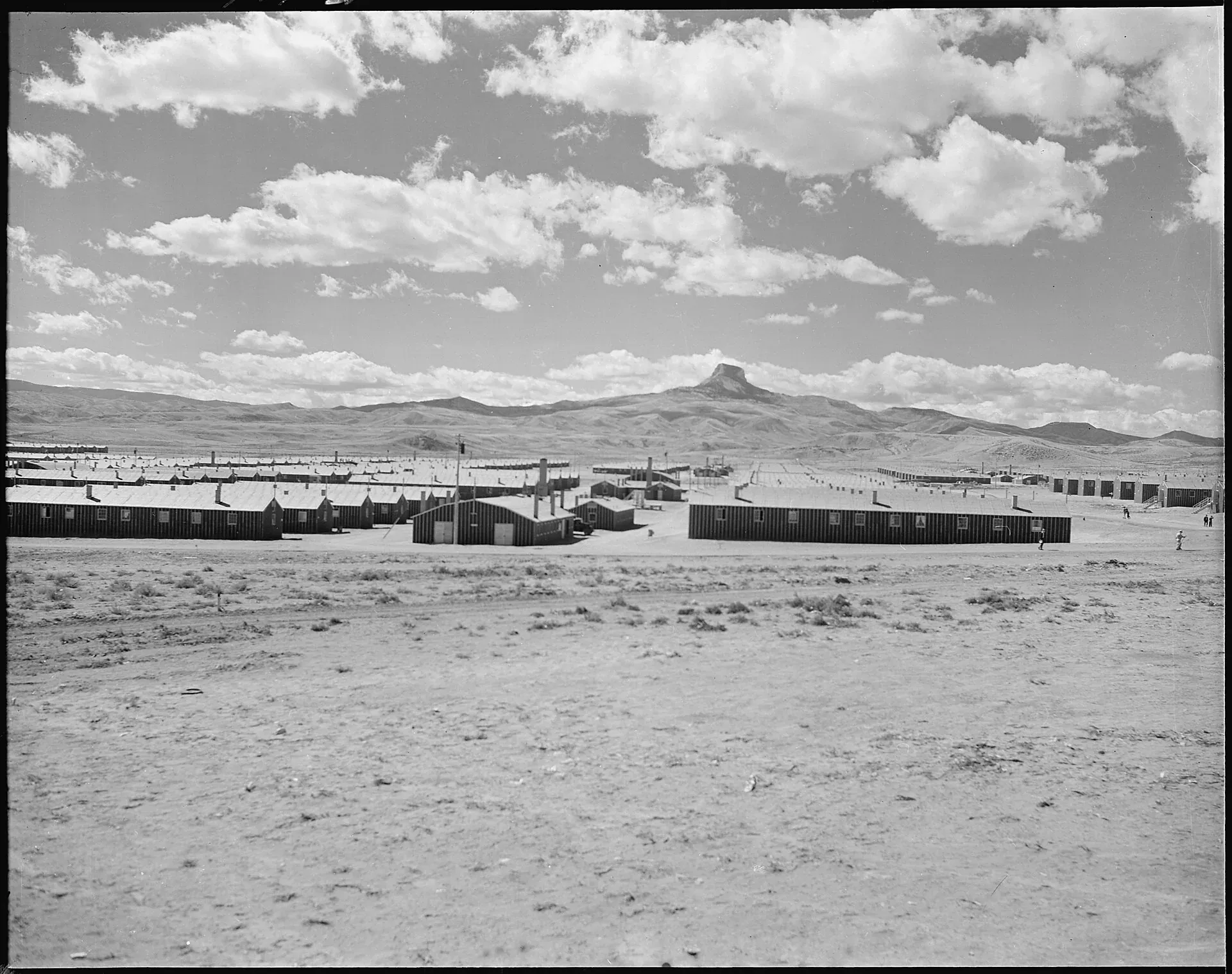
The camp occupied 46,000 acres between Cody and Powell, bordering the Shoshone River at 4,700 feet, with Heart Mountain itself eight miles to the west. This is Eastern Shoshone homeland. The acreage was part of the Heart Mountain Irrigation Project, itself a piece of the Bureau of Reclamation’s Shoshone Project, which carried water off the Shoshone River to irrigate the Bighorn Basin. A canal went in with Civilian Conservation Corps labor in 1937 and stood half finished when the war started. The land was transferred to the War Relocation Authority on June 1, 1942.
The state had 643 Japanese residents before the war. Wyoming had been writing anti-Asian sentiment into its law since 1910, and the prewar consensus, recorded in Densho’s account, was that the internees were not welcome to stay once the war ended. Governor Nels Smith said the state would not be California’s dumping ground and that the people held there should be kept under armed guard.
The removal
Executive Order 9066, signed February 19, 1942, established military exclusion zones on the West Coast and authorized the removal that followed. Across the ten confinement sites, about 120,000 people were incarcerated. Roughly two thirds of the people held at Heart Mountain were American citizens.
Construction was fast and careless. The Army Corps of Engineers and civilian laborers put up 468 barracks and 39 halls and utility buildings between June and August 1942 at a cost over five million dollars, with about 2,000 workers pulled in with overtime pay. The advertisements said that if you could drive a nail you could qualify as a carpenter, and the laborers bragged that they took 58 minutes to build one apartment barrack. The wood frames went up under black tar paper, twenty feet by a hundred and twenty, divided into six apartments with no kitchen, no bathroom, and no running water. Meals came from mess halls, showers from utility halls. Doors and windows were installed badly and would not close, and there were gaping cracks between the wallboards.
People arrived from assembly centers at Pomona, Santa Anita, and Portland. They arrived with what they could carry and they fixed the cracks themselves, hanging spare sheets and celotex from the roof and stuffing the gaps with rags and newspaper before the first winter. Densho records winters at Heart Mountain dropping to thirty degrees below zero, with dust storms through the summer.
The fence, and what it cost
When the first families arrived the barbed wire was not finished, and people inside refused to help build it. Three thousand signed a petition charging that the fence proved Heart Mountain was a concentration camp and that the people in it were prisoners of war. It was finished by December anyway. In October 1942 military police arrested thirty-two boys for sledding outside the boundary.
Most people held at Heart Mountain had no say over what happened there. The War Relocation Authority ran the camp, but daily life was largely organized by the people confined in it, through block managers, through the Heart Mountain Sentinel, which ran 145 issues between October 1942 and July 1945, and through a high school that enrolled about 1,500 students in its first year. Work was unpaid and nearly useless: twelve dollars a month for unskilled labor, nineteen for skilled, including the camp’s teachers and doctors. The hospital, a 150-bed complex with seventeen wings, delivered 556 babies.
Draft resistance
This is where Heart Mountain is unlike the other nine sites. When the War Department extended the draft to the camps in 1944, the Fair Play Committee refused to report for physicals, on the argument that civil rights had to come back first. Sixty-three draft resisters were tried in Cheyenne in what remains the largest mass trial in Wyoming history, and the seven committee leaders were convicted separately of counseling others to evade. The leaders went to Leavenworth Penitentiary. Truman pardoned the sixty-three in 1946.
At the same time 385 people confined at Heart Mountain did enlist, and eleven of them died. Of the ten confinement sites, Heart Mountain alone produced more than one Medal of Honor recipient.
What is left
Less than you would expect. The hospital complex ran to seventeen wings around a long corridor; three buildings remain, including the boiler house whose red brick chimney can be seen for miles. The chimney was stabilized in 2013.
One original 1942 barrack came back. It was sold after the war to Greybull for veterans’ housing, later moved to a geology field station at Shell, cut into three pieces and trucked back in three pieces, and returned to the site in 2015. A root cellar was also recovered and reconstructed on site.
Above the center and across the road is the Setsuko Saito Higuchi Interpretive Trail, a quarter mile of pavement through the surviving features, dedicated in 2005. A short walk takes you out to a replica guard tower. Nine guard towers stood around the original perimeter, manned by military police.
What happened to the buildings
Farmers homesteaded the former camp grounds and bid for the buildings and equipment at auction. Barracks were cut into halves and thirds and became sheds, storage buildings, and houses across the Bighorn Basin. The people who had lived in them could not bid at all. Wyoming had passed laws that kept Japanese Americans from owning land and from voting in the state while they were there, and the Alien Land Law was not repealed until 2001.
Redress, and the pilgrimage
In 1980 Congress created the Commission on Wartimes Relocation and Internment of Civilians. Two Boy Scouts had met at the camp in 1943 — Norman Mineta, incarcerated, and Alan Simpson, visiting from Cody, thirteen miles away — and they stayed friends. Mineta went to the House from California and Simpson to the Senate from Wyoming, and as a congressman and a senator they co-sponsored the Civil Liberties Act of 1988, which acknowledged the incarceration was wrong, apologized, and paid reparations. Mineta died in 2022 and Simpson in 2025.
Japanese American activists began the pilgrimage to Manzanar in 1969; the annual Heart Mountain Pilgrimage followed in 2011, the year the Interpretive Center opened.
Going
It is off Highway 14A, fifteen minutes from Cody and ten from Powell, about an hour from Yellowstone’s East Entrance. As you come up Road 19 you look for the brick chimney on the hill.
Admission is $14 for an adult, $12 for seniors and students, $10 for ages ten to seventeen, and free under ten. It is open daily from mid-May to early October and on shortened days in between — the winter schedule changes, so check before you go.
Budget two hours. Go to the museum first, then walk the ground. The exhibits are what make an empty sagebrush flat mean something, and reversing that order is the one thing we would do differently.
The Interpretive Center, the barrack, and the Higuchi Trail are all wheelchair accessible, and a manual wheelchair is available in the building. Audio guides are free in English, Japanese, Spanish, and German, the videos are subtitled with transcripts on request, and there is a Social Story for anyone who wants to know what to expect before arriving. Two walking trails run outside, where pets are welcome. The hospital grounds are open but unpaved, with tripping hazards and wildlife. Groups and school field trips run through the Foundation.
Before you walk the site, download the free Heart Mountain AR app. Sixteen signs around the grounds and inside the barrack trigger 3D reconstructions on the empty land, and the kids will use it for the rest of the trip.
The camp’s own newspaper is online at Wyoming Newspapers, and the Foundation keeps its collections and archives for research. Wyoming Humanities has a classroom toolkit on the site, and Densho’s encyclopedia entry is the best single account of the place.